
CS-25
Large Aeroplanes
Amendment 28; corrected 20 November 2025 Source checked 2026-11-28
Scope, source and reading notes
Complete official CS-25 Amendment 28, including AMC and appendices.
Aerospace Consulting reference note: Certification specifications and acceptable means of compliance for large aeroplanes, using the corrected official publication.
The complete selected publication is available in reading text and as the original PDF. Reading text is extracted from the official PDF; page layout is simplified, and figures and tables should be checked in the original page view.
Search covers extracted text. Words contained only in graphics may not be searchable. The original publication is available below.
Official source recordOriginal PDF on this siteSource: EASA. Reproduced with source acknowledgment; source edition and status are shown above. SHA-256: 32f1a9acf26e8ceceb291d206bf07a7071f7f59f40f10c096bb17f34c6a58007
10. Supercooled Liquid (SL) Conditions
The following proposed test points are intended to provide the most critical conditions of the complete CS-25 Appendix C icing envelope, however, a Critical Points Analysis (CPA) may be used to justify different values.
10.1 Stabilized conditions
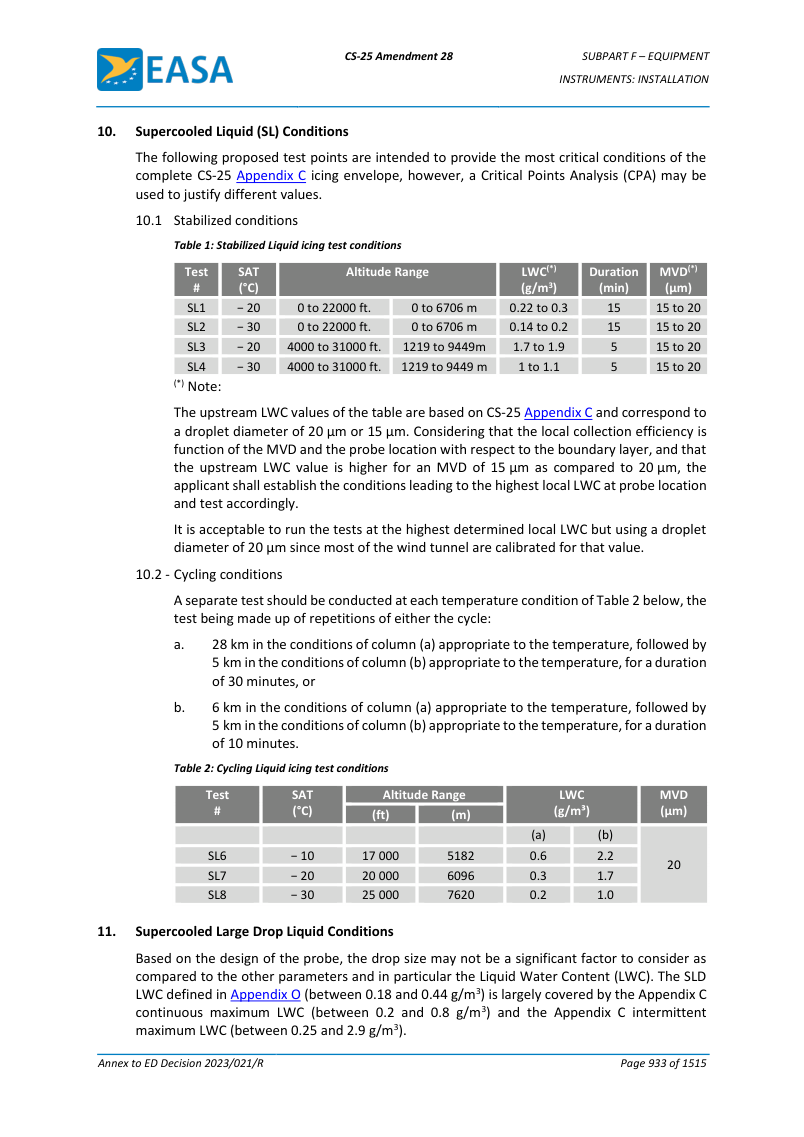
Table 1: Stabilized Liquid icing test conditions
Test
Duration
MVD(*)
#
SAT (°C)
Altitude Range LWC(*) (g/m3)
(min)
(µm) SL1 − 20 0 to 22000 ft. 0 to 6706 m 0.22 to 0.3 15 15 to 20 SL2 − 30 0 to 22000 ft. 0 to 6706 m 0.14 to 0.2 15 15 to 20 SL3 − 20 4000 to 31000 ft. 1219 to 9449m 1.7 to 1.9 5 15 to 20 SL4 − 30 4000 to 31000 ft. 1219 to 9449 m 1 to 1.1 5 15 to 20
(*) Note:
The upstream LWC values of the table are based on CS-25 Appendix C and correspond to a droplet diameter of 20 µm or 15 µm. Considering that the local collection efficiency is function of the MVD and the probe location with respect to the boundary layer, and that the upstream LWC value is higher for an MVD of 15 µm as compared to 20 µm, the applicant shall establish the conditions leading to the highest local LWC at probe location and test accordingly.
It is acceptable to run the tests at the highest determined local LWC but using a droplet diameter of 20 µm since most of the wind tunnel are calibrated for that value.
10.2 - Cycling conditions
A separate test should be conducted at each temperature condition of Table 2 below, the test being made up of repetitions of either the cycle:
a. 28 km in the conditions of column (a) appropriate to the temperature, followed by 5 km in the conditions of column (b) appropriate to the temperature, for a duration of 30 minutes, or
b. 6 km in the conditions of column (a) appropriate to the temperature, followed by 5 km in the conditions of column (b) appropriate to the temperature, for a duration of 10 minutes.
Table 2: Cycling Liquid icing test conditions
Test
#
SAT (°C)
Altitude Range LWC (g/m³)
MVD (µm) (ft) (m)
(a) (b)
20 SL6 − 10 17 000 5182 0.6 2.2 SL7 − 20 20 000 6096 0.3 1.7 SL8 − 30 25 000 7620 0.2 1.0 11. Supercooled Large Drop Liquid Conditions
Based on the design of the probe, the drop size may not be a significant factor to consider as compared to the other parameters and in particular the Liquid Water Content (LWC). The SLD LWC defined in Appendix O (between 0.18 and 0.44 g/m3) is largely covered by the Appendix C continuous maximum LWC (between 0.2 and 0.8 g/m3) and the Appendix C intermittent maximum LWC (between 0.25 and 2.9 g/m3).
View figures, tables and original page layout
Connected references
Source-backed citations and subject-based engineering context are labelled separately. These links do not establish equivalence or project acceptance.
Listed as related material by
Source-backedEvidence and scope
AMC 20-152A §8(a)(2)
Lists CS-25 without an amendment or specific paragraph.
Family reference; does not select a certification basis.
Supporting source