
CS-25
Large Aeroplanes
Amendment 28; corrected 20 November 2025 Source checked 2026-11-28
Scope, source and reading notes
Complete official CS-25 Amendment 28, including AMC and appendices.
Aerospace Consulting reference note: Certification specifications and acceptable means of compliance for large aeroplanes, using the corrected official publication.
The complete selected publication is available in reading text and as the original PDF. Reading text is extracted from the official PDF; page layout is simplified, and figures and tables should be checked in the original page view.
Search covers extracted text. Words contained only in graphics may not be searchable. The original publication is available below.
Official source recordOriginal PDF on this siteSource: EASA. Reproduced with source acknowledgment; source edition and status are shown above. SHA-256: 32f1a9acf26e8ceceb291d206bf07a7071f7f59f40f10c096bb17f34c6a58007
1 Intentional flight, including Take-off, is not permitted into Appendix O conditions beyond those in which the aeroplane is certified to operate.
2 It is not necessary to consider an unintentional encounter with Appendix O icing conditions beyond those in which the aeroplane is certified to operate while operating with a failed ice protection system.
A1.4.3 Ice Accretions for Encounters with Appendix O Atmospheric Icing Conditions in Which
the Aeroplane is Certified to Operate.
a. The applicant should use the ice accretions in Table 2 to evaluate compliance with the applicable CS-25 subpart B requirements for operating safely in the Appendix O atmospheric icing conditions for which approval is sought.
b. The decision about which ice accretions to use should include consideration of combinations of Appendix C and Appendix O icing conditions within the scenarios defined in paragraph A1.4.3(c) of this appendix. For example, flight in Appendix O conditions may result in ice accumulating, and potentially forming a ridge, behind a protected surface. Once this accretion site has been established, flight in Appendix C icing conditions for the remaining portion of the applicable flight phase scenario may result in a more critical additional accretion than would occur for continued flight in Appendix O icing conditions.
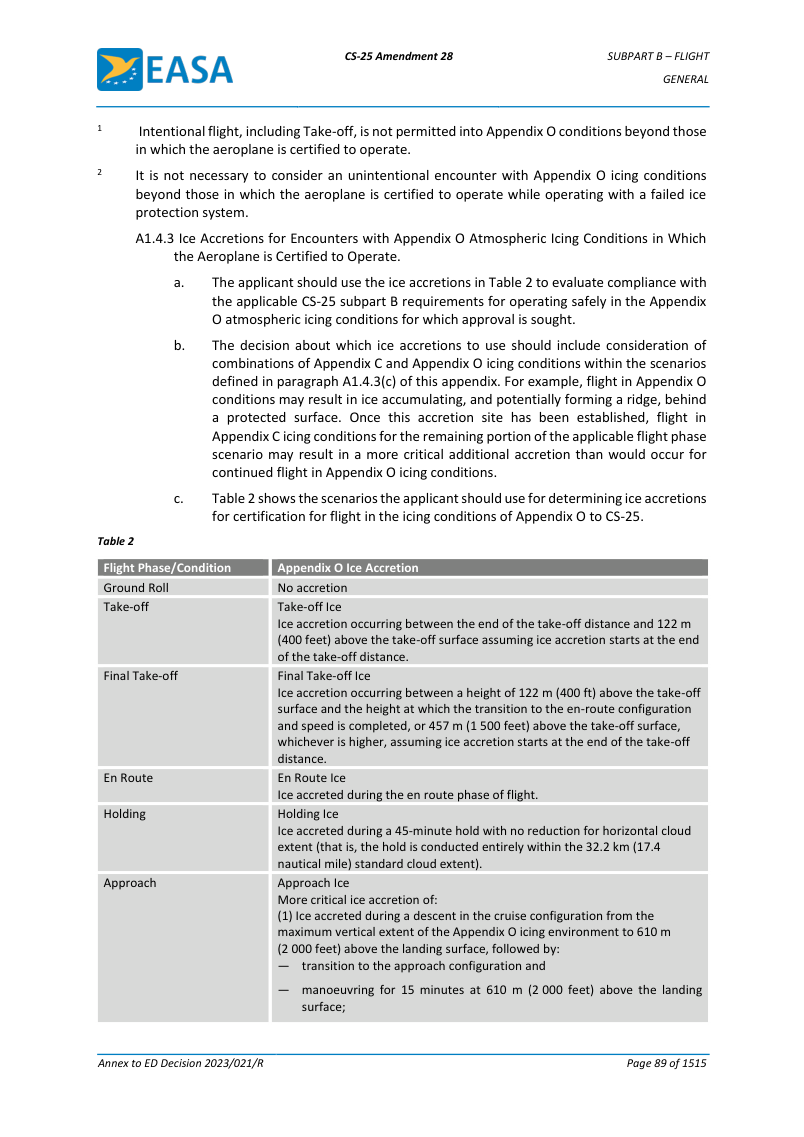
c. Table 2 shows the scenarios the applicant should use for determining ice accretions for certification for flight in the icing conditions of Appendix O to CS-25.
Table 2
Flight Phase/Condition Appendix O Ice Accretion Ground Roll No accretion Take-off Take-off Ice Ice accretion occurring between the end of the take-off distance and 122 m (400 feet) above the take-off surface assuming ice accretion starts at the end of the take-off distance. Final Take-off Final Take-off Ice Ice accretion occurring between a height of 122 m (400 ft) above the take-off surface and the height at which the transition to the en-route configuration and speed is completed, or 457 m (1 500 feet) above the take-off surface, whichever is higher, assuming ice accretion starts at the end of the take-off distance. En Route En Route Ice Ice accreted during the en route phase of flight. Holding Holding Ice Ice accreted during a 45-minute hold with no reduction for horizontal cloud extent (that is, the hold is conducted entirely within the 32.2 km (17.4 nautical mile) standard cloud extent). Approach Approach Ice More critical ice accretion of: (1) Ice accreted during a descent in the cruise configuration from the maximum vertical extent of the Appendix O icing environment to 610 m (2 000 feet) above the landing surface, followed by: — transition to the approach configuration and
— manoeuvring for 15 minutes at 610 m (2 000 feet) above the landing
surface;
View figures, tables and original page layout
Connected references
Source-backed citations and subject-based engineering context are labelled separately. These links do not establish equivalence or project acceptance.
Listed as related material by
Source-backedEvidence and scope
AMC 20-152A §8(a)(2)
Lists CS-25 without an amendment or specific paragraph.
Family reference; does not select a certification basis.
Supporting source