
CS-25
Large Aeroplanes
Amendment 28; corrected 20 November 2025 Source checked 2026-11-28
Scope, source and reading notes
Complete official CS-25 Amendment 28, including AMC and appendices.
Aerospace Consulting reference note: Certification specifications and acceptable means of compliance for large aeroplanes, using the corrected official publication.
The complete selected publication is available in reading text and as the original PDF. Reading text is extracted from the official PDF; page layout is simplified, and figures and tables should be checked in the original page view.
Search covers extracted text. Words contained only in graphics may not be searchable. The original publication is available below.
Official source recordOriginal PDF on this siteSource: EASA. Reproduced with source acknowledgment; source edition and status are shown above. SHA-256: 32f1a9acf26e8ceceb291d206bf07a7071f7f59f40f10c096bb17f34c6a58007
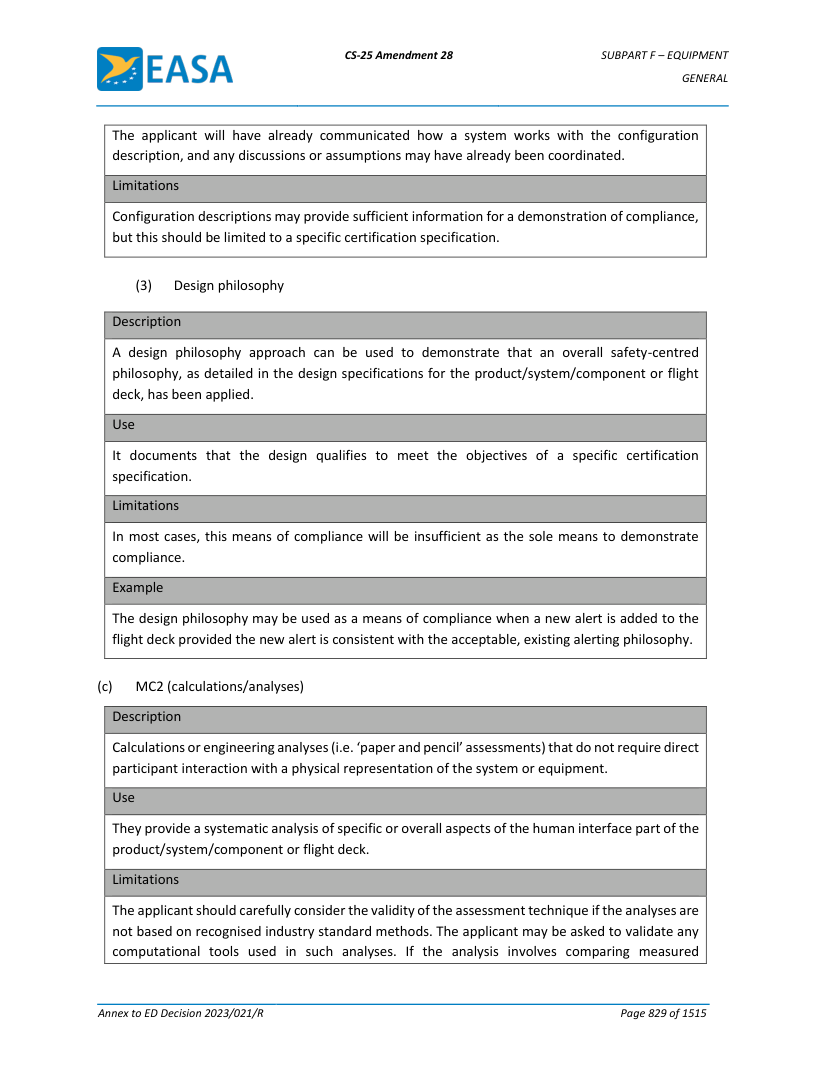
The applicant will have already communicated how a system works with the configuration description, and any discussions or assumptions may have already been coordinated.
Limitations
Configuration descriptions may provide sufficient information for a demonstration of compliance, but this should be limited to a specific certification specification.
(3) Design philosophy Description
A design philosophy approach can be used to demonstrate that an overall safety-centred philosophy, as detailed in the design specifications for the product/system/component or flight deck, has been applied.
Use
It documents that the design qualifies to meet the objectives of a specific certification specification.
Limitations
In most cases, this means of compliance will be insufficient as the sole means to demonstrate compliance.
Example
The design philosophy may be used as a means of compliance when a new alert is added to the flight deck provided the new alert is consistent with the acceptable, existing alerting philosophy.
(c) MC2 (calculations/analyses)
Description
Calculations or engineering analyses (i.e. ‘paper and pencil’ assessments) that do not require direct participant interaction with a physical representation of the system or equipment.
Use
They provide a systematic analysis of specific or overall aspects of the human interface part of the product/system/component or flight deck.
Limitations
The applicant should carefully consider the validity of the assessment technique if the analyses are not based on recognised industry standard methods. The applicant may be asked to validate any computational tools used in such analyses. If the analysis involves comparing measured
View figures, tables and original page layout
Connected references
Source-backed citations and subject-based engineering context are labelled separately. These links do not establish equivalence or project acceptance.
Listed as related material by
Source-backedEvidence and scope
AMC 20-152A §8(a)(2)
Lists CS-25 without an amendment or specific paragraph.
Family reference; does not select a certification basis.
Supporting source