
CS-25
Large Aeroplanes
Amendment 28; corrected 20 November 2025 Source checked 2026-11-28
Scope, source and reading notes
Complete official CS-25 Amendment 28, including AMC and appendices.
Aerospace Consulting reference note: Certification specifications and acceptable means of compliance for large aeroplanes, using the corrected official publication.
The complete selected publication is available in reading text and as the original PDF. Reading text is extracted from the official PDF; page layout is simplified, and figures and tables should be checked in the original page view.
Search covers extracted text. Words contained only in graphics may not be searchable. The original publication is available below.
Official source recordOriginal PDF on this siteSource: EASA. Reproduced with source acknowledgment; source edition and status are shown above. SHA-256: 32f1a9acf26e8ceceb291d206bf07a7071f7f59f40f10c096bb17f34c6a58007
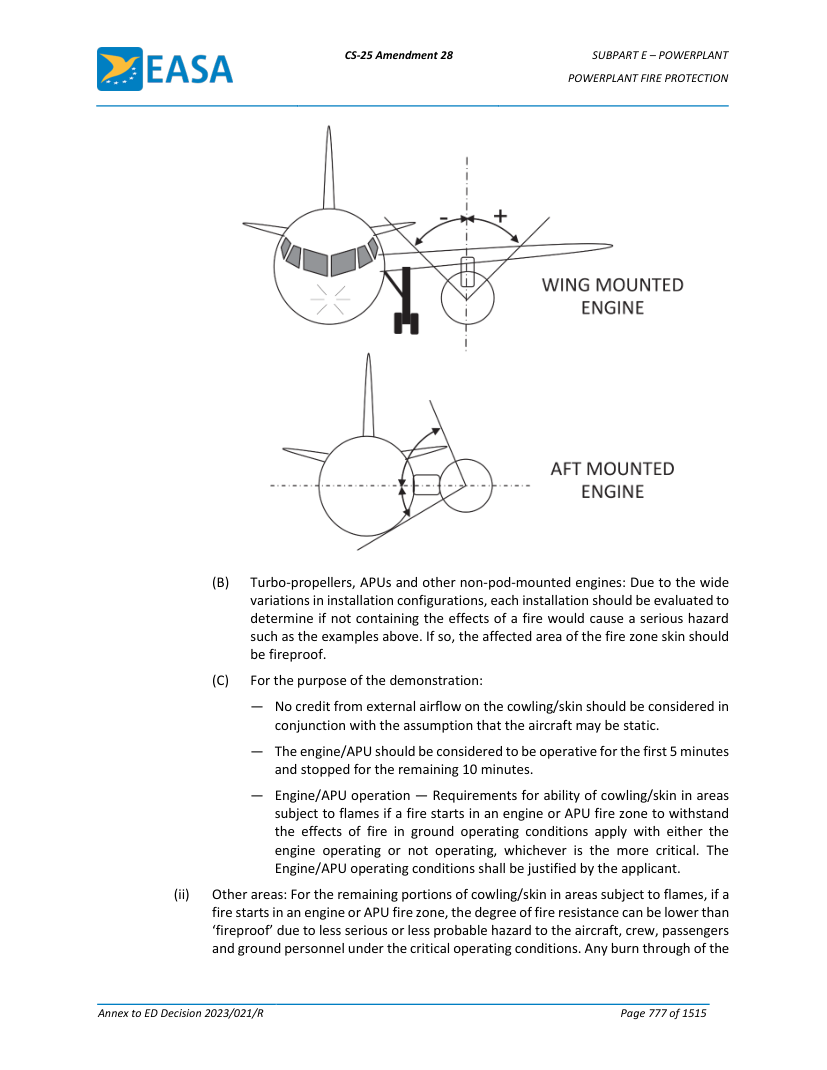
(B) Turbo-propellers, APUs and other non-pod-mounted engines: Due to the wide variations in installation configurations, each installation should be evaluated to determine if not containing the effects of a fire would cause a serious hazard such as the examples above. If so, the affected area of the fire zone skin should be fireproof.
(C) For the purpose of the demonstration:
— No credit from external airflow on the cowling/skin should be considered in
conjunction with the assumption that the aircraft may be static.
— The engine/APU should be considered to be operative for the first 5 minutes
and stopped for the remaining 10 minutes.
— Engine/APU operation — Requirements for ability of cowling/skin in areas
subject to flames if a fire starts in an engine or APU fire zone to withstand the effects of fire in ground operating conditions apply with either the engine operating or not operating, whichever is the more critical. The Engine/APU operating conditions shall be justified by the applicant.
(ii) Other areas: For the remaining portions of cowling/skin in areas subject to flames, if a fire starts in an engine or APU fire zone, the degree of fire resistance can be lower than ‘fireproof’ due to less serious or less probable hazard to the aircraft, crew, passengers and ground personnel under the critical operating conditions. Any burn through of the
View figures, tables and original page layout
Connected references
Source-backed citations and subject-based engineering context are labelled separately. These links do not establish equivalence or project acceptance.
Listed as related material by
Source-backedEvidence and scope
AMC 20-152A §8(a)(2)
Lists CS-25 without an amendment or specific paragraph.
Family reference; does not select a certification basis.
Supporting source