
CS-25
Large Aeroplanes
Amendment 28; corrected 20 November 2025 Source checked 2026-11-28
Scope, source and reading notes
Complete official CS-25 Amendment 28, including AMC and appendices.
Aerospace Consulting reference note: Certification specifications and acceptable means of compliance for large aeroplanes, using the corrected official publication.
The complete selected publication is available in reading text and as the original PDF. Reading text is extracted from the official PDF; page layout is simplified, and figures and tables should be checked in the original page view.
Search covers extracted text. Words contained only in graphics may not be searchable. The original publication is available below.
Official source recordOriginal PDF on this siteSource: EASA. Reproduced with source acknowledgment; source edition and status are shown above. SHA-256: 32f1a9acf26e8ceceb291d206bf07a7071f7f59f40f10c096bb17f34c6a58007
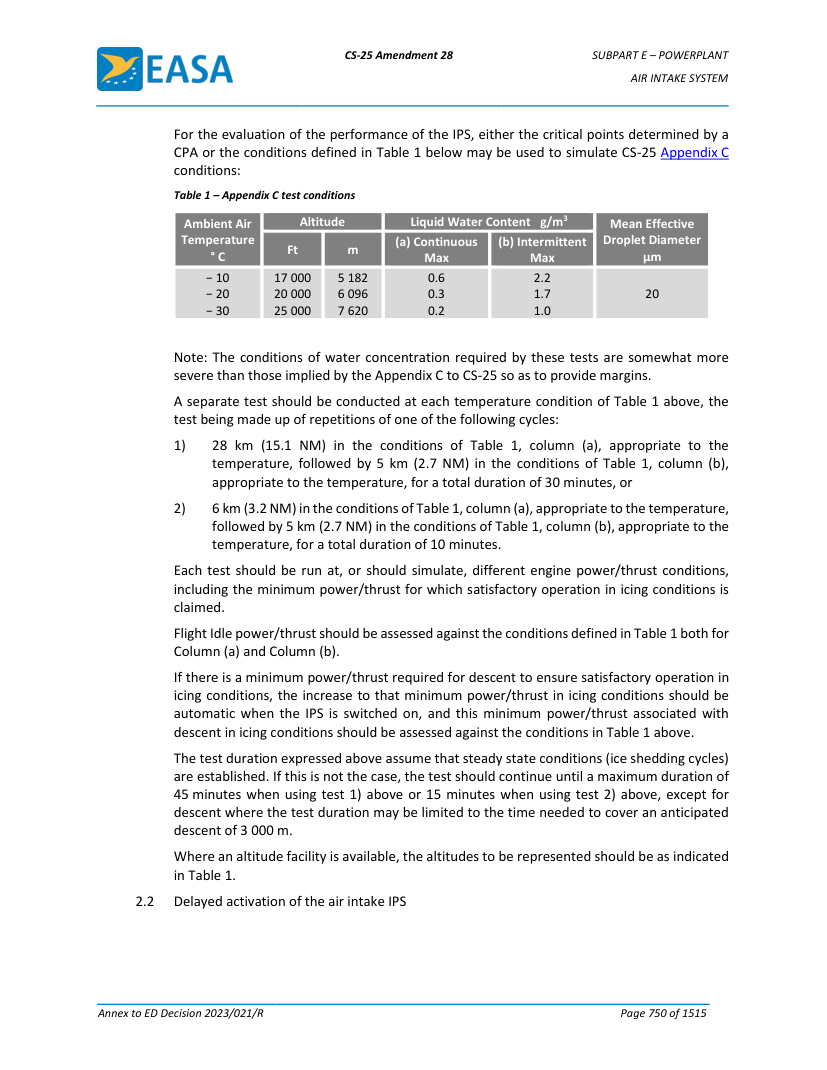
For the evaluation of the performance of the IPS, either the critical points determined by a CPA or the conditions defined in Table 1 below may be used to simulate CS-25 Appendix C conditions:
Table 1 – Appendix C test conditions
Ambient Air Temperature
Altitude Liquid Water Content g/m3 Mean Effective Droplet Diameter
(b) Intermittent
° C
µm Ft m (a) Continuous
Max
20
Max − 10 − 20 − 30
17 000 20 000 25 000
5 182 6 096 7 620
0.6 0.3 0.2
2.2 1.7 1.0
Note: The conditions of water concentration required by these tests are somewhat more severe than those implied by the Appendix C to CS-25 so as to provide margins.
A separate test should be conducted at each temperature condition of Table 1 above, the test being made up of repetitions of one of the following cycles:
1) 28 km (15.1 NM) in the conditions of Table 1, column (a), appropriate to the temperature, followed by 5 km (2.7 NM) in the conditions of Table 1, column (b), appropriate to the temperature, for a total duration of 30 minutes, or
2) 6 km (3.2 NM) in the conditions of Table 1, column (a), appropriate to the temperature, followed by 5 km (2.7 NM) in the conditions of Table 1, column (b), appropriate to the temperature, for a total duration of 10 minutes.
Each test should be run at, or should simulate, different engine power/thrust conditions, including the minimum power/thrust for which satisfactory operation in icing conditions is claimed.
Flight Idle power/thrust should be assessed against the conditions defined in Table 1 both for Column (a) and Column (b).
If there is a minimum power/thrust required for descent to ensure satisfactory operation in icing conditions, the increase to that minimum power/thrust in icing conditions should be automatic when the IPS is switched on, and this minimum power/thrust associated with descent in icing conditions should be assessed against the conditions in Table 1 above.
The test duration expressed above assume that steady state conditions (ice shedding cycles) are established. If this is not the case, the test should continue until a maximum duration of 45 minutes when using test 1) above or 15 minutes when using test 2) above, except for descent where the test duration may be limited to the time needed to cover an anticipated descent of 3 000 m.
Where an altitude facility is available, the altitudes to be represented should be as indicated in Table 1.
2.2 Delayed activation of the air intake IPS
View figures, tables and original page layout
Connected references
Source-backed citations and subject-based engineering context are labelled separately. These links do not establish equivalence or project acceptance.
Listed as related material by
Source-backedEvidence and scope
AMC 20-152A §8(a)(2)
Lists CS-25 without an amendment or specific paragraph.
Family reference; does not select a certification basis.
Supporting source