
CS-25
Large Aeroplanes
Amendment 28; corrected 20 November 2025 Source checked 2026-11-28
Scope, source and reading notes
Complete official CS-25 Amendment 28, including AMC and appendices.
Aerospace Consulting reference note: Certification specifications and acceptable means of compliance for large aeroplanes, using the corrected official publication.
The complete selected publication is available in reading text and as the original PDF. Reading text is extracted from the official PDF; page layout is simplified, and figures and tables should be checked in the original page view.
Search covers extracted text. Words contained only in graphics may not be searchable. The original publication is available below.
Official source recordOriginal PDF on this siteSource: EASA. Reproduced with source acknowledgment; source edition and status are shown above. SHA-256: 32f1a9acf26e8ceceb291d206bf07a7071f7f59f40f10c096bb17f34c6a58007
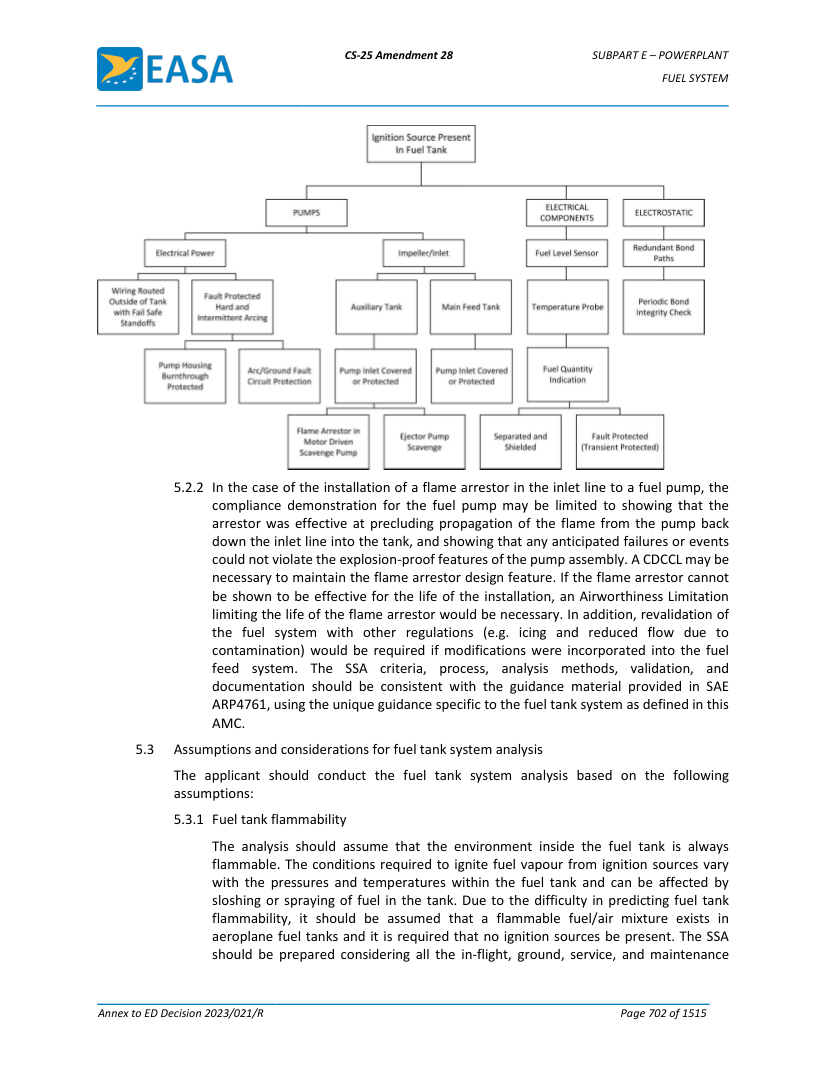
5.2.2 In the case of the installation of a flame arrestor in the inlet line to a fuel pump, the
compliance demonstration for the fuel pump may be limited to showing that the arrestor was effective at precluding propagation of the flame from the pump back down the inlet line into the tank, and showing that any anticipated failures or events could not violate the explosion-proof features of the pump assembly. A CDCCL may be necessary to maintain the flame arrestor design feature. If the flame arrestor cannot be shown to be effective for the life of the installation, an Airworthiness Limitation limiting the life of the flame arrestor would be necessary. In addition, revalidation of the fuel system with other regulations (e.g. icing and reduced flow due to contamination) would be required if modifications were incorporated into the fuel feed system. The SSA criteria, process, analysis methods, validation, and documentation should be consistent with the guidance material provided in SAE ARP4761, using the unique guidance specific to the fuel tank system as defined in this AMC.
5.3 Assumptions and considerations for fuel tank system analysis
The applicant should conduct the fuel tank system analysis based on the following assumptions:
5.3.1 Fuel tank flammability
The analysis should assume that the environment inside the fuel tank is always flammable. The conditions required to ignite fuel vapour from ignition sources vary with the pressures and temperatures within the fuel tank and can be affected by sloshing or spraying of fuel in the tank. Due to the difficulty in predicting fuel tank flammability, it should be assumed that a flammable fuel/air mixture exists in aeroplane fuel tanks and it is required that no ignition sources be present. The SSA should be prepared considering all the in-flight, ground, service, and maintenance
View figures, tables and original page layout
Connected references
Source-backed citations and subject-based engineering context are labelled separately. These links do not establish equivalence or project acceptance.
Listed as related material by
Source-backedEvidence and scope
AMC 20-152A §8(a)(2)
Lists CS-25 without an amendment or specific paragraph.
Family reference; does not select a certification basis.
Supporting source