
CS-25
Large Aeroplanes
Amendment 28; corrected 20 November 2025 Source checked 2026-11-28
Scope, source and reading notes
Complete official CS-25 Amendment 28, including AMC and appendices.
Aerospace Consulting reference note: Certification specifications and acceptable means of compliance for large aeroplanes, using the corrected official publication.
The complete selected publication is available in reading text and as the original PDF. Reading text is extracted from the official PDF; page layout is simplified, and figures and tables should be checked in the original page view.
Search covers extracted text. Words contained only in graphics may not be searchable. The original publication is available below.
Official source recordOriginal PDF on this siteSource: EASA. Reproduced with source acknowledgment; source edition and status are shown above. SHA-256: 32f1a9acf26e8ceceb291d206bf07a7071f7f59f40f10c096bb17f34c6a58007
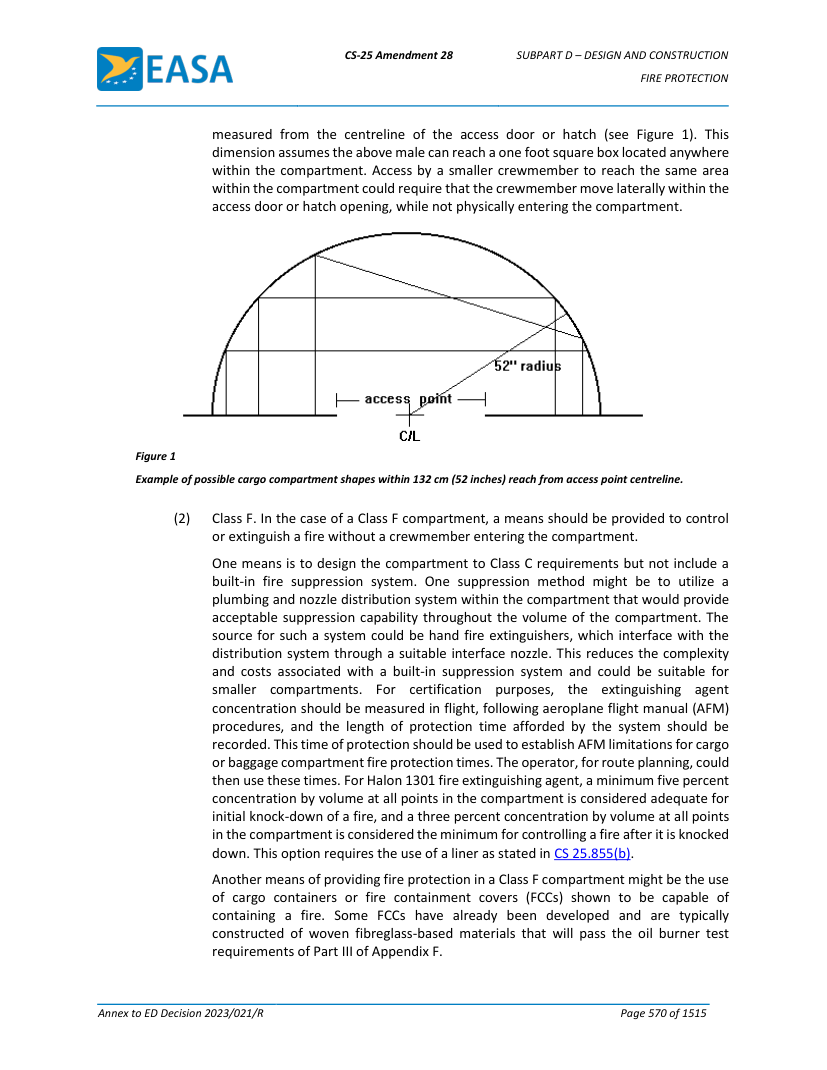
measured from the centreline of the access door or hatch (see Figure 1). This dimension assumes the above male can reach a one foot square box located anywhere within the compartment. Access by a smaller crewmember to reach the same area within the compartment could require that the crewmember move laterally within the access door or hatch opening, while not physically entering the compartment.
Figure 1
Example of possible cargo compartment shapes within 132 cm (52 inches) reach from access point centreline.
(2) Class F. In the case of a Class F compartment, a means should be provided to control or extinguish a fire without a crewmember entering the compartment.
One means is to design the compartment to Class C requirements but not include a built-in fire suppression system. One suppression method might be to utilize a plumbing and nozzle distribution system within the compartment that would provide acceptable suppression capability throughout the volume of the compartment. The source for such a system could be hand fire extinguishers, which interface with the distribution system through a suitable interface nozzle. This reduces the complexity and costs associated with a built-in suppression system and could be suitable for smaller compartments. For certification purposes, the extinguishing agent concentration should be measured in flight, following aeroplane flight manual (AFM) procedures, and the length of protection time afforded by the system should be recorded. This time of protection should be used to establish AFM limitations for cargo or baggage compartment fire protection times. The operator, for route planning, could then use these times. For Halon 1301 fire extinguishing agent, a minimum five percent concentration by volume at all points in the compartment is considered adequate for initial knock-down of a fire, and a three percent concentration by volume at all points in the compartment is considered the minimum for controlling a fire after it is knocked down. This option requires the use of a liner as stated in CS 25.855(b).
Another means of providing fire protection in a Class F compartment might be the use of cargo containers or fire containment covers (FCCs) shown to be capable of containing a fire. Some FCCs have already been developed and are typically constructed of woven fibreglass-based materials that will pass the oil burner test requirements of Part III of Appendix F.
View figures, tables and original page layout
Connected references
Source-backed citations and subject-based engineering context are labelled separately. These links do not establish equivalence or project acceptance.
Listed as related material by
Source-backedEvidence and scope
AMC 20-152A §8(a)(2)
Lists CS-25 without an amendment or specific paragraph.
Family reference; does not select a certification basis.
Supporting source