
CS-25
Large Aeroplanes
Amendment 28; corrected 20 November 2025 Source checked 2026-11-28
Scope, source and reading notes
Complete official CS-25 Amendment 28, including AMC and appendices.
Aerospace Consulting reference note: Certification specifications and acceptable means of compliance for large aeroplanes, using the corrected official publication.
The complete selected publication is available in reading text and as the original PDF. Reading text is extracted from the official PDF; page layout is simplified, and figures and tables should be checked in the original page view.
Search covers extracted text. Words contained only in graphics may not be searchable. The original publication is available below.
Official source recordOriginal PDF on this siteSource: EASA. Reproduced with source acknowledgment; source edition and status are shown above. SHA-256: 32f1a9acf26e8ceceb291d206bf07a7071f7f59f40f10c096bb17f34c6a58007
that the exemptions were predicated on the basis that there were, at that time, no suitable alternate agents or systems available for use on commercial transport category aeroplanes.
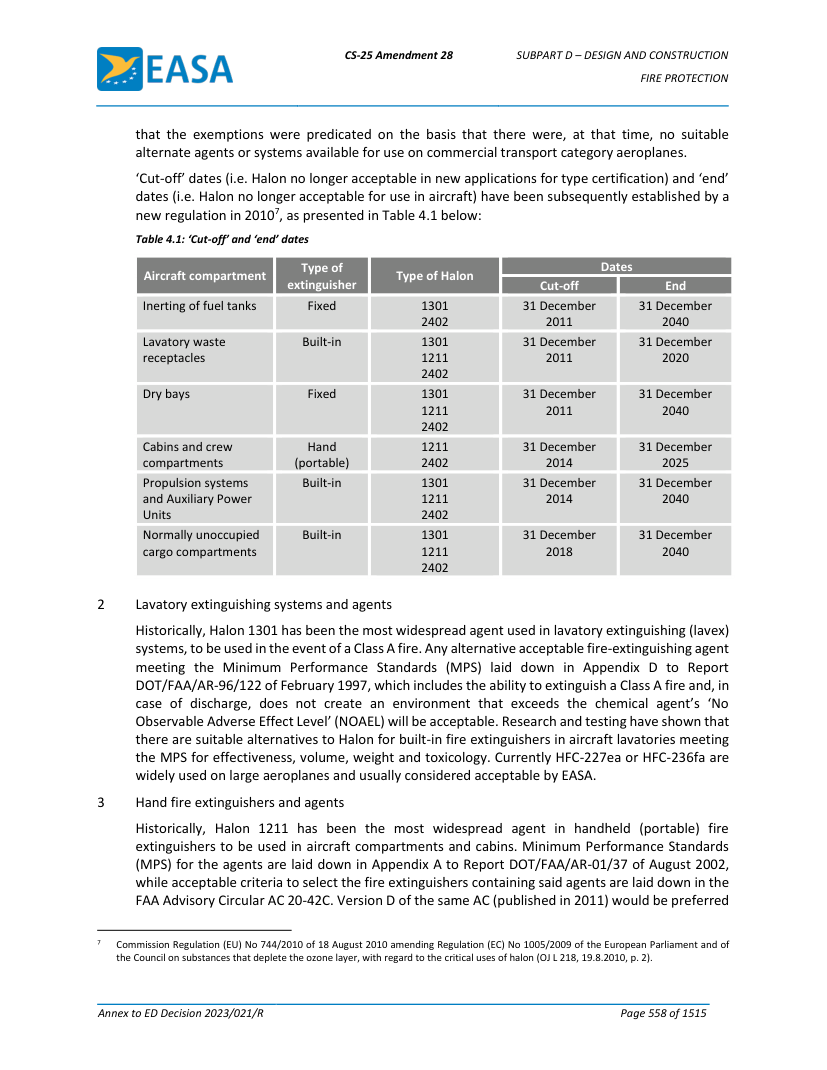
‘Cut-off’ dates (i.e. Halon no longer acceptable in new applications for type certification) and ‘end’ dates (i.e. Halon no longer acceptable for use in aircraft) have been subsequently established by a new regulation in 20107, as presented in Table 4.1 below:
Table 4.1: ‘Cut-off’ and ‘end’ dates
31 December
31 December
Aircraft compartment Type of extinguisher Type of Halon Dates Cut-off End Inerting of fuel tanks Fixed 1301 2402
2011
31 December
31 December
2040 Lavatory waste receptacles
2011
2020
Built-in 1301 1211 2402
31 December
31 December
2011
2040
Dry bays Fixed 1301 1211 2402
31 December
31 December
Cabins and crew compartments
Hand (portable)
1211 2402
2014
31 December
31 December
2014
2040
2025 Propulsion systems and Auxiliary Power Units
Built-in 1301 1211 2402
31 December
31 December
Normally unoccupied cargo compartments
2018
2040
Built-in 1301 1211 2402
2 Lavatory extinguishing systems and agents
Historically, Halon 1301 has been the most widespread agent used in lavatory extinguishing (lavex) systems, to be used in the event of a Class A fire. Any alternative acceptable fire-extinguishing agent meeting the Minimum Performance Standards (MPS) laid down in Appendix D to Report DOT/FAA/AR-96/122 of February 1997, which includes the ability to extinguish a Class A fire and, in case of discharge, does not create an environment that exceeds the chemical agent’s ‘No Observable Adverse Effect Level’ (NOAEL) will be acceptable. Research and testing have shown that there are suitable alternatives to Halon for built-in fire extinguishers in aircraft lavatories meeting the MPS for effectiveness, volume, weight and toxicology. Currently HFC-227ea or HFC-236fa are widely used on large aeroplanes and usually considered acceptable by EASA.
3 Hand fire extinguishers and agents
Historically, Halon 1211 has been the most widespread agent in handheld (portable) fire extinguishers to be used in aircraft compartments and cabins. Minimum Performance Standards (MPS) for the agents are laid down in Appendix A to Report DOT/FAA/AR-01/37 of August 2002, while acceptable criteria to select the fire extinguishers containing said agents are laid down in the FAA Advisory Circular AC 20-42C. Version D of the same AC (published in 2011) would be preferred
7 Commission Regulation (EU) No 744/2010 of 18 August 2010 amending Regulation (EC) No 1005/2009 of the European Parliament and of the Council on substances that deplete the ozone layer, with regard to the critical uses of halon (OJ L 218, 19.8.2010, p. 2).
View figures, tables and original page layout
Connected references
Source-backed citations and subject-based engineering context are labelled separately. These links do not establish equivalence or project acceptance.
Listed as related material by
Source-backedEvidence and scope
AMC 20-152A §8(a)(2)
Lists CS-25 without an amendment or specific paragraph.
Family reference; does not select a certification basis.
Supporting source