
CS-25
Large Aeroplanes
Amendment 28; corrected 20 November 2025 Source checked 2026-11-28
Scope, source and reading notes
Complete official CS-25 Amendment 28, including AMC and appendices.
Aerospace Consulting reference note: Certification specifications and acceptable means of compliance for large aeroplanes, using the corrected official publication.
The complete selected publication is available in reading text and as the original PDF. Reading text is extracted from the official PDF; page layout is simplified, and figures and tables should be checked in the original page view.
Search covers extracted text. Words contained only in graphics may not be searchable. The original publication is available below.
Official source recordOriginal PDF on this siteSource: EASA. Reproduced with source acknowledgment; source edition and status are shown above. SHA-256: 32f1a9acf26e8ceceb291d206bf07a7071f7f59f40f10c096bb17f34c6a58007
(8) Type B. This type is a floor-level exit with a rectangular opening of not less than 81.3 cm (32 inches) wide by 182.9 cm (72 inches) high, with corner radii not greater than 15.3 cm (6 inches).
(9) Type C. This type is a floor-level exit with a rectangular opening of not less than 76.2 cm (30 inches) wide by 121.9 cm (48 inches) high, with corner radii not greater than 25.4 cm (10 inches).
(b) Step down distance. Step down distance, as used in this paragraph, means the actual distance between the bottom of the required opening and a usable foot hold, extending out from the fuselage, that is large enough to be effective without searching by sight or feel.
(c) Over-sized exits. Openings larger than those specified in this paragraph, whether or not of rectangular shape, may be used if the specified rectangular opening can be inscribed within the opening and the base of the inscribed rectangular opening meets the specified step-up and step- down heights.
(d) Asymmetry. Exits of an exit pair need not be diametrically opposite each other nor of the same size; however, the number of passenger seats permitted under subparagraph (g) of this paragraph is based on the smaller of the two exits.
(e) Uniformity. Exits must be distributed as uniformly as practical, taking into account passenger seat distribution. (See AMC 25.807(e))
(f) Location. (See AMC 25.807(f))
(1) Each required passenger emergency exit must be accessible to the passengers and located where it will afford the most effective means of passenger evacuation.
(2) If only one floor-level exit per side is prescribed, and the aeroplane does not have a tail cone or ventral emergency exit, the floor-level exits must be in the rearward part of the passenger compartment unless another location affords a more effective means of passenger evacuation.
(3) If more than one floor-level exit per side is prescribed, and the aeroplane does not have a combination cargo and passenger configuration, at least one floor-level exit must be located on each side near each end of the cabin.
(4) For an aeroplane that is required to have more than one passenger emergency exits for each side of the fuselage, no passenger emergency exit shall be more than 18.3 m (60 feet) from any adjacent passenger emergency exit on the same side of the same deck of the fuselage, as measured parallel to the aeroplane’s longitudinal axis between the nearest edges.
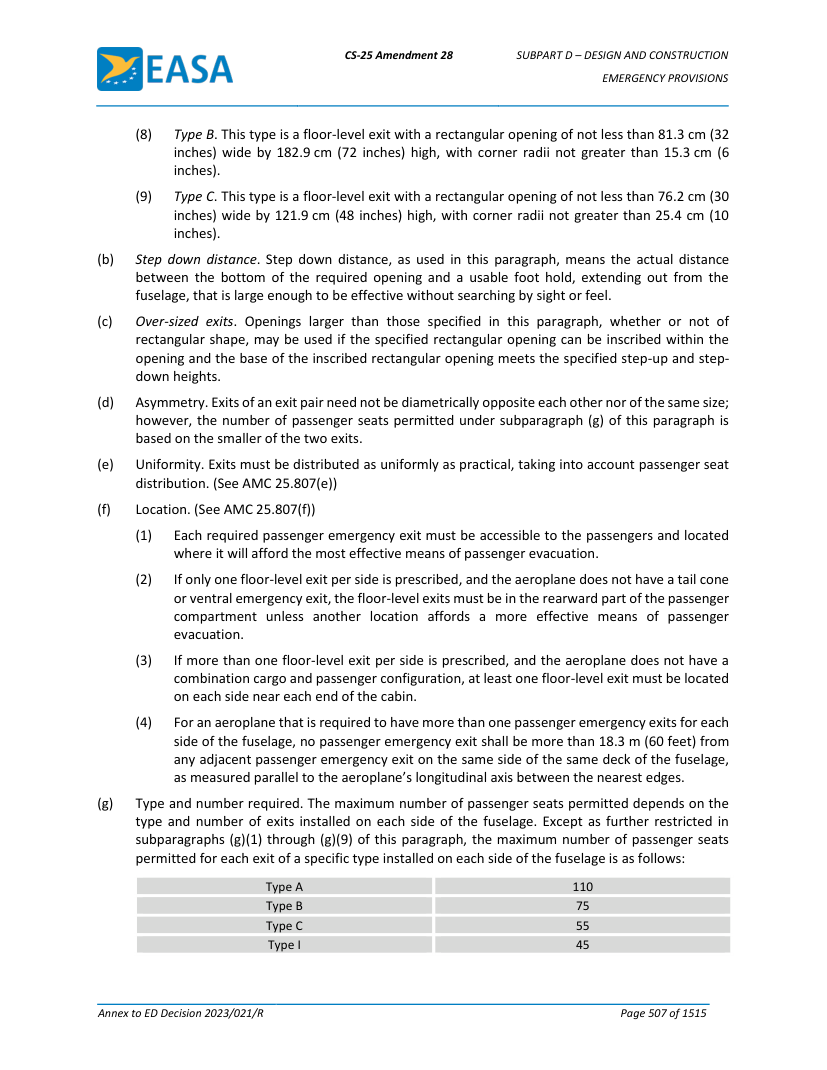
(g) Type and number required. The maximum number of passenger seats permitted depends on the type and number of exits installed on each side of the fuselage. Except as further restricted in subparagraphs (g)(1) through (g)(9) of this paragraph, the maximum number of passenger seats permitted for each exit of a specific type installed on each side of the fuselage is as follows:
Type A 110 Type B 75 Type C 55 Type I 45
View figures, tables and original page layout
Connected references
Source-backed citations and subject-based engineering context are labelled separately. These links do not establish equivalence or project acceptance.
Listed as related material by
Source-backedEvidence and scope
AMC 20-152A §8(a)(2)
Lists CS-25 without an amendment or specific paragraph.
Family reference; does not select a certification basis.
Supporting source