
CS-25
Large Aeroplanes
Amendment 28; corrected 20 November 2025 Source checked 2026-11-28
Scope, source and reading notes
Complete official CS-25 Amendment 28, including AMC and appendices.
Aerospace Consulting reference note: Certification specifications and acceptable means of compliance for large aeroplanes, using the corrected official publication.
The complete selected publication is available in reading text and as the original PDF. Reading text is extracted from the official PDF; page layout is simplified, and figures and tables should be checked in the original page view.
Search covers extracted text. Words contained only in graphics may not be searchable. The original publication is available below.
Official source recordOriginal PDF on this siteSource: EASA. Reproduced with source acknowledgment; source edition and status are shown above. SHA-256: 32f1a9acf26e8ceceb291d206bf07a7071f7f59f40f10c096bb17f34c6a58007
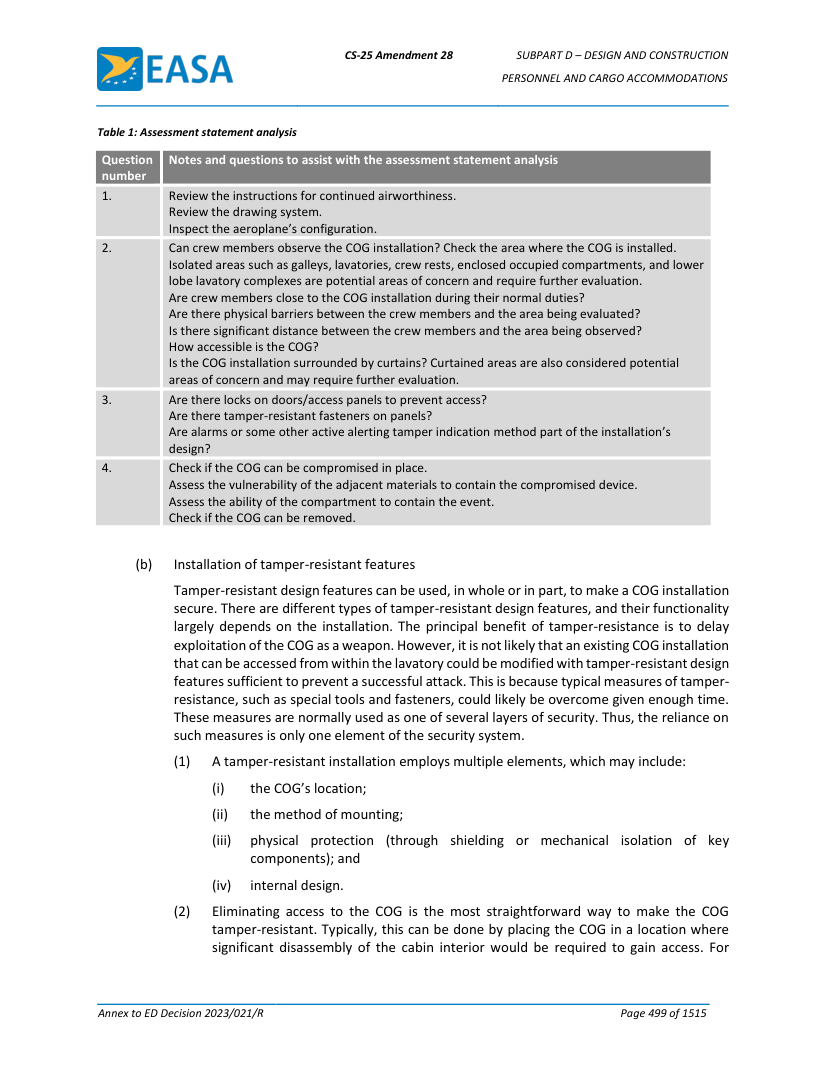
Table 1: Assessment statement analysis
Notes and questions to assist with the assessment statement analysis
Question number
1. Review the instructions for continued airworthiness. Review the drawing system. Inspect the aeroplane’s configuration. 2. Can crew members observe the COG installation? Check the area where the COG is installed. Isolated areas such as galleys, lavatories, crew rests, enclosed occupied compartments, and lower lobe lavatory complexes are potential areas of concern and require further evaluation. Are crew members close to the COG installation during their normal duties? Are there physical barriers between the crew members and the area being evaluated? Is there significant distance between the crew members and the area being observed? How accessible is the COG? Is the COG installation surrounded by curtains? Curtained areas are also considered potential areas of concern and may require further evaluation. 3. Are there locks on doors/access panels to prevent access? Are there tamper-resistant fasteners on panels? Are alarms or some other active alerting tamper indication method part of the installation’s design? 4. Check if the COG can be compromised in place. Assess the vulnerability of the adjacent materials to contain the compromised device. Assess the ability of the compartment to contain the event. Check if the COG can be removed.
(b) Installation of tamper-resistant features
Tamper-resistant design features can be used, in whole or in part, to make a COG installation secure. There are different types of tamper-resistant design features, and their functionality largely depends on the installation. The principal benefit of tamper-resistance is to delay exploitation of the COG as a weapon. However, it is not likely that an existing COG installation that can be accessed from within the lavatory could be modified with tamper-resistant design features sufficient to prevent a successful attack. This is because typical measures of tamper- resistance, such as special tools and fasteners, could likely be overcome given enough time. These measures are normally used as one of several layers of security. Thus, the reliance on such measures is only one element of the security system.
(1) A tamper-resistant installation employs multiple elements, which may include:
(i) the COG’s location;
(ii) the method of mounting;
(iii) physical protection (through shielding or mechanical isolation of key components); and
(iv) internal design.
(2) Eliminating access to the COG is the most straightforward way to make the COG tamper-resistant. Typically, this can be done by placing the COG in a location where significant disassembly of the cabin interior would be required to gain access. For
View figures, tables and original page layout
Connected references
Source-backed citations and subject-based engineering context are labelled separately. These links do not establish equivalence or project acceptance.
Listed as related material by
Source-backedEvidence and scope
AMC 20-152A §8(a)(2)
Lists CS-25 without an amendment or specific paragraph.
Family reference; does not select a certification basis.
Supporting source