
CS-25
Large Aeroplanes
Amendment 28; corrected 20 November 2025 Source checked 2026-11-28
Scope, source and reading notes
Complete official CS-25 Amendment 28, including AMC and appendices.
Aerospace Consulting reference note: Certification specifications and acceptable means of compliance for large aeroplanes, using the corrected official publication.
The complete selected publication is available in reading text and as the original PDF. Reading text is extracted from the official PDF; page layout is simplified, and figures and tables should be checked in the original page view.
Search covers extracted text. Words contained only in graphics may not be searchable. The original publication is available below.
Official source recordOriginal PDF on this siteSource: EASA. Reproduced with source acknowledgment; source edition and status are shown above. SHA-256: 32f1a9acf26e8ceceb291d206bf07a7071f7f59f40f10c096bb17f34c6a58007
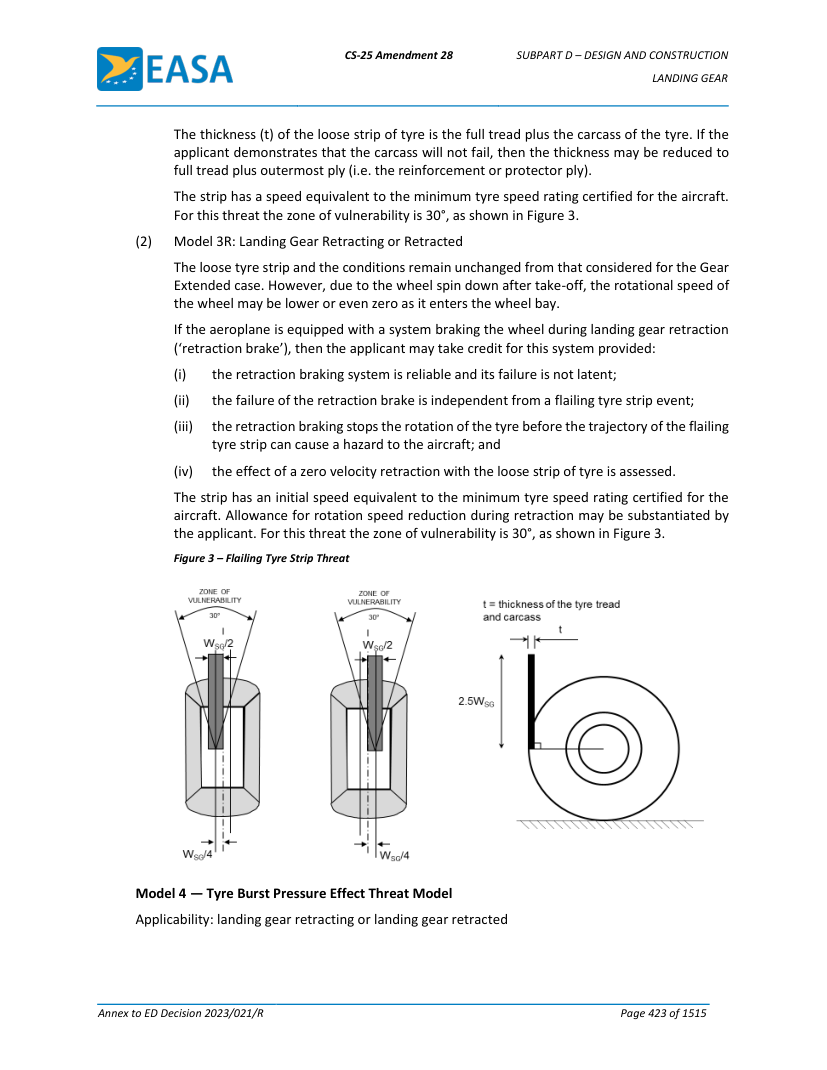
The thickness (t) of the loose strip of tyre is the full tread plus the carcass of the tyre. If the applicant demonstrates that the carcass will not fail, then the thickness may be reduced to full tread plus outermost ply (i.e. the reinforcement or protector ply).
The strip has a speed equivalent to the minimum tyre speed rating certified for the aircraft. For this threat the zone of vulnerability is 30°, as shown in Figure 3.
(2) Model 3R: Landing Gear Retracting or Retracted
The loose tyre strip and the conditions remain unchanged from that considered for the Gear Extended case. However, due to the wheel spin down after take-off, the rotational speed of the wheel may be lower or even zero as it enters the wheel bay.
If the aeroplane is equipped with a system braking the wheel during landing gear retraction (‘retraction brake’), then the applicant may take credit for this system provided:
(i) the retraction braking system is reliable and its failure is not latent;
(ii) the failure of the retraction brake is independent from a flailing tyre strip event;
(iii) the retraction braking stops the rotation of the tyre before the trajectory of the flailing tyre strip can cause a hazard to the aircraft; and
(iv) the effect of a zero velocity retraction with the loose strip of tyre is assessed.
The strip has an initial speed equivalent to the minimum tyre speed rating certified for the aircraft. Allowance for rotation speed reduction during retraction may be substantiated by the applicant. For this threat the zone of vulnerability is 30°, as shown in Figure 3.
Figure 3 – Flailing Tyre Strip Threat
Model 4 — Tyre Burst Pressure Effect Threat Model
Applicability: landing gear retracting or landing gear retracted
View figures, tables and original page layout
Connected references
Source-backed citations and subject-based engineering context are labelled separately. These links do not establish equivalence or project acceptance.
Listed as related material by
Source-backedEvidence and scope
AMC 20-152A §8(a)(2)
Lists CS-25 without an amendment or specific paragraph.
Family reference; does not select a certification basis.
Supporting source