
CS-25
Large Aeroplanes
Amendment 28; corrected 20 November 2025 Source checked 2026-11-28
Scope, source and reading notes
Complete official CS-25 Amendment 28, including AMC and appendices.
Aerospace Consulting reference note: Certification specifications and acceptable means of compliance for large aeroplanes, using the corrected official publication.
The complete selected publication is available in reading text and as the original PDF. Reading text is extracted from the official PDF; page layout is simplified, and figures and tables should be checked in the original page view.
Search covers extracted text. Words contained only in graphics may not be searchable. The original publication is available below.
Official source recordOriginal PDF on this siteSource: EASA. Reproduced with source acknowledgment; source edition and status are shown above. SHA-256: 32f1a9acf26e8ceceb291d206bf07a7071f7f59f40f10c096bb17f34c6a58007
(a) Rejections should be investigated and process corrections made as necessary.
(b) Alternative techniques may be employed if the equivalence in the acceptance levels can be demonstrated.
(c) In addition, tensile tests should be taken from the prolongations on every component produced, and the results should comply with limits developed in the process qualification and product proving programs.
(d) Additionally, as previously mentioned, a periodic casting cut-up inspection should be undertaken, with the inspection schedule as agreed upon during the proof of product program.
(e) Deviations from the limits established in the process qualification and product proving programs should be investigated and corrective action taken.
7. Modifications to the Casting Design, Material, and Process.
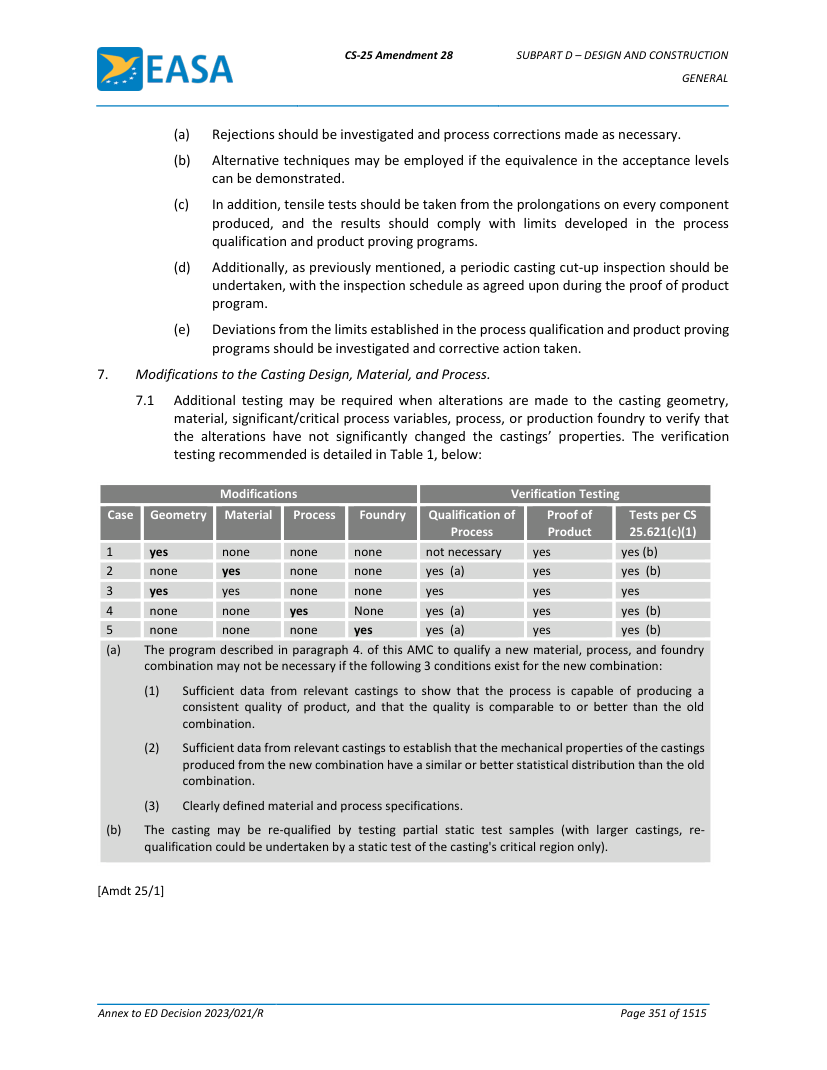
7.1 Additional testing may be required when alterations are made to the casting geometry, material, significant/critical process variables, process, or production foundry to verify that the alterations have not significantly changed the castings’ properties. The verification testing recommended is detailed in Table 1, below:
Modifications Verification Testing
Case Geometry Material Process Foundry Qualification of
Process
Proof of Product
Tests per CS 25.621(c)(1)
1 yes none none none not necessary yes yes (b) 2 none yes none none yes (a) yes yes (b) 3 yes yes none none yes yes yes 4 none none yes None yes (a) yes yes (b) 5 none none none yes yes (a) yes yes (b) (a) The program described in paragraph 4. of this AMC to qualify a new material, process, and foundry combination may not be necessary if the following 3 conditions exist for the new combination:
(1) Sufficient data from relevant castings to show that the process is capable of producing a consistent quality of product, and that the quality is comparable to or better than the old combination.
(2) Sufficient data from relevant castings to establish that the mechanical properties of the castings produced from the new combination have a similar or better statistical distribution than the old combination.
(3) Clearly defined material and process specifications.
(b) The casting may be re-qualified by testing partial static test samples (with larger castings, re- qualification could be undertaken by a static test of the casting's critical region only).
[Amdt 25/1]
View figures, tables and original page layout
Connected references
Source-backed citations and subject-based engineering context are labelled separately. These links do not establish equivalence or project acceptance.
Listed as related material by
Source-backedEvidence and scope
AMC 20-152A §8(a)(2)
Lists CS-25 without an amendment or specific paragraph.
Family reference; does not select a certification basis.
Supporting source