
CS-25
Large Aeroplanes
Amendment 28; corrected 20 November 2025 Source checked 2026-11-28
Scope, source and reading notes
Complete official CS-25 Amendment 28, including AMC and appendices.
Aerospace Consulting reference note: Certification specifications and acceptable means of compliance for large aeroplanes, using the corrected official publication.
The complete selected publication is available in reading text and as the original PDF. Reading text is extracted from the official PDF; page layout is simplified, and figures and tables should be checked in the original page view.
Search covers extracted text. Words contained only in graphics may not be searchable. The original publication is available below.
Official source recordOriginal PDF on this siteSource: EASA. Reproduced with source acknowledgment; source edition and status are shown above. SHA-256: 32f1a9acf26e8ceceb291d206bf07a7071f7f59f40f10c096bb17f34c6a58007
d. Non-linear Solution Methodology. Where explicit simulation of non-linearities is required, the loads response may be calculated through time domain integration of the equations of motion.
For the tuned discrete gust conditions of CS 25.341(a), limit loads should be identified by peak values in the non-linear time domain simulation response of the aeroplane model excited by the discrete gust model described in Paragraph 5.b. of this AMC.
For time domain solution of the continuous turbulence conditions of CS 25.341(b), a variety of approaches may be taken for the specification of the turbulence input time history and the mechanism for identifying limit loads from the resulting responses.
It will normally be necessary to justify that the selected approach provides an equivalent level of safety as a conventional linear analysis and is appropriate to handle the types of non-linearity on the aircraft. This should include verification that the approach provides adequate statistical significance in the loads results.
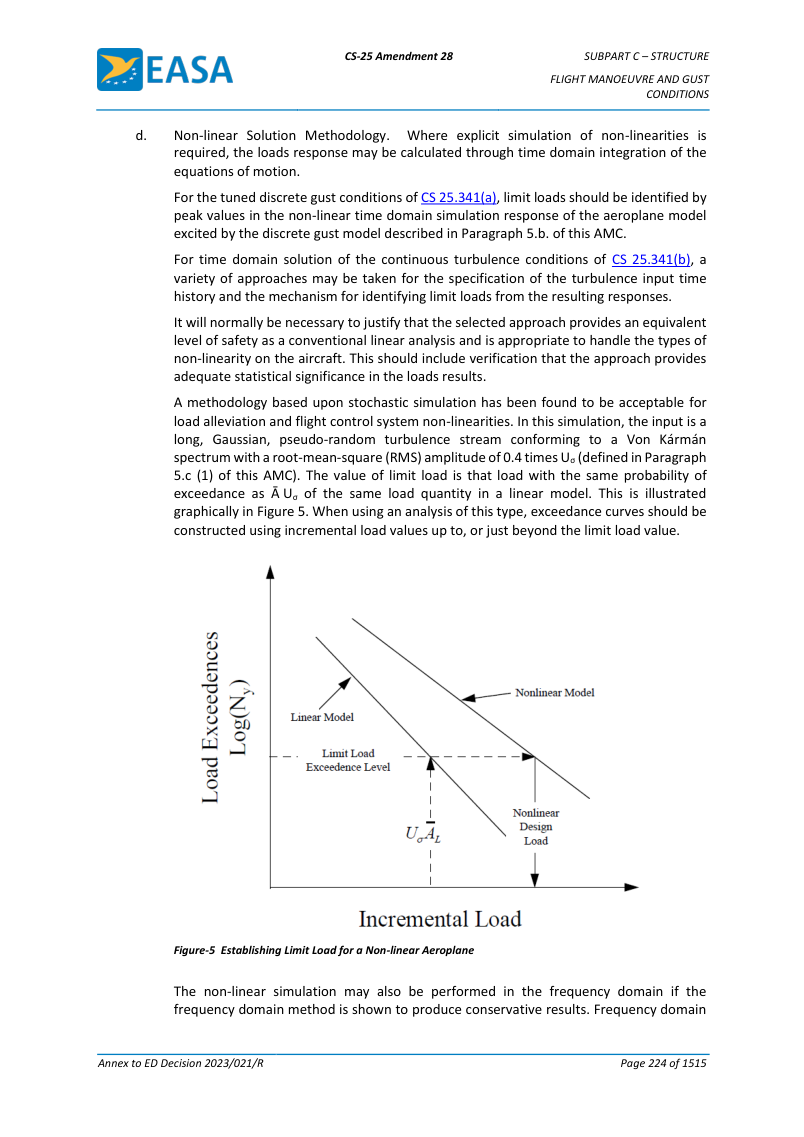
A methodology based upon stochastic simulation has been found to be acceptable for load alleviation and flight control system non-linearities. In this simulation, the input is a long, Gaussian, pseudo-random turbulence stream conforming to a Von Kármán spectrum with a root-mean-square (RMS) amplitude of 0.4 times Uσ (defined in Paragraph 5.c (1) of this AMC). The value of limit load is that load with the same probability of exceedance as Ā Uσ of the same load quantity in a linear model. This is illustrated graphically in Figure 5. When using an analysis of this type, exceedance curves should be constructed using incremental load values up to, or just beyond the limit load value.
Figure-5 Establishing Limit Load for a Non-linear Aeroplane
The non-linear simulation may also be performed in the frequency domain if the frequency domain method is shown to produce conservative results. Frequency domain
View figures, tables and original page layout
Connected references
Source-backed citations and subject-based engineering context are labelled separately. These links do not establish equivalence or project acceptance.
Listed as related material by
Source-backedEvidence and scope
AMC 20-152A §8(a)(2)
Lists CS-25 without an amendment or specific paragraph.
Family reference; does not select a certification basis.
Supporting source