
CS-25
Large Aeroplanes
Amendment 28; corrected 20 November 2025 Source checked 2026-11-28
Scope, source and reading notes
Complete official CS-25 Amendment 28, including AMC and appendices.
Aerospace Consulting reference note: Certification specifications and acceptable means of compliance for large aeroplanes, using the corrected official publication.
The complete selected publication is available in reading text and as the original PDF. Reading text is extracted from the official PDF; page layout is simplified, and figures and tables should be checked in the original page view.
Search covers extracted text. Words contained only in graphics may not be searchable. The original publication is available below.
Official source recordOriginal PDF on this siteSource: EASA. Reproduced with source acknowledgment; source edition and status are shown above. SHA-256: 32f1a9acf26e8ceceb291d206bf07a7071f7f59f40f10c096bb17f34c6a58007
approved load spectrum (such as used in satisfying the requirements of CS 25.571) for the duration specified in Table 1. Average material properties may be used.
(cc) For the windmilling phase, crack growth should be calculated for the
diversion profile starting from the crack length calculated in paragraph 5c(4)(b)2(bb) above. The diversion profile should be consistent with the AFM recommended operation accounting for transient exposure to peak vibrations as well as the more sustained exposures to vibrations. Average material properties may be used.
(dd) The residual strength for the structure with damage equal to the crack
length calculated in paragraph 5c(4)(b)2(cc) above should be shown capable of sustaining the combined loading conditions defined in paragraph 5c(3)(a) above with a factor of safety of 1.0.
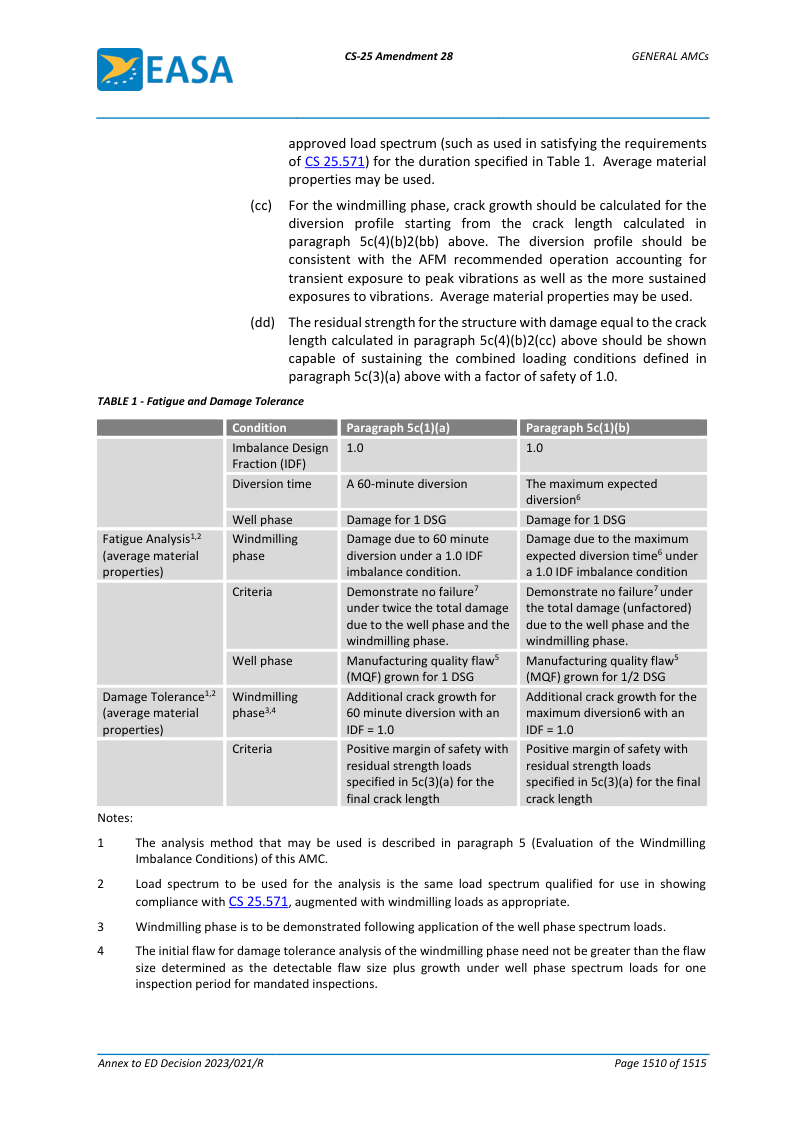
TABLE 1 - Fatigue and Damage Tolerance
1.0 1.0
Condition Paragraph 5c(1)(a) Paragraph 5c(1)(b) Imbalance Design Fraction (IDF)
Diversion time A 60-minute diversion The maximum expected diversion6 Well phase Damage for 1 DSG Damage for 1 DSG Fatigue Analysis1,2
Windmilling phase
(average material properties)
Damage due to 60 minute diversion under a 1.0 IDF imbalance condition.
Criteria Demonstrate no failure7
Damage due to the maximum expected diversion time6 under a 1.0 IDF imbalance condition
under twice the total damage due to the well phase and the windmilling phase.
Demonstrate no failure7 under the total damage (unfactored) due to the well phase and the windmilling phase. Well phase Manufacturing quality flaw5 (MQF) grown for 1 DSG
Windmilling phase3,4
Manufacturing quality flaw5 (MQF) grown for 1/2 DSG Damage Tolerance1,2 (average material properties)
Additional crack growth for 60 minute diversion with an IDF = 1.0
Additional crack growth for the maximum diversion6 with an IDF = 1.0 Criteria Positive margin of safety with residual strength loads specified in 5c(3)(a) for the final crack length
Positive margin of safety with residual strength loads specified in 5c(3)(a) for the final crack length Notes:
1 The analysis method that may be used is described in paragraph 5 (Evaluation of the Windmilling Imbalance Conditions) of this AMC.
2 Load spectrum to be used for the analysis is the same load spectrum qualified for use in showing compliance with CS 25.571, augmented with windmilling loads as appropriate.
3 Windmilling phase is to be demonstrated following application of the well phase spectrum loads.
4 The initial flaw for damage tolerance analysis of the windmilling phase need not be greater than the flaw size determined as the detectable flaw size plus growth under well phase spectrum loads for one inspection period for mandated inspections.
View figures, tables and original page layout
Connected references
Source-backed citations and subject-based engineering context are labelled separately. These links do not establish equivalence or project acceptance.
Listed as related material by
Source-backedEvidence and scope
AMC 20-152A §8(a)(2)
Lists CS-25 without an amendment or specific paragraph.
Family reference; does not select a certification basis.
Supporting source