
CS-25
Large Aeroplanes
Amendment 28; corrected 20 November 2025 Source checked 2026-11-28
Scope, source and reading notes
Complete official CS-25 Amendment 28, including AMC and appendices.
Aerospace Consulting reference note: Certification specifications and acceptable means of compliance for large aeroplanes, using the corrected official publication.
The complete selected publication is available in reading text and as the original PDF. Reading text is extracted from the official PDF; page layout is simplified, and figures and tables should be checked in the original page view.
Search covers extracted text. Words contained only in graphics may not be searchable. The original publication is available below.
Official source recordOriginal PDF on this siteSource: EASA. Reproduced with source acknowledgment; source edition and status are shown above. SHA-256: 32f1a9acf26e8ceceb291d206bf07a7071f7f59f40f10c096bb17f34c6a58007
confusion or errors, and do not adversely impact the intended function of the system(s) involved.
(c) If colour is used for coding it is considered good practice to use six colours or less for coding parameters. Each coded colour should have sufficient chrominance separation so it is identifiable and distinguishable in all foreseeable lighting and operating conditions and when used with other colours. Colours should be identifiable and distinguishable across the range of information element size, shape, and movement. The colours available for coding from an electronic display system should be carefully selected to maximise their chrominance separation. Colour combinations that are similar in luminance should be avoided (for example, Navy blue on black or yellow on white).
(d) Other graphic depictions such as terrain maps and synthetic vision presentations may use more than six colours and use colour blending techniques to represent colours in the outside world or to emphasize terrain features. These displays are often presented as background imagery and the colours used in the displays should not interfere with the flight crew interpretation of overlaid information parameters as addressed in paragraph 31c(5)(e)1 of this chapter.
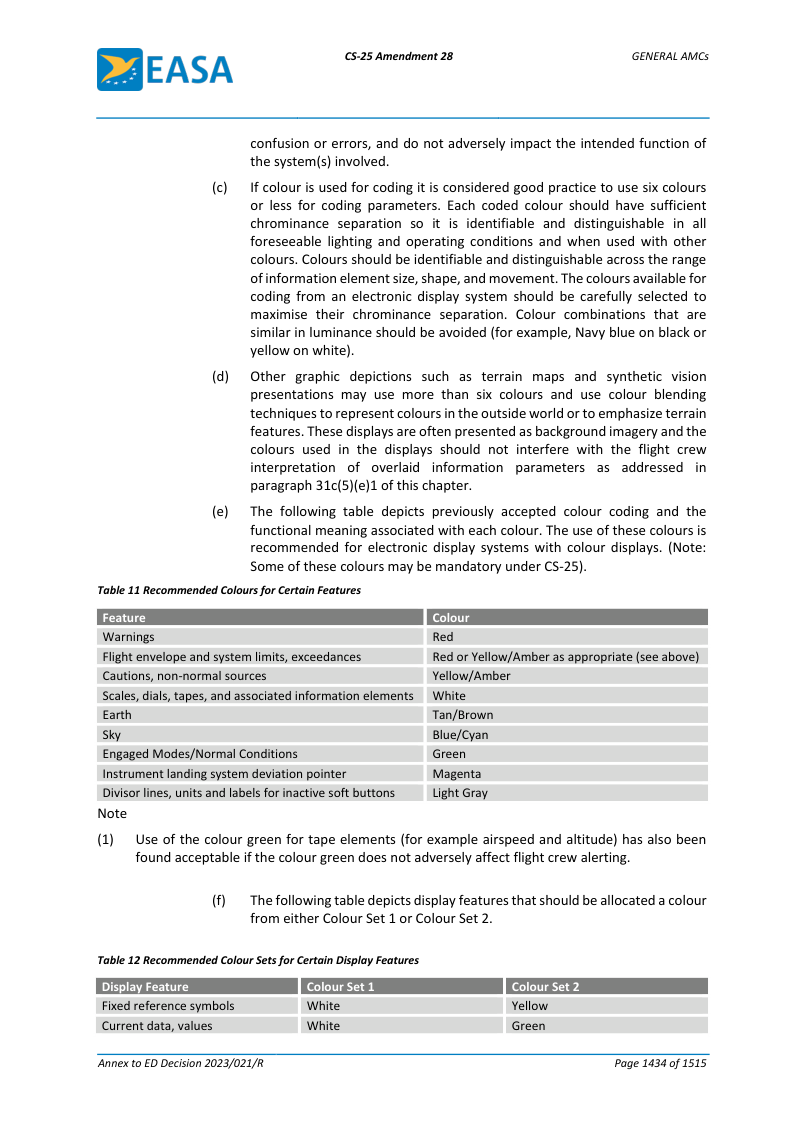
(e) The following table depicts previously accepted colour coding and the functional meaning associated with each colour. The use of these colours is recommended for electronic display systems with colour displays. (Note: Some of these colours may be mandatory under CS-25).
Table 11 Recommended Colours for Certain Features
Feature Colour Warnings Red Flight envelope and system limits, exceedances Red or Yellow/Amber as appropriate (see above) Cautions, non-normal sources Yellow/Amber Scales, dials, tapes, and associated information elements White Earth Tan/Brown Sky Blue/Cyan Engaged Modes/Normal Conditions Green Instrument landing system deviation pointer Magenta Divisor lines, units and labels for inactive soft buttons Light Gray Note
(1) Use of the colour green for tape elements (for example airspeed and altitude) has also been found acceptable if the colour green does not adversely affect flight crew alerting.
(f) The following table depicts display features that should be allocated a colour from either Colour Set 1 or Colour Set 2.
Table 12 Recommended Colour Sets for Certain Display Features
Display Feature Colour Set 1 Colour Set 2 Fixed reference symbols White Yellow Current data, values White Green
View figures, tables and original page layout
Connected references
Source-backed citations and subject-based engineering context are labelled separately. These links do not establish equivalence or project acceptance.
Listed as related material by
Source-backedEvidence and scope
AMC 20-152A §8(a)(2)
Lists CS-25 without an amendment or specific paragraph.
Family reference; does not select a certification basis.
Supporting source