
CS-25
Large Aeroplanes
Amendment 28; corrected 20 November 2025 Source checked 2026-11-28
Scope, source and reading notes
Complete official CS-25 Amendment 28, including AMC and appendices.
Aerospace Consulting reference note: Certification specifications and acceptable means of compliance for large aeroplanes, using the corrected official publication.
The complete selected publication is available in reading text and as the original PDF. Reading text is extracted from the official PDF; page layout is simplified, and figures and tables should be checked in the original page view.
Search covers extracted text. Words contained only in graphics may not be searchable. The original publication is available below.
Official source recordOriginal PDF on this siteSource: EASA. Reproduced with source acknowledgment; source edition and status are shown above. SHA-256: 32f1a9acf26e8ceceb291d206bf07a7071f7f59f40f10c096bb17f34c6a58007
for non-commercially operated aeroplanes and low-occupancy
aeroplanes
Calculation of additional passenger seating limitations due to exit deactivation
Firstly, a zonal analysis is conducted on the right side of the fuselage, in accordance with S25.10(d). Two zones are represented by the remaining functional exits on this side (all original emergency exits remain functional).
The allowable number of seats for installation between the forward Type C and the overwing exit is limited to one half of the sum of the ratings of the exits that bound the zone: 1/2 of 90 (55 + 35) = 45.
The same limit is also valid for the zone between the overwing emergency exit and the rearmost Type C exit. Secondly, a zonal analysis is conducted on the left side of the fuselage. Again, two zones are represented by the remaining functional emergency exits on this side, but this time, one zone is a so-called dead end zone.
As for the right side, it is acceptable to install 45 seats between the forward Type C and the overwing exit: 1/2 of 90 (55 + 35) = 45.
In the dead end zone aft of the overwing exit, it is acceptable to install a maximum of 18 seats (1/2 of 35 rounded up).
The passenger seating locations for taxiing, take-off, and landing should simultaneously satisfy all basic limitations set by S25.1(a) and both of the zonal analyses in accordance with S25.10(d).
Therefore, for non-commercial operations, this results in a maximum total seating capacity of 63 when it simultaneously satisfies the upper limit for each zone, i.e. 45 for the forward zone and 18 for the aft zone.
In case of commercial operations, the total capacity of the aeroplane will be limited to 48 passengers, not exceeding 30 passengers forward of and 18 aft of the overwing exits.
Further examples
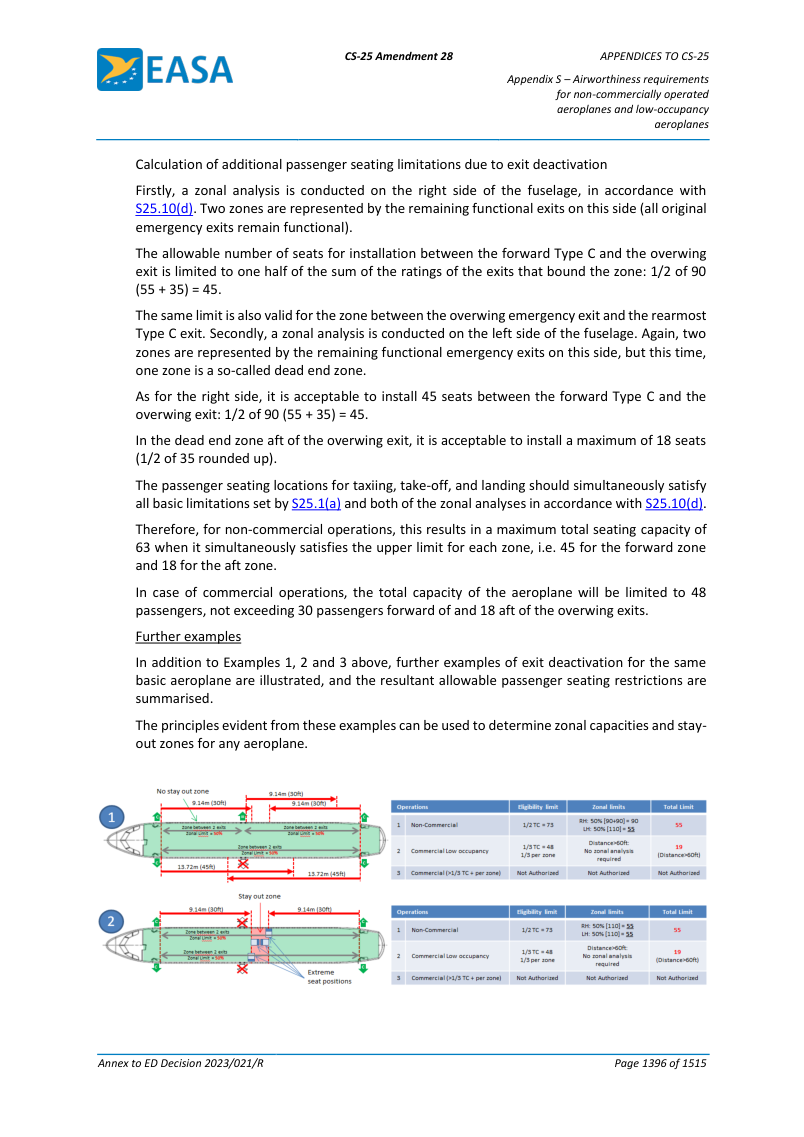
In addition to Examples 1, 2 and 3 above, further examples of exit deactivation for the same basic aeroplane are illustrated, and the resultant allowable passenger seating restrictions are summarised.
The principles evident from these examples can be used to determine zonal capacities and stay- out zones for any aeroplane.
View figures, tables and original page layout
Connected references
Source-backed citations and subject-based engineering context are labelled separately. These links do not establish equivalence or project acceptance.
Listed as related material by
Source-backedEvidence and scope
AMC 20-152A §8(a)(2)
Lists CS-25 without an amendment or specific paragraph.
Family reference; does not select a certification basis.
Supporting source