
CS-25
Large Aeroplanes
Amendment 28; corrected 20 November 2025 Source checked 2026-11-28
Scope, source and reading notes
Complete official CS-25 Amendment 28, including AMC and appendices.
Aerospace Consulting reference note: Certification specifications and acceptable means of compliance for large aeroplanes, using the corrected official publication.
The complete selected publication is available in reading text and as the original PDF. Reading text is extracted from the official PDF; page layout is simplified, and figures and tables should be checked in the original page view.
Search covers extracted text. Words contained only in graphics may not be searchable. The original publication is available below.
Official source recordOriginal PDF on this siteSource: EASA. Reproduced with source acknowledgment; source edition and status are shown above. SHA-256: 32f1a9acf26e8ceceb291d206bf07a7071f7f59f40f10c096bb17f34c6a58007
for non-commercially operated aeroplanes and low-occupancy
aeroplanes
and landing; however, passenger seats do not need to be considered as sleeping installations in this context);
(B) specialised rooms for which permanent occupation during the flight is unlikely (examples would include smoking rooms, cinema rooms, etc.);
(C) washrooms/bathrooms, although the intent of S25.10(c) will be met in any case, if they are compliant with CS 25.854; however, a shower cubicle does not need to be considered an isolated compartment;
(D) crew rest compartments; and
(E) galley compartments.
(ii) On the other hand, an isolated compartment, unless meeting one of the criteria in (i) above, will be accepted as being occupied for at least the majority of the flight time, thus providing for smoke/fire detection by the occupants, if any of the following conditions are met:
(A) it is the flight crew compartment
(B) all required cabin crew seats are located in the isolated compartment;
(C) the isolated compartment contains a crew station that due to its specialised purpose, is likely to be occupied for the majority of the flight time;
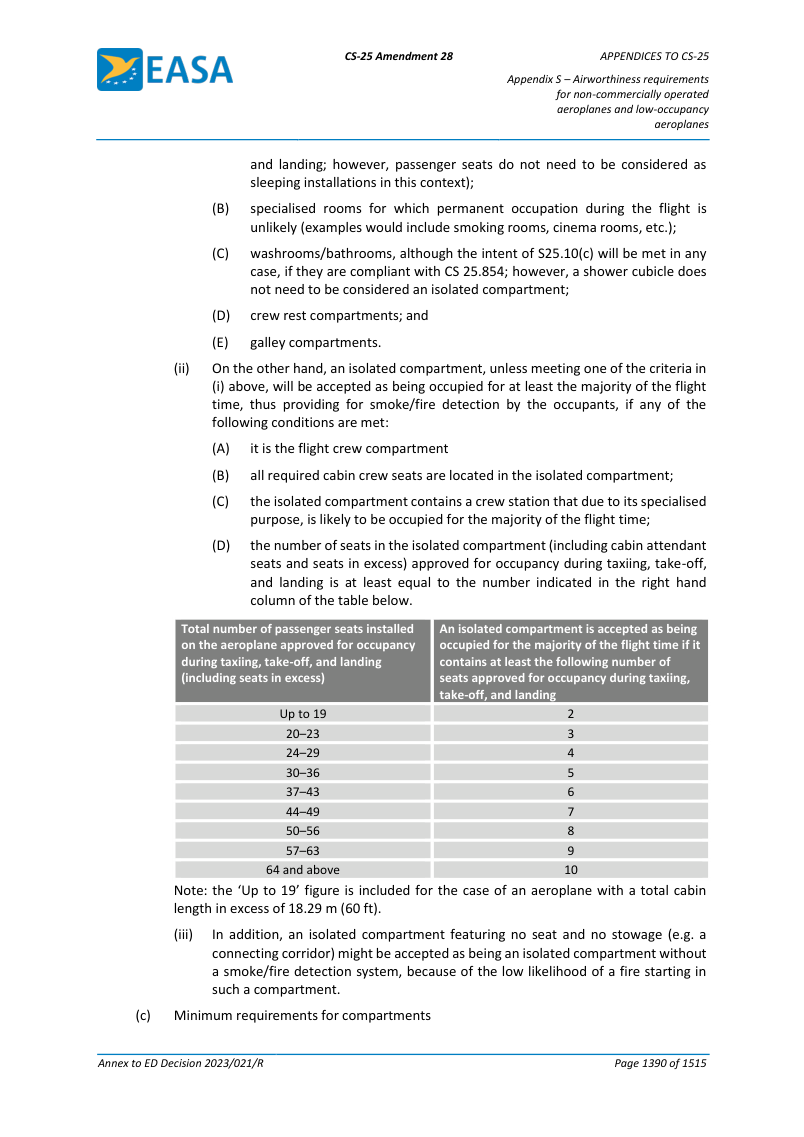
(D) the number of seats in the isolated compartment (including cabin attendant seats and seats in excess) approved for occupancy during taxiing, take-off, and landing is at least equal to the number indicated in the right hand column of the table below.
Total number of passenger seats installed on the aeroplane approved for occupancy during taxiing, take-off, and landing (including seats in excess)
An isolated compartment is accepted as being occupied for the majority of the flight time if it contains at least the following number of seats approved for occupancy during taxiing, take-off, and landing Up to 19 2 20–23 3 24–29 4 30–36 5 37–43 6 44–49 7 50–56 8 57–63 9 64 and above 10 Note: the ‘Up to 19’ figure is included for the case of an aeroplane with a total cabin length in excess of 18.29 m (60 ft).
(iii) In addition, an isolated compartment featuring no seat and no stowage (e.g. a connecting corridor) might be accepted as being an isolated compartment without a smoke/fire detection system, because of the low likelihood of a fire starting in such a compartment.
(c) Minimum requirements for compartments
View figures, tables and original page layout
Connected references
Source-backed citations and subject-based engineering context are labelled separately. These links do not establish equivalence or project acceptance.
Listed as related material by
Source-backedEvidence and scope
AMC 20-152A §8(a)(2)
Lists CS-25 without an amendment or specific paragraph.
Family reference; does not select a certification basis.
Supporting source