
CS-25
Large Aeroplanes
Amendment 28; corrected 20 November 2025 Source checked 2026-11-28
Scope, source and reading notes
Complete official CS-25 Amendment 28, including AMC and appendices.
Aerospace Consulting reference note: Certification specifications and acceptable means of compliance for large aeroplanes, using the corrected official publication.
The complete selected publication is available in reading text and as the original PDF. Reading text is extracted from the official PDF; page layout is simplified, and figures and tables should be checked in the original page view.
Search covers extracted text. Words contained only in graphics may not be searchable. The original publication is available below.
Official source recordOriginal PDF on this siteSource: EASA. Reproduced with source acknowledgment; source edition and status are shown above. SHA-256: 32f1a9acf26e8ceceb291d206bf07a7071f7f59f40f10c096bb17f34c6a58007
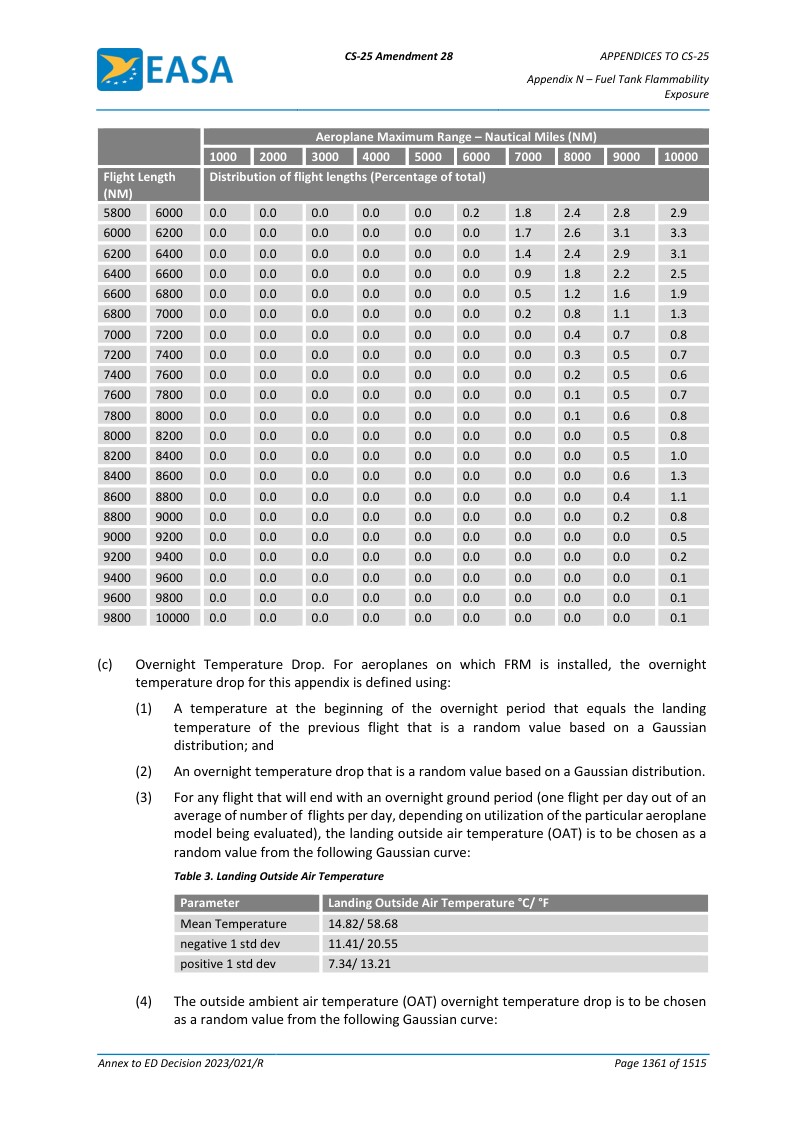
Aeroplane Maximum Range – Nautical Miles (NM) 1000 2000 3000 4000 5000 6000 7000 8000 9000 10000
Distribution of flight lengths (Percentage of total)
Flight Length (NM)
5800 6000 0.0 0.0 0.0 0.0 0.0 0.2 1.8 2.4 2.8 2.9
6000 6200 0.0 0.0 0.0 0.0 0.0 0.0 1.7 2.6 3.1 3.3
6200 6400 0.0 0.0 0.0 0.0 0.0 0.0 1.4 2.4 2.9 3.1
6400 6600 0.0 0.0 0.0 0.0 0.0 0.0 0.9 1.8 2.2 2.5
6600 6800 0.0 0.0 0.0 0.0 0.0 0.0 0.5 1.2 1.6 1.9
6800 7000 0.0 0.0 0.0 0.0 0.0 0.0 0.2 0.8 1.1 1.3
7000 7200 0.0 0.0 0.0 0.0 0.0 0.0 0.0 0.4 0.7 0.8
7200 7400 0.0 0.0 0.0 0.0 0.0 0.0 0.0 0.3 0.5 0.7
7400 7600 0.0 0.0 0.0 0.0 0.0 0.0 0.0 0.2 0.5 0.6
7600 7800 0.0 0.0 0.0 0.0 0.0 0.0 0.0 0.1 0.5 0.7
7800 8000 0.0 0.0 0.0 0.0 0.0 0.0 0.0 0.1 0.6 0.8
8000 8200 0.0 0.0 0.0 0.0 0.0 0.0 0.0 0.0 0.5 0.8
8200 8400 0.0 0.0 0.0 0.0 0.0 0.0 0.0 0.0 0.5 1.0
8400 8600 0.0 0.0 0.0 0.0 0.0 0.0 0.0 0.0 0.6 1.3
8600 8800 0.0 0.0 0.0 0.0 0.0 0.0 0.0 0.0 0.4 1.1
8800 9000 0.0 0.0 0.0 0.0 0.0 0.0 0.0 0.0 0.2 0.8
9000 9200 0.0 0.0 0.0 0.0 0.0 0.0 0.0 0.0 0.0 0.5
9200 9400 0.0 0.0 0.0 0.0 0.0 0.0 0.0 0.0 0.0 0.2
9400 9600 0.0 0.0 0.0 0.0 0.0 0.0 0.0 0.0 0.0 0.1
9600 9800 0.0 0.0 0.0 0.0 0.0 0.0 0.0 0.0 0.0 0.1
9800 10000 0.0 0.0 0.0 0.0 0.0 0.0 0.0 0.0 0.0 0.1
(c) Overnight Temperature Drop. For aeroplanes on which FRM is installed, the overnight temperature drop for this appendix is defined using:
(1) A temperature at the beginning of the overnight period that equals the landing temperature of the previous flight that is a random value based on a Gaussian distribution; and
(2) An overnight temperature drop that is a random value based on a Gaussian distribution.
(3) For any flight that will end with an overnight ground period (one flight per day out of an average of number of flights per day, depending on utilization of the particular aeroplane model being evaluated), the landing outside air temperature (OAT) is to be chosen as a random value from the following Gaussian curve:
Table 3. Landing Outside Air Temperature
Parameter Landing Outside Air Temperature °C/ °F
Mean Temperature 14.82/ 58.68
negative 1 std dev 11.41/ 20.55
positive 1 std dev 7.34/ 13.21
(4) The outside ambient air temperature (OAT) overnight temperature drop is to be chosen as a random value from the following Gaussian curve:
View figures, tables and original page layout
Connected references
Source-backed citations and subject-based engineering context are labelled separately. These links do not establish equivalence or project acceptance.
Listed as related material by
Source-backedEvidence and scope
AMC 20-152A §8(a)(2)
Lists CS-25 without an amendment or specific paragraph.
Family reference; does not select a certification basis.
Supporting source