
CS-25
Large Aeroplanes
Amendment 28; corrected 20 November 2025 Source checked 2026-11-28
Scope, source and reading notes
Complete official CS-25 Amendment 28, including AMC and appendices.
Aerospace Consulting reference note: Certification specifications and acceptable means of compliance for large aeroplanes, using the corrected official publication.
The complete selected publication is available in reading text and as the original PDF. Reading text is extracted from the official PDF; page layout is simplified, and figures and tables should be checked in the original page view.
Search covers extracted text. Words contained only in graphics may not be searchable. The original publication is available below.
Official source recordOriginal PDF on this siteSource: EASA. Reproduced with source acknowledgment; source edition and status are shown above. SHA-256: 32f1a9acf26e8ceceb291d206bf07a7071f7f59f40f10c096bb17f34c6a58007
(iv) Failures of the system that result in forced structural vibrations (oscillatory failures) must not produce loads that could result in detrimental deformation of primary structure.
(2) For the continuation of the flight. For the aeroplane, in the system failed state and considering any appropriate reconfiguration and flight limitations, the following apply:
(i) The loads derived from the following conditions at speeds up to VC / MC, or the speed limitation prescribed for the remainder of the flight must be determined:
(A) the limit symmetrical manoeuvring conditions specified in CS 25.331 and in CS 25.345.
(B) the limit gust and turbulence conditions specified in CS 25.341 and in CS 25.345.
(C) the limit rolling conditions specified in CS 25.349 and the limit unsymmetrical conditions specified in CS 25.367 and CS 25.427(b) and (c).
(D) the limit yaw manoeuvring conditions specified in CS 25.351.
(E) the limit ground loading conditions specified in CS 25.473 and CS 25.491.
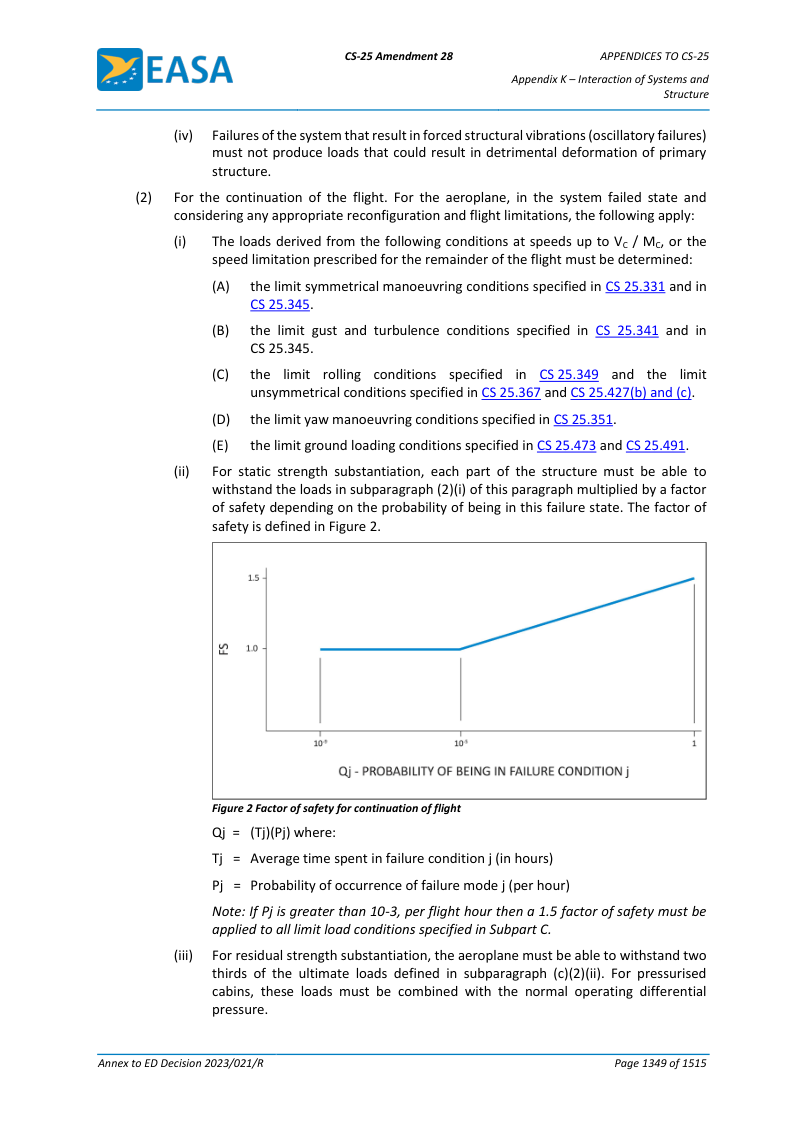
(ii) For static strength substantiation, each part of the structure must be able to withstand the loads in subparagraph (2)(i) of this paragraph multiplied by a factor of safety depending on the probability of being in this failure state. The factor of safety is defined in Figure 2.
Figure 2 Factor of safety for continuation of flight
Qj = (Tj)(Pj) where:
Tj = Average time spent in failure condition j (in hours)
Pj = Probability of occurrence of failure mode j (per hour)
Note: If Pj is greater than 10-3, per flight hour then a 1.5 factor of safety must be applied to all limit load conditions specified in Subpart C.
(iii) For residual strength substantiation, the aeroplane must be able to withstand two thirds of the ultimate loads defined in subparagraph (c)(2)(ii). For pressurised cabins, these loads must be combined with the normal operating differential pressure.
View figures, tables and original page layout
Connected references
Source-backed citations and subject-based engineering context are labelled separately. These links do not establish equivalence or project acceptance.
Listed as related material by
Source-backedEvidence and scope
AMC 20-152A §8(a)(2)
Lists CS-25 without an amendment or specific paragraph.
Family reference; does not select a certification basis.
Supporting source