
CS-25
Large Aeroplanes
Amendment 28; corrected 20 November 2025 Source checked 2026-11-28
Scope, source and reading notes
Complete official CS-25 Amendment 28, including AMC and appendices.
Aerospace Consulting reference note: Certification specifications and acceptable means of compliance for large aeroplanes, using the corrected official publication.
The complete selected publication is available in reading text and as the original PDF. Reading text is extracted from the official PDF; page layout is simplified, and figures and tables should be checked in the original page view.
Search covers extracted text. Words contained only in graphics may not be searchable. The original publication is available below.
Official source recordOriginal PDF on this siteSource: EASA. Reproduced with source acknowledgment; source edition and status are shown above. SHA-256: 32f1a9acf26e8ceceb291d206bf07a7071f7f59f40f10c096bb17f34c6a58007
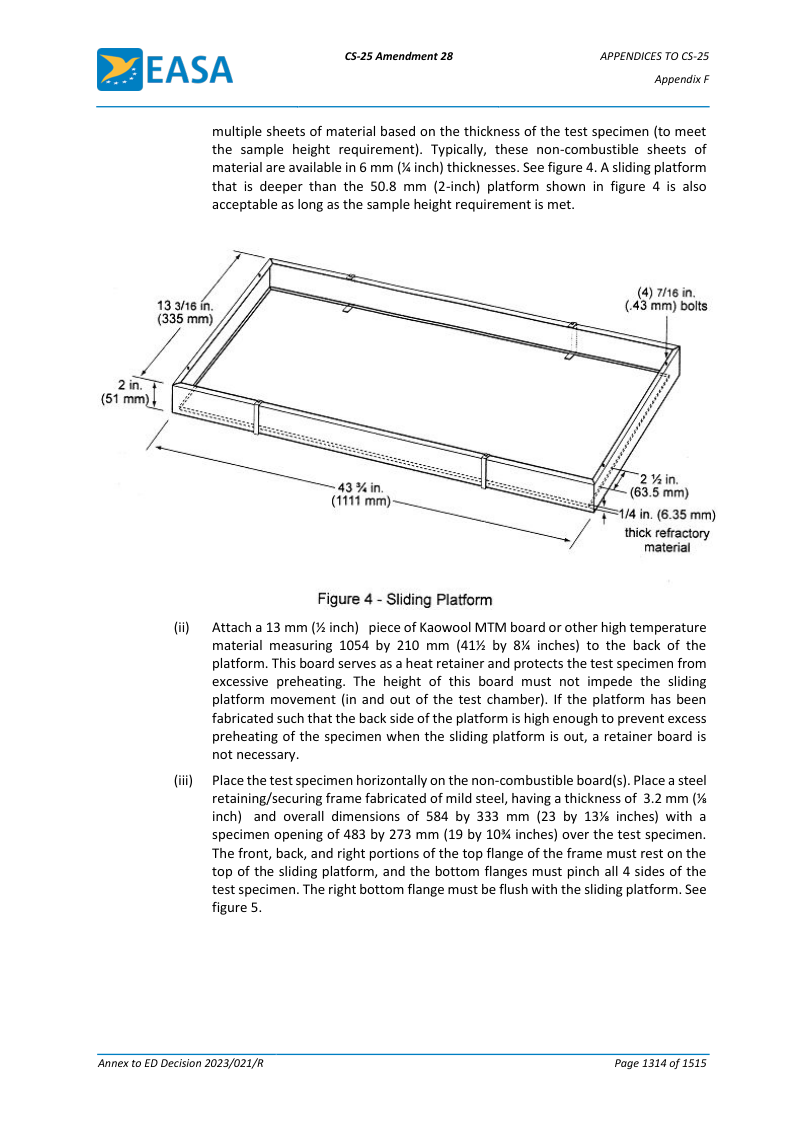
multiple sheets of material based on the thickness of the test specimen (to meet the sample height requirement). Typically, these non-combustible sheets of material are available in 6 mm (¼ inch) thicknesses. See figure 4. A sliding platform that is deeper than the 50.8 mm (2-inch) platform shown in figure 4 is also acceptable as long as the sample height requirement is met.
(ii) Attach a 13 mm (½ inch) piece of Kaowool MTM board or other high temperature material measuring 1054 by 210 mm (41½ by 8¼ inches) to the back of the platform. This board serves as a heat retainer and protects the test specimen from excessive preheating. The height of this board must not impede the sliding platform movement (in and out of the test chamber). If the platform has been fabricated such that the back side of the platform is high enough to prevent excess preheating of the specimen when the sliding platform is out, a retainer board is not necessary.
(iii) Place the test specimen horizontally on the non-combustible board(s). Place a steel retaining/securing frame fabricated of mild steel, having a thickness of 3.2 mm (⅛ inch) and overall dimensions of 584 by 333 mm (23 by 13⅛ inches) with a specimen opening of 483 by 273 mm (19 by 10¾ inches) over the test specimen. The front, back, and right portions of the top flange of the frame must rest on the top of the sliding platform, and the bottom flanges must pinch all 4 sides of the test specimen. The right bottom flange must be flush with the sliding platform. See figure 5.
View figures, tables and original page layout
Connected references
Source-backed citations and subject-based engineering context are labelled separately. These links do not establish equivalence or project acceptance.
Listed as related material by
Source-backedEvidence and scope
AMC 20-152A §8(a)(2)
Lists CS-25 without an amendment or specific paragraph.
Family reference; does not select a certification basis.
Supporting source