
CS-25
Large Aeroplanes
Amendment 28; corrected 20 November 2025 Source checked 2026-11-28
Scope, source and reading notes
Complete official CS-25 Amendment 28, including AMC and appendices.
Aerospace Consulting reference note: Certification specifications and acceptable means of compliance for large aeroplanes, using the corrected official publication.
The complete selected publication is available in reading text and as the original PDF. Reading text is extracted from the official PDF; page layout is simplified, and figures and tables should be checked in the original page view.
Search covers extracted text. Words contained only in graphics may not be searchable. The original publication is available below.
Official source recordOriginal PDF on this siteSource: EASA. Reproduced with source acknowledgment; source edition and status are shown above. SHA-256: 32f1a9acf26e8ceceb291d206bf07a7071f7f59f40f10c096bb17f34c6a58007
Such contaminant drag is an additional force that helps decelerate the aeroplane, thus reducing the distance needed to stop the aeroplane. As the contaminant drag increases with the contaminant depth, the deeper the contaminant is, the shorter the stopping distance will be. However, the actual contaminant depth may be less than the reported depth for the following reasons:
— contaminant depths are reported in runway surface condition reports using specific
depth increments;
— the procedure for reporting contaminant depths is to report the highest depth of the
contaminant along the reported portion of the runway surface; contaminant depths, however, may not be uniform over the whole runway surface (or reported portion of the runway surface), therefore, areas of lower contaminant depth are likely;
— in a stable weather environment (the contaminant is not replenished on the runway),
the contaminant depth is likely to decrease as successive aeroplanes use the runway displacing the contaminant; and
— contaminated conditions are reported starting from 25 % coverage in each runway
third; the total coverage of the runway with significant depths of contaminant may thus be less than 10 % of the entire runway surface.
If the actual contaminant depth is lower than the reported value, using the reported value to determine the contaminant drag will result in a higher drag level than the actual one, leading to an optimistic prediction of the stopping distance. Therefore, it is recommended not to include the effect of contaminant drag when calculating the landing distances for assessing the landing performance at the time of arrival. However, if the effect of contaminant drag is included, the applicant should limit it to no more than the drag resulting from 50 % of the reported depth.
If the effect of contaminant depth is included in the landing-distance data, the applicant should provide data for up to the maximum depth of each runway contaminant, for which landing operations are permitted. When determining the maximum depth of runway contaminants, the applicant may need to consider the maximum depth for which the engine air intakes are shown to be free of hazardous ingestion of water in accordance with CS 25.1091(d)(2).
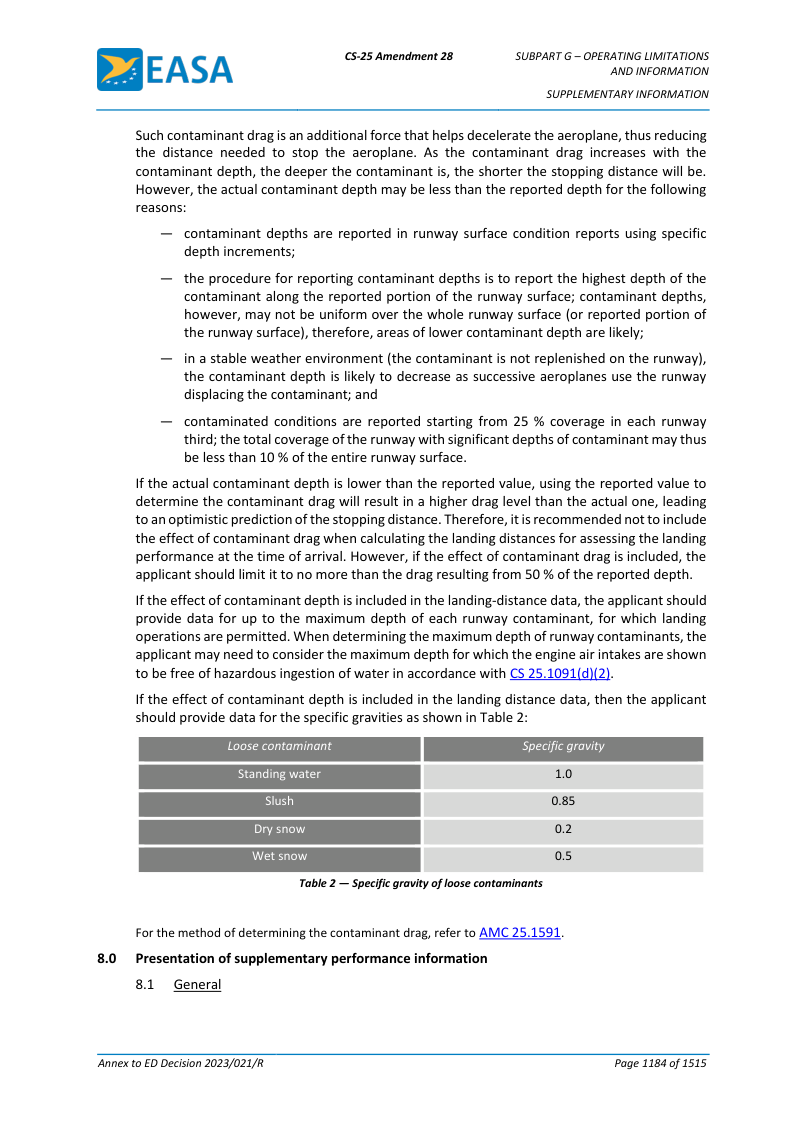
If the effect of contaminant depth is included in the landing distance data, then the applicant should provide data for the specific gravities as shown in Table 2:
Loose contaminant Specific gravity
Standing water 1.0
Slush 0.85
Dry snow 0.2
Wet snow 0.5
Table 2 — Specific gravity of loose contaminants
For the method of determining the contaminant drag, refer to AMC 25.1591.
8.0 Presentation of supplementary performance information
8.1 General
View figures, tables and original page layout
Connected references
Source-backed citations and subject-based engineering context are labelled separately. These links do not establish equivalence or project acceptance.
Listed as related material by
Source-backedEvidence and scope
AMC 20-152A §8(a)(2)
Lists CS-25 without an amendment or specific paragraph.
Family reference; does not select a certification basis.
Supporting source