
CS-25
Large Aeroplanes
Amendment 28; corrected 20 November 2025 Source checked 2026-11-28
Scope, source and reading notes
Complete official CS-25 Amendment 28, including AMC and appendices.
Aerospace Consulting reference note: Certification specifications and acceptable means of compliance for large aeroplanes, using the corrected official publication.
The complete selected publication is available in reading text and as the original PDF. Reading text is extracted from the official PDF; page layout is simplified, and figures and tables should be checked in the original page view.
Search covers extracted text. Words contained only in graphics may not be searchable. The original publication is available below.
Official source recordOriginal PDF on this siteSource: EASA. Reproduced with source acknowledgment; source edition and status are shown above. SHA-256: 32f1a9acf26e8ceceb291d206bf07a7071f7f59f40f10c096bb17f34c6a58007
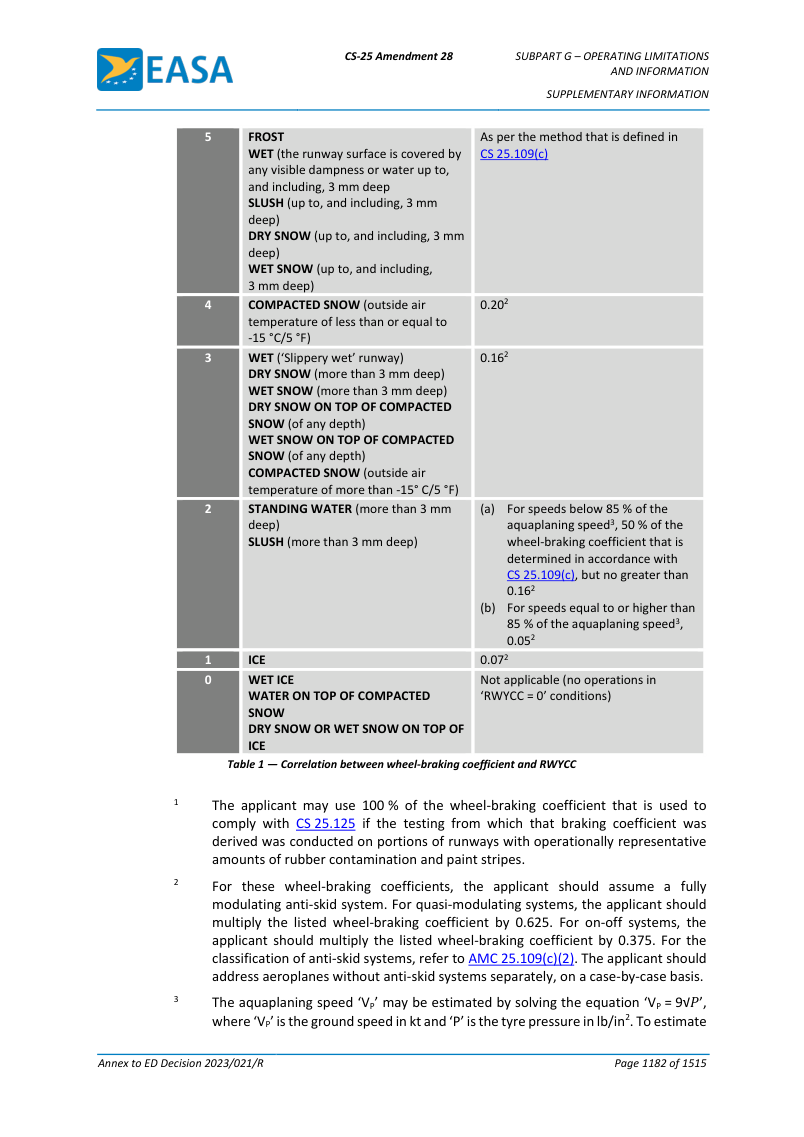
As per the method that is defined in CS 25.109(c)
5 FROST WET (the runway surface is covered by any visible dampness or water up to, and including, 3 mm deep SLUSH (up to, and including, 3 mm deep) DRY SNOW (up to, and including, 3 mm deep) WET SNOW (up to, and including, 3 mm deep)
0.202
4 COMPACTED SNOW (outside air temperature of less than or equal to -15 °C/5 °F)
0.162
3 WET (‘Slippery wet’ runway) DRY SNOW (more than 3 mm deep) WET SNOW (more than 3 mm deep) DRY SNOW ON TOP OF COMPACTED SNOW (of any depth) WET SNOW ON TOP OF COMPACTED SNOW (of any depth) COMPACTED SNOW (outside air temperature of more than -15° C/5 °F)
(a) For speeds below 85 % of the
2 STANDING WATER (more than 3 mm deep) SLUSH (more than 3 mm deep)
aquaplaning speed3, 50 % of the wheel-braking coefficient that is determined in accordance with CS 25.109(c), but no greater than 0.162 (b) For speeds equal to or higher than
Not applicable (no operations in ‘RWYCC = 0’ conditions)
85 % of the aquaplaning speed3, 0.052 1 ICE 0.072 0 WET ICE WATER ON TOP OF COMPACTED SNOW DRY SNOW OR WET SNOW ON TOP OF ICE
Table 1 — Correlation between wheel-braking coefficient and RWYCC
1 The applicant may use 100 % of the wheel-braking coefficient that is used to comply with CS 25.125 if the testing from which that braking coefficient was derived was conducted on portions of runways with operationally representative amounts of rubber contamination and paint stripes.
2 For these wheel-braking coefficients, the applicant should assume a fully modulating anti-skid system. For quasi-modulating systems, the applicant should multiply the listed wheel-braking coefficient by 0.625. For on-off systems, the applicant should multiply the listed wheel-braking coefficient by 0.375. For the classification of anti-skid systems, refer to AMC 25.109(c)(2). The applicant should address aeroplanes without anti-skid systems separately, on a case-by-case basis.
3 The aquaplaning speed ‘VP’ may be estimated by solving the equation ‘VP = 9√𝑃’, where ‘VP’ is the ground speed in kt and ‘P’ is the tyre pressure in lb/in2. To estimate
View figures, tables and original page layout
Connected references
Source-backed citations and subject-based engineering context are labelled separately. These links do not establish equivalence or project acceptance.
Listed as related material by
Source-backedEvidence and scope
AMC 20-152A §8(a)(2)
Lists CS-25 without an amendment or specific paragraph.
Family reference; does not select a certification basis.
Supporting source