
CS-25
Large Aeroplanes
Amendment 28; corrected 20 November 2025 Source checked 2026-11-28
Scope, source and reading notes
Complete official CS-25 Amendment 28, including AMC and appendices.
Aerospace Consulting reference note: Certification specifications and acceptable means of compliance for large aeroplanes, using the corrected official publication.
The complete selected publication is available in reading text and as the original PDF. Reading text is extracted from the official PDF; page layout is simplified, and figures and tables should be checked in the original page view.
Search covers extracted text. Words contained only in graphics may not be searchable. The original publication is available below.
Official source recordOriginal PDF on this siteSource: EASA. Reproduced with source acknowledgment; source edition and status are shown above. SHA-256: 32f1a9acf26e8ceceb291d206bf07a7071f7f59f40f10c096bb17f34c6a58007
— pressure altitudes within the approved operational envelope for landing;
— weights up to the maximum take-off weight (MTOW);
— expected airspeeds at the runway threshold, including speeds up to the maximum
recommended final-approach speed, considering possible speed additives for winds and icing conditions;
— temperatures within the approved operational envelope for landing;
— operational correction factors for winds within the established operational limits of the
aeroplane for:
— no more than 50 % of the nominal wind components along the take-off path opposite
to the direction of landing; and
— no less than 150 % of nominal wind components along the take-off path in the
direction of landing;
— runway slopes within the approved operational envelope for landing; and
— icing conditions if CS 25.125(a)(2) applies.
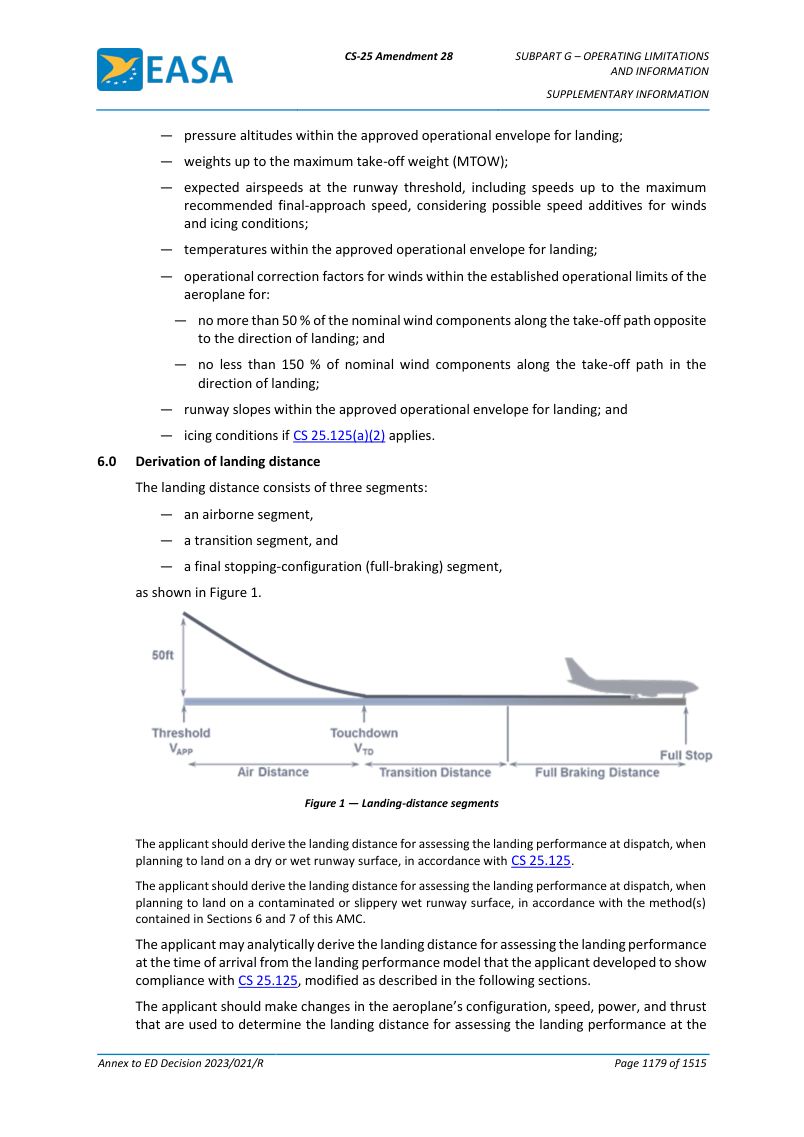
6.0 Derivation of landing distance
The landing distance consists of three segments:
— an airborne segment,
— a transition segment, and
— a final stopping-configuration (full-braking) segment,
as shown in Figure 1.
Figure 1 — Landing-distance segments
The applicant should derive the landing distance for assessing the landing performance at dispatch, when planning to land on a dry or wet runway surface, in accordance with CS 25.125.
The applicant should derive the landing distance for assessing the landing performance at dispatch, when planning to land on a contaminated or slippery wet runway surface, in accordance with the method(s) contained in Sections 6 and 7 of this AMC.
The applicant may analytically derive the landing distance for assessing the landing performance at the time of arrival from the landing performance model that the applicant developed to show compliance with CS 25.125, modified as described in the following sections.
The applicant should make changes in the aeroplane’s configuration, speed, power, and thrust that are used to determine the landing distance for assessing the landing performance at the
View figures, tables and original page layout
Connected references
Source-backed citations and subject-based engineering context are labelled separately. These links do not establish equivalence or project acceptance.
Listed as related material by
Source-backedEvidence and scope
AMC 20-152A §8(a)(2)
Lists CS-25 without an amendment or specific paragraph.
Family reference; does not select a certification basis.
Supporting source