
CS-25
Large Aeroplanes
Amendment 28; corrected 20 November 2025 Source checked 2026-11-28
Scope, source and reading notes
Complete official CS-25 Amendment 28, including AMC and appendices.
Aerospace Consulting reference note: Certification specifications and acceptable means of compliance for large aeroplanes, using the corrected official publication.
The complete selected publication is available in reading text and as the original PDF. Reading text is extracted from the official PDF; page layout is simplified, and figures and tables should be checked in the original page view.
Search covers extracted text. Words contained only in graphics may not be searchable. The original publication is available below.
Official source recordOriginal PDF on this siteSource: EASA. Reproduced with source acknowledgment; source edition and status are shown above. SHA-256: 32f1a9acf26e8ceceb291d206bf07a7071f7f59f40f10c096bb17f34c6a58007
runway friction. The runway friction is monitored and reported on a regular basis in accordance with national procedures.
4.9 Specific gravity
The density of the contaminant divided by the density of the water.
5.0 Contaminant Properties to be Considered
5.1 Range of Contaminants
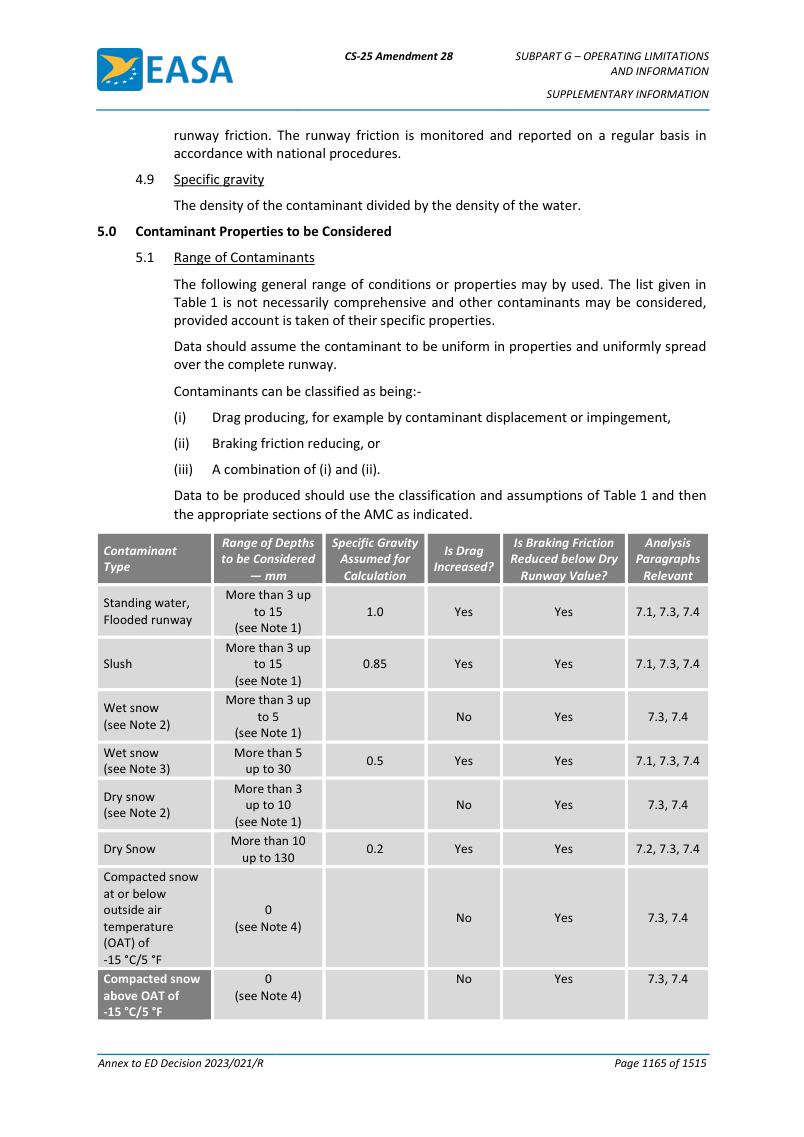
The following general range of conditions or properties may by used. The list given in Table 1 is not necessarily comprehensive and other contaminants may be considered, provided account is taken of their specific properties.
Data should assume the contaminant to be uniform in properties and uniformly spread over the complete runway.
Contaminants can be classified as being:-
(i) Drag producing, for example by contaminant displacement or impingement,
(ii) Braking friction reducing, or
(iii) A combination of (i) and (ii).
Data to be produced should use the classification and assumptions of Table 1 and then the appropriate sections of the AMC as indicated.
Specific Gravity
Range of Depths to be Considered
Assumed for
Is Braking Friction Reduced below Dry
Analysis Paragraphs
Contaminant Type
Is Drag Increased?
— mm
Calculation
Runway Value?
Relevant
More than 3 up
1.0 Yes Yes 7.1, 7.3, 7.4
Standing water, Flooded runway
to 15 (see Note 1)
More than 3 up
Slush
0.85 Yes Yes 7.1, 7.3, 7.4
to 15 (see Note 1)
More than 3 up
No Yes 7.3, 7.4
Wet snow (see Note 2)
to 5 (see Note 1)
More than 5
Wet snow (see Note 3)
up to 30 0.5 Yes Yes 7.1, 7.3, 7.4
More than 3
No Yes 7.3, 7.4
Dry snow (see Note 2)
up to 10 (see Note 1)
Dry Snow More than 10
up to 130 0.2 Yes Yes 7.2, 7.3, 7.4
0 (see Note 4) No Yes 7.3, 7.4
Compacted snow at or below outside air temperature (OAT) of -15 °C/5 °F
No Yes 7.3, 7.4
0 (see Note 4)
Compacted snow above OAT of -15 °C/5 °F
View figures, tables and original page layout
Connected references
Source-backed citations and subject-based engineering context are labelled separately. These links do not establish equivalence or project acceptance.
Listed as related material by
Source-backedEvidence and scope
AMC 20-152A §8(a)(2)
Lists CS-25 without an amendment or specific paragraph.
Family reference; does not select a certification basis.
Supporting source