
CS-25
Large Aeroplanes
Amendment 28; corrected 20 November 2025 Source checked 2026-11-28
Scope, source and reading notes
Complete official CS-25 Amendment 28, including AMC and appendices.
Aerospace Consulting reference note: Certification specifications and acceptable means of compliance for large aeroplanes, using the corrected official publication.
The complete selected publication is available in reading text and as the original PDF. Reading text is extracted from the official PDF; page layout is simplified, and figures and tables should be checked in the original page view.
Search covers extracted text. Words contained only in graphics may not be searchable. The original publication is available below.
Official source recordOriginal PDF on this siteSource: EASA. Reproduced with source acknowledgment; source edition and status are shown above. SHA-256: 32f1a9acf26e8ceceb291d206bf07a7071f7f59f40f10c096bb17f34c6a58007
(1) The accelerate-stop distance on a dry runway determined in accordance with sub- paragraph (a) of this paragraph; or
(2) The accelerate-stop distance determined in accordance with sub-paragraph (a) of this paragraph, except that the runway is wet and the corresponding wet runway values of VEF and V1 are used. In determining the wet runway accelerate-stop distance, the stopping force from the wheel brakes may never exceed:
(i) The wheel brakes stopping force determined in meeting the requirements of CS 25.101(i) and sub-paragraph (a) of this paragraph; and
(ii) The force resulting from the wet runway braking coefficient of friction determined in accordance with subparagraphs (c) or (d) of this paragraph, as applicable, taking into account the distribution of the normal load between braked and unbraked wheels at the most adverse centre of gravity position approved for take-off.
(c) The wet runway braking coefficient of friction for a smooth wet runway is defined as a curve of friction coefficient versus ground speed and must be computed as follows:
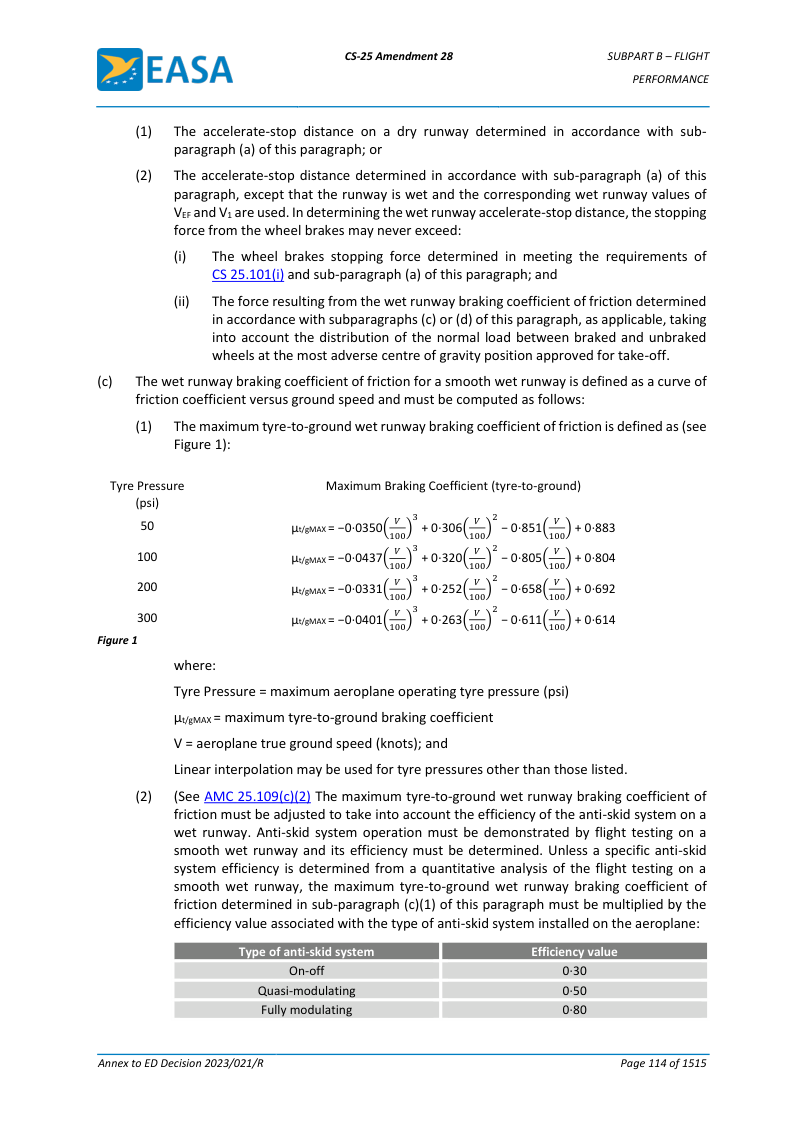
(1) The maximum tyre-to-ground wet runway braking coefficient of friction is defined as (see Figure 1):
Tyre Pressure
Maximum Braking Coefficient (tyre-to-ground)
(psi)
3
2
𝑉
𝑉
𝑉
50 µt/gMAX = −0⋅0350(
+ 0⋅306(
− 0⋅851(
100)
100)
100) + 0⋅883
3
2
𝑉
𝑉
𝑉
100 µt/gMAX = −0⋅0437(
+ 0⋅320(
− 0⋅805(
100)
100)
100) + 0⋅804
3
2
𝑉
𝑉
𝑉
200 µt/gMAX = −0⋅0331(
+ 0⋅252(
− 0⋅658(
100)
100)
100) + 0⋅692
3
2
𝑉
𝑉
𝑉
300 µt/gMAX = −0⋅0401(
+ 0⋅263(
− 0⋅611(
100)
100)
100) + 0⋅614
Figure 1
where:
Tyre Pressure = maximum aeroplane operating tyre pressure (psi)
µt/gMAX = maximum tyre-to-ground braking coefficient
V = aeroplane true ground speed (knots); and
Linear interpolation may be used for tyre pressures other than those listed.
(2) (See AMC 25.109(c)(2) The maximum tyre-to-ground wet runway braking coefficient of friction must be adjusted to take into account the efficiency of the anti-skid system on a wet runway. Anti-skid system operation must be demonstrated by flight testing on a smooth wet runway and its efficiency must be determined. Unless a specific anti-skid system efficiency is determined from a quantitative analysis of the flight testing on a smooth wet runway, the maximum tyre-to-ground wet runway braking coefficient of friction determined in sub-paragraph (c)(1) of this paragraph must be multiplied by the efficiency value associated with the type of anti-skid system installed on the aeroplane:
Type of anti-skid system Efficiency value On-off 0⋅30 Quasi-modulating 0⋅50 Fully modulating 0⋅80
View figures, tables and original page layout
Connected references
Source-backed citations and subject-based engineering context are labelled separately. These links do not establish equivalence or project acceptance.
Listed as related material by
Source-backedEvidence and scope
AMC 20-152A §8(a)(2)
Lists CS-25 without an amendment or specific paragraph.
Family reference; does not select a certification basis.
Supporting source