
CS-25
Large Aeroplanes
Amendment 28; corrected 20 November 2025 Source checked 2026-11-28
Scope, source and reading notes
Complete official CS-25 Amendment 28, including AMC and appendices.
Aerospace Consulting reference note: Certification specifications and acceptable means of compliance for large aeroplanes, using the corrected official publication.
The complete selected publication is available in reading text and as the original PDF. Reading text is extracted from the official PDF; page layout is simplified, and figures and tables should be checked in the original page view.
Search covers extracted text. Words contained only in graphics may not be searchable. The original publication is available below.
Official source recordOriginal PDF on this siteSource: EASA. Reproduced with source acknowledgment; source edition and status are shown above. SHA-256: 32f1a9acf26e8ceceb291d206bf07a7071f7f59f40f10c096bb17f34c6a58007
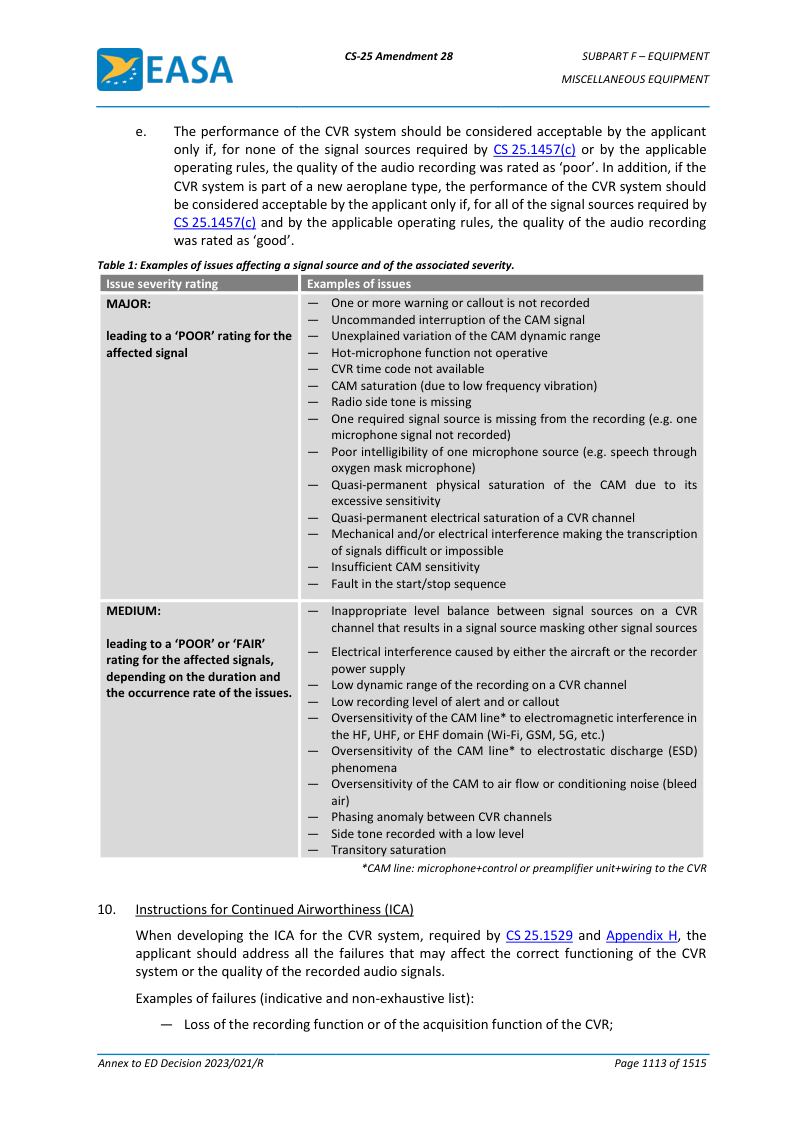
e. The performance of the CVR system should be considered acceptable by the applicant only if, for none of the signal sources required by CS 25.1457(c) or by the applicable operating rules, the quality of the audio recording was rated as ‘poor’. In addition, if the CVR system is part of a new aeroplane type, the performance of the CVR system should be considered acceptable by the applicant only if, for all of the signal sources required by CS 25.1457(c) and by the applicable operating rules, the quality of the audio recording was rated as ‘good’.
Table 1: Examples of issues affecting a signal source and of the associated severity.
Issue severity rating Examples of issues MAJOR:
leading to a ‘POOR’ rating for the affected signal
— One or more warning or callout is not recorded — Uncommanded interruption of the CAM signal — Unexplained variation of the CAM dynamic range — Hot-microphone function not operative — CVR time code not available — CAM saturation (due to low frequency vibration) — Radio side tone is missing — One required signal source is missing from the recording (e.g. one
microphone signal not recorded) — Poor intelligibility of one microphone source (e.g. speech through
oxygen mask microphone) — Quasi-permanent physical saturation of the CAM due to its
excessive sensitivity — Quasi-permanent electrical saturation of a CVR channel — Mechanical and/or electrical interference making the transcription
of signals difficult or impossible — Insufficient CAM sensitivity — Fault in the start/stop sequence
MEDIUM:
— Inappropriate level balance between signal sources on a CVR
channel that results in a signal source masking other signal sources
— Electrical interference caused by either the aircraft or the recorder
leading to a ‘POOR’ or ‘FAIR’ rating for the affected signals, depending on the duration and the occurrence rate of the issues.
power supply — Low dynamic range of the recording on a CVR channel — Low recording level of alert and or callout — Oversensitivity of the CAM line* to electromagnetic interference in
the HF, UHF, or EHF domain (Wi-Fi, GSM, 5G, etc.) — Oversensitivity of the CAM line* to electrostatic discharge (ESD)
phenomena — Oversensitivity of the CAM to air flow or conditioning noise (bleed
air) — Phasing anomaly between CVR channels — Side tone recorded with a low level — Transitory saturation
*CAM line: microphone+control or preamplifier unit+wiring to the CVR
10. Instructions for Continued Airworthiness (ICA)
When developing the ICA for the CVR system, required by CS 25.1529 and Appendix H, the applicant should address all the failures that may affect the correct functioning of the CVR system or the quality of the recorded audio signals.
Examples of failures (indicative and non-exhaustive list):
— Loss of the recording function or of the acquisition function of the CVR;
View figures, tables and original page layout
Connected references
Source-backed citations and subject-based engineering context are labelled separately. These links do not establish equivalence or project acceptance.
Listed as related material by
Source-backedEvidence and scope
AMC 20-152A §8(a)(2)
Lists CS-25 without an amendment or specific paragraph.
Family reference; does not select a certification basis.
Supporting source