
CS-25
Large Aeroplanes
Amendment 28; corrected 20 November 2025 Source checked 2026-11-28
Scope, source and reading notes
Complete official CS-25 Amendment 28, including AMC and appendices.
Aerospace Consulting reference note: Certification specifications and acceptable means of compliance for large aeroplanes, using the corrected official publication.
The complete selected publication is available in reading text and as the original PDF. Reading text is extracted from the official PDF; page layout is simplified, and figures and tables should be checked in the original page view.
Search covers extracted text. Words contained only in graphics may not be searchable. The original publication is available below.
Official source recordOriginal PDF on this siteSource: EASA. Reproduced with source acknowledgment; source edition and status are shown above. SHA-256: 32f1a9acf26e8ceceb291d206bf07a7071f7f59f40f10c096bb17f34c6a58007
— Procedures should address the precautions that should be taken to avoid
injuries which could be caused by an unintended deployment during emergency evacuation;
— Information that addresses the precautions to be taken by search-and-rescue
services after an accident should be publicly available; and
— The deployment mechanism should only release the recorder in one piece.
d. There may be a means to manually disengage the deployment capability when the aeroplane is not capable of moving under its own power; however, in this case, an alert should be provided to the flight crew during the pre-flight checks if the deployment capability is disengaged;
e. The deployable recorder installation should be such as to guarantee the highest probability of the deployment of the recorder in the event of an explosion or a collision. In particular, the installation and the performance of the deployment capability should be such that, in most cases of collision, the deployment of the recorder can take place before the deployment mechanism is damaged. However, the installation should be such that, to the extent possible, the recorder does not deploy in a non-catastrophic occurrence such as a hard landing or a tail strike.
f. The demonstration of compliance with CS 25.1457(e) should cover the whole flight envelope of the aeroplane, and additional trajectories that might be expected during the initial stages of an accident sequence.
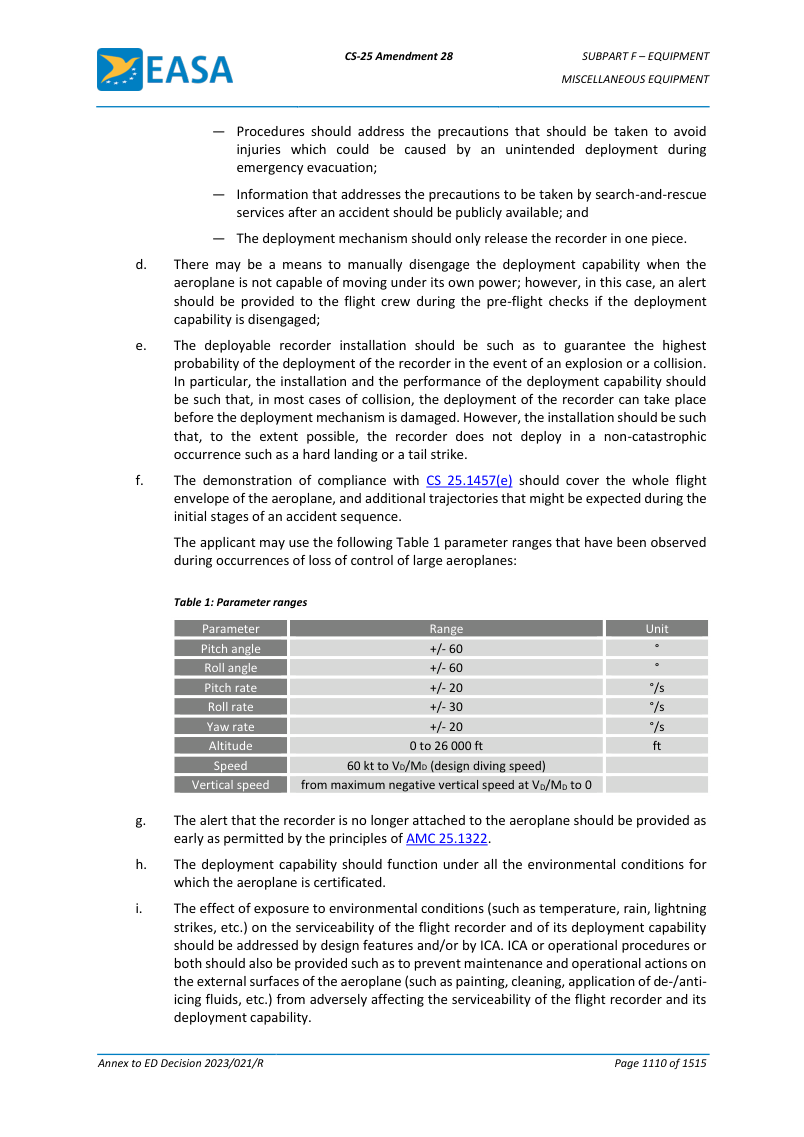
The applicant may use the following Table 1 parameter ranges that have been observed during occurrences of loss of control of large aeroplanes:
Table 1: Parameter ranges
Parameter Range Unit Pitch angle +/- 60 ° Roll angle +/- 60 ° Pitch rate +/- 20 °/s Roll rate +/- 30 °/s Yaw rate +/- 20 °/s Altitude 0 to 26 000 ft ft Speed 60 kt to VD/MD (design diving speed)
Vertical speed from maximum negative vertical speed at VD/MD to 0
g. The alert that the recorder is no longer attached to the aeroplane should be provided as early as permitted by the principles of AMC 25.1322.
h. The deployment capability should function under all the environmental conditions for which the aeroplane is certificated.
i. The effect of exposure to environmental conditions (such as temperature, rain, lightning strikes, etc.) on the serviceability of the flight recorder and of its deployment capability should be addressed by design features and/or by ICA. ICA or operational procedures or both should also be provided such as to prevent maintenance and operational actions on the external surfaces of the aeroplane (such as painting, cleaning, application of de-/anti- icing fluids, etc.) from adversely affecting the serviceability of the flight recorder and its deployment capability.
View figures, tables and original page layout
Connected references
Source-backed citations and subject-based engineering context are labelled separately. These links do not establish equivalence or project acceptance.
Listed as related material by
Source-backedEvidence and scope
AMC 20-152A §8(a)(2)
Lists CS-25 without an amendment or specific paragraph.
Family reference; does not select a certification basis.
Supporting source