
CS-29
Large Rotorcraft
Amendment 12 Source checked 2026-11-28
Scope, source and reading notes
Complete Easy Access Rules consolidation of CS-29 Amendment 12.
Aerospace Consulting reference note: Certification specifications and related compliance guidance for large rotorcraft, including the Amendment 12 vibration health monitoring provisions.
The complete selected publication is available in reading text and as the original PDF. Reading text is extracted from the official PDF; page layout is simplified, and figures and tables should be checked in the original page view.
Search covers extracted text. Words contained only in graphics may not be searchable. The original publication is available below.
Official source recordOriginal PDF on this siteSource: EASA. Reproduced with source acknowledgment; source edition and status are shown above. SHA-256: 37c3d4af295ea3ec222370e326c63753dabcbf00735cf671f3ad86e9d46cba66
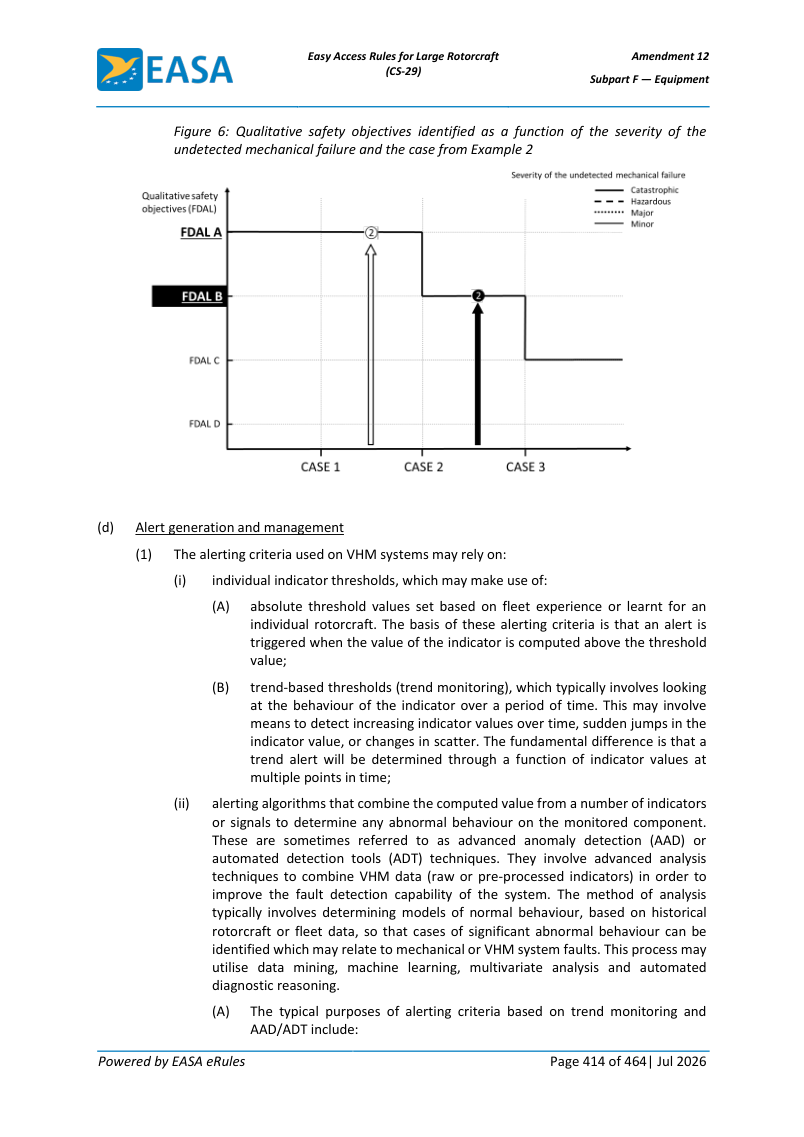
Figure 6: Qualitative safety objectives identified as a function of the severity of the undetected mechanical failure and the case from Example 2
(d) Alert generation and management
(1) The alerting criteria used on VHM systems may rely on:
(i) individual indicator thresholds, which may make use of:
(A) absolute threshold values set based on fleet experience or learnt for an individual rotorcraft. The basis of these alerting criteria is that an alert is triggered when the value of the indicator is computed above the threshold value;
(B) trend-based thresholds (trend monitoring), which typically involves looking at the behaviour of the indicator over a period of time. This may involve means to detect increasing indicator values over time, sudden jumps in the indicator value, or changes in scatter. The fundamental difference is that a trend alert will be determined through a function of indicator values at multiple points in time;
(ii) alerting algorithms that combine the computed value from a number of indicators or signals to determine any abnormal behaviour on the monitored component. These are sometimes referred to as advanced anomaly detection (AAD) or automated detection tools (ADT) techniques. They involve advanced analysis techniques to combine VHM data (raw or pre-processed indicators) in order to improve the fault detection capability of the system. The method of analysis typically involves determining models of normal behaviour, based on historical rotorcraft or fleet data, so that cases of significant abnormal behaviour can be identified which may relate to mechanical or VHM system faults. This process may utilise data mining, machine learning, multivariate analysis and automated diagnostic reasoning.
(A) The typical purposes of alerting criteria based on trend monitoring and AAD/ADT include:
View figures, tables and original page layout
Connected references
Source-backed citations and subject-based engineering context are labelled separately. These links do not establish equivalence or project acceptance.
Related technical context
Engineering contextEvidence and scope
CS-29 and AC 29-2C — published scope
Aerospace Consulting navigation suggestion based on the subject and stated scope of the two publications.
This connection does not establish regulatory equivalence, acceptance of a newer edition, or applicability of a project-specific precedent to another programme.
Supporting source