
CS-29
Large Rotorcraft
Amendment 12 Source checked 2026-11-28
Scope, source and reading notes
Complete Easy Access Rules consolidation of CS-29 Amendment 12.
Aerospace Consulting reference note: Certification specifications and related compliance guidance for large rotorcraft, including the Amendment 12 vibration health monitoring provisions.
The complete selected publication is available in reading text and as the original PDF. Reading text is extracted from the official PDF; page layout is simplified, and figures and tables should be checked in the original page view.
Search covers extracted text. Words contained only in graphics may not be searchable. The original publication is available below.
Official source recordOriginal PDF on this siteSource: EASA. Reproduced with source acknowledgment; source edition and status are shown above. SHA-256: 37c3d4af295ea3ec222370e326c63753dabcbf00735cf671f3ad86e9d46cba66
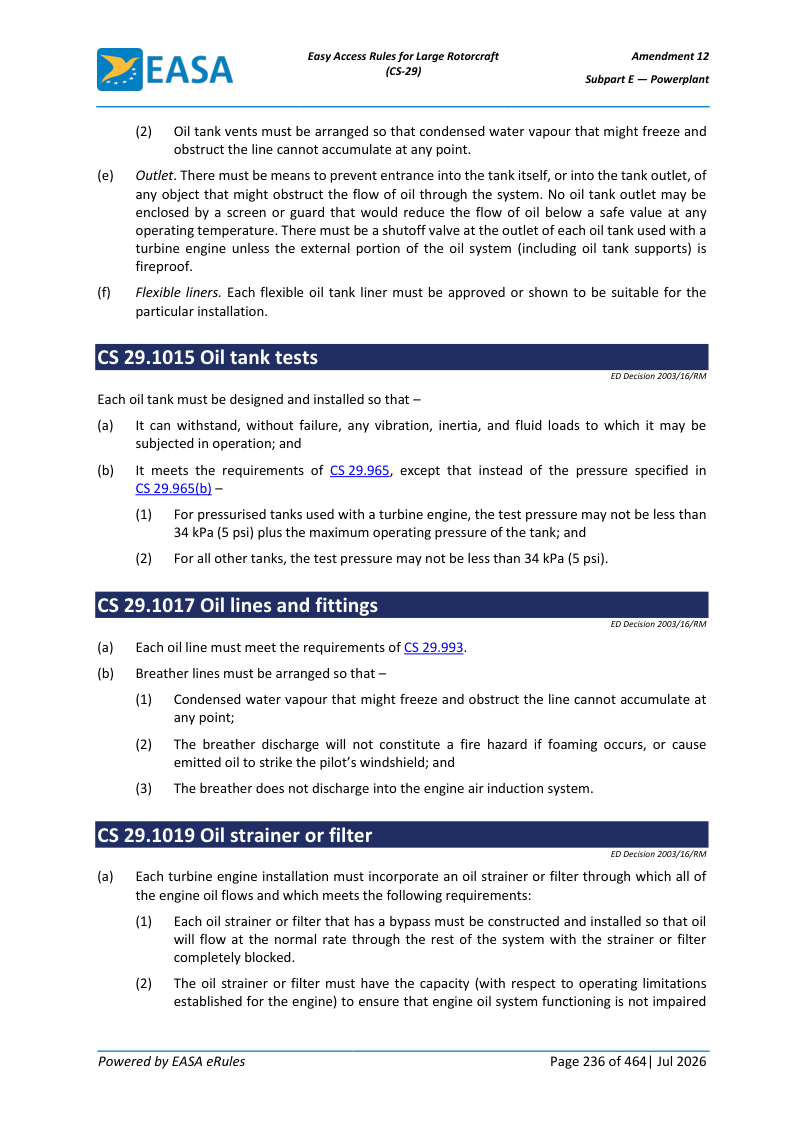
(2) Oil tank vents must be arranged so that condensed water vapour that might freeze and obstruct the line cannot accumulate at any point.
(e) Outlet. There must be means to prevent entrance into the tank itself, or into the tank outlet, of any object that might obstruct the flow of oil through the system. No oil tank outlet may be enclosed by a screen or guard that would reduce the flow of oil below a safe value at any operating temperature. There must be a shutoff valve at the outlet of each oil tank used with a turbine engine unless the external portion of the oil system (including oil tank supports) is fireproof.
(f) Flexible liners. Each flexible oil tank liner must be approved or shown to be suitable for the particular installation.
CS 29.1015 Oil tank tests
ED Decision 2003/16/RM
Each oil tank must be designed and installed so that –
(a) It can withstand, without failure, any vibration, inertia, and fluid loads to which it may be subjected in operation; and
(b) It meets the requirements of CS 29.965, except that instead of the pressure specified in CS 29.965(b) –
(1) For pressurised tanks used with a turbine engine, the test pressure may not be less than 34 kPa (5 psi) plus the maximum operating pressure of the tank; and
(2) For all other tanks, the test pressure may not be less than 34 kPa (5 psi).
CS 29.1017 Oil lines and fittings
ED Decision 2003/16/RM
(a) Each oil line must meet the requirements of CS 29.993.
(b) Breather lines must be arranged so that –
(1) Condensed water vapour that might freeze and obstruct the line cannot accumulate at any point;
(2) The breather discharge will not constitute a fire hazard if foaming occurs, or cause emitted oil to strike the pilot’s windshield; and
(3) The breather does not discharge into the engine air induction system.
CS 29.1019 Oil strainer or filter
ED Decision 2003/16/RM
(a) Each turbine engine installation must incorporate an oil strainer or filter through which all of the engine oil flows and which meets the following requirements:
(1) Each oil strainer or filter that has a bypass must be constructed and installed so that oil will flow at the normal rate through the rest of the system with the strainer or filter completely blocked.
(2) The oil strainer or filter must have the capacity (with respect to operating limitations established for the engine) to ensure that engine oil system functioning is not impaired
View figures, tables and original page layout
Connected references
Source-backed citations and subject-based engineering context are labelled separately. These links do not establish equivalence or project acceptance.
Related technical context
Engineering contextEvidence and scope
CS-29 and AC 29-2C — published scope
Aerospace Consulting navigation suggestion based on the subject and stated scope of the two publications.
This connection does not establish regulatory equivalence, acceptance of a newer edition, or applicability of a project-specific precedent to another programme.
Supporting source