
CS-29
Large Rotorcraft
Amendment 12 Source checked 2026-11-28
Scope, source and reading notes
Complete Easy Access Rules consolidation of CS-29 Amendment 12.
Aerospace Consulting reference note: Certification specifications and related compliance guidance for large rotorcraft, including the Amendment 12 vibration health monitoring provisions.
The complete selected publication is available in reading text and as the original PDF. Reading text is extracted from the official PDF; page layout is simplified, and figures and tables should be checked in the original page view.
Search covers extracted text. Words contained only in graphics may not be searchable. The original publication is available below.
Official source recordOriginal PDF on this siteSource: EASA. Reproduced with source acknowledgment; source edition and status are shown above. SHA-256: 37c3d4af295ea3ec222370e326c63753dabcbf00735cf671f3ad86e9d46cba66
(1) Be capable of extinguishing flames emanating from any burning of fluids or other combustible materials in the area protected by the fire extinguishing system; and
(2) Have thermal stability over the temperature range likely to be experienced in the compartment in which they are stored.
(b) If any toxic extinguishing agent is used, it must be shown by test that entry of harmful concentrations of fluid or fluid vapours into any personnel compartment (due to leakage during normal operation of the rotorcraft, or discharge on the ground or in flight) is prevented, even though a defect may exist in the extinguishing system.
AMC 29.1197 Fire extinguishing agents
ED Decision 2012/022/R
1. This AMC addresses alternatives to Halon and provides further guidance and acceptable means of compliance to supplement FAA AC 29-2C AC 29.1197. As such it should be used in conjunction with the FAA AC and take precedence over it in the showing of compliance.
2. The Montreal Protocol, in existence since 1987, is an international agreement to phase out production and use of ozone-depleting substances, including halogenated hydrocarbons also known as Halon. A European regulation1 governing substances that deplete the ozone layer was published in 2000 containing initial provisions for Halon phase-out, but also exemptions for critical uses of Halon, including fire extinguishing in aviation.
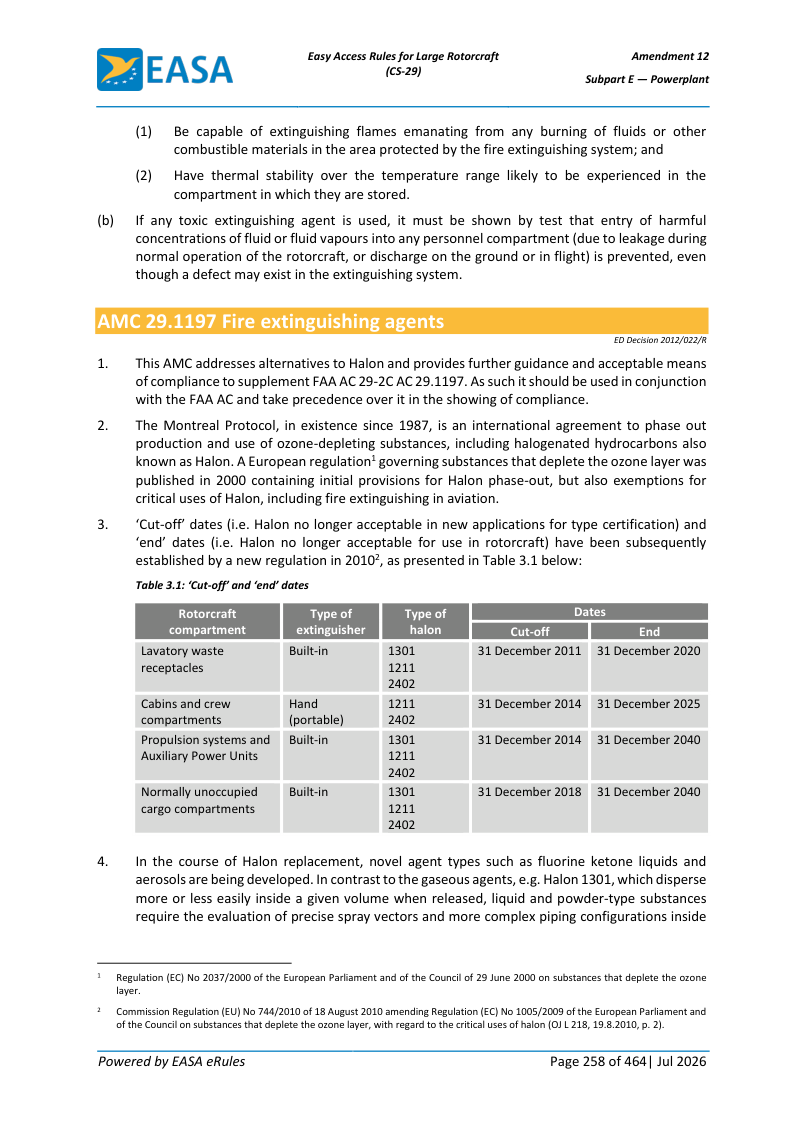
3. ‘Cut-off’ dates (i.e. Halon no longer acceptable in new applications for type certification) and ‘end’ dates (i.e. Halon no longer acceptable for use in rotorcraft) have been subsequently established by a new regulation in 20102, as presented in Table 3.1 below:
Table 3.1: ‘Cut-off’ and ‘end’ dates
Type of
Rotorcraft compartment
Type of extinguisher
halon
31 December 2011 31 December 2020
Dates Cut-off End Lavatory waste receptacles
Built-in 1301 1211 2402
31 December 2014 31 December 2025
Cabins and crew compartments
Hand (portable)
1211 2402
31 December 2014 31 December 2040
Propulsion systems and Auxiliary Power Units
Built-in 1301 1211 2402
31 December 2018 31 December 2040
Normally unoccupied cargo compartments
Built-in 1301 1211 2402
4. In the course of Halon replacement, novel agent types such as fluorine ketone liquids and aerosols are being developed. In contrast to the gaseous agents, e.g. Halon 1301, which disperse more or less easily inside a given volume when released, liquid and powder-type substances require the evaluation of precise spray vectors and more complex piping configurations inside
1 Regulation (EC) No 2037/2000 of the European Parliament and of the Council of 29 June 2000 on substances that deplete the ozone layer.
2 Commission Regulation (EU) No 744/2010 of 18 August 2010 amending Regulation (EC) No 1005/2009 of the European Parliament and of the Council on substances that deplete the ozone layer, with regard to the critical uses of halon (OJ L 218, 19.8.2010, p. 2).
View figures, tables and original page layout
Connected references
Source-backed citations and subject-based engineering context are labelled separately. These links do not establish equivalence or project acceptance.
Related technical context
Engineering contextEvidence and scope
CS-29 and AC 29-2C — published scope
Aerospace Consulting navigation suggestion based on the subject and stated scope of the two publications.
This connection does not establish regulatory equivalence, acceptance of a newer edition, or applicability of a project-specific precedent to another programme.
Supporting source