
CS-29
Large Rotorcraft
Amendment 12 Source checked 2026-11-28
Scope, source and reading notes
Complete Easy Access Rules consolidation of CS-29 Amendment 12.
Aerospace Consulting reference note: Certification specifications and related compliance guidance for large rotorcraft, including the Amendment 12 vibration health monitoring provisions.
The complete selected publication is available in reading text and as the original PDF. Reading text is extracted from the official PDF; page layout is simplified, and figures and tables should be checked in the original page view.
Search covers extracted text. Words contained only in graphics may not be searchable. The original publication is available below.
Official source recordOriginal PDF on this siteSource: EASA. Reproduced with source acknowledgment; source edition and status are shown above. SHA-256: 37c3d4af295ea3ec222370e326c63753dabcbf00735cf671f3ad86e9d46cba66
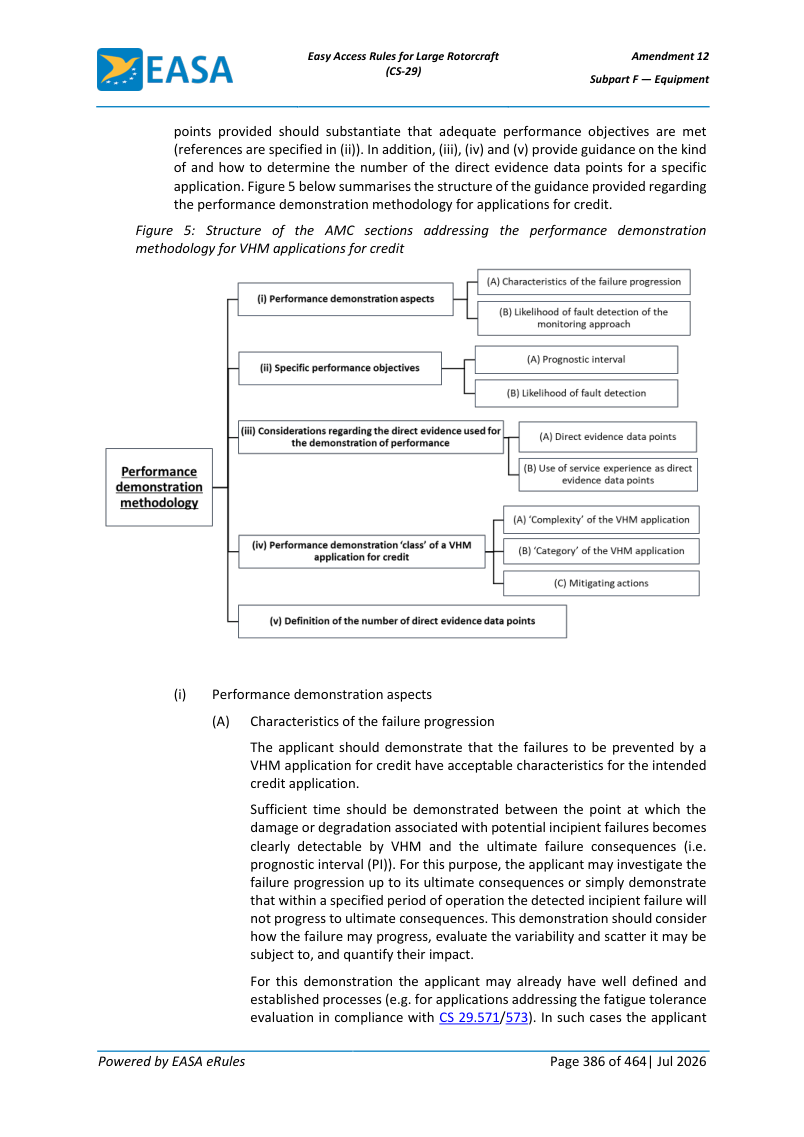
points provided should substantiate that adequate performance objectives are met (references are specified in (ii)). In addition, (iii), (iv) and (v) provide guidance on the kind of and how to determine the number of the direct evidence data points for a specific application. Figure 5 below summarises the structure of the guidance provided regarding the performance demonstration methodology for applications for credit.
Figure 5: Structure of the AMC sections addressing the performance demonstration methodology for VHM applications for credit
(i) Performance demonstration aspects
(A) Characteristics of the failure progression
The applicant should demonstrate that the failures to be prevented by a VHM application for credit have acceptable characteristics for the intended credit application.
Sufficient time should be demonstrated between the point at which the damage or degradation associated with potential incipient failures becomes clearly detectable by VHM and the ultimate failure consequences (i.e. prognostic interval (PI)). For this purpose, the applicant may investigate the failure progression up to its ultimate consequences or simply demonstrate that within a specified period of operation the detected incipient failure will not progress to ultimate consequences. This demonstration should consider how the failure may progress, evaluate the variability and scatter it may be subject to, and quantify their impact.
For this demonstration the applicant may already have well defined and established processes (e.g. for applications addressing the fatigue tolerance evaluation in compliance with CS 29.571/573). In such cases the applicant
View figures, tables and original page layout
Connected references
Source-backed citations and subject-based engineering context are labelled separately. These links do not establish equivalence or project acceptance.
Related technical context
Engineering contextEvidence and scope
CS-29 and AC 29-2C — published scope
Aerospace Consulting navigation suggestion based on the subject and stated scope of the two publications.
This connection does not establish regulatory equivalence, acceptance of a newer edition, or applicability of a project-specific precedent to another programme.
Supporting source