Certification of Normal Category Rotorcraft — Changes 1–9
Normal category rotorcraft guidance with Changes 1–9 incorporated. Search the complete AC or start with the system safety, flight controls and instrument-flight guidance.
This source includes guidance for different amendments of Part 27. Match the guidance to the aircraft’s agreed certification basis: the 27.1309 entries for Amendments 27-21, 27-46 and 27-51 are separate. The base AC was issued on 30 September 1999; Change 9 is dated 23 June 2023. The FAA catalogue’s 30 September 2008 date is not the date of the latest change.
The source, within reach.
Search within this AC, jump to a source page, or download the complete saved publication.
This extraction supports search. Read the original page for complete notation and layout.
2/4/2016 AC 27-1B, Chg 7
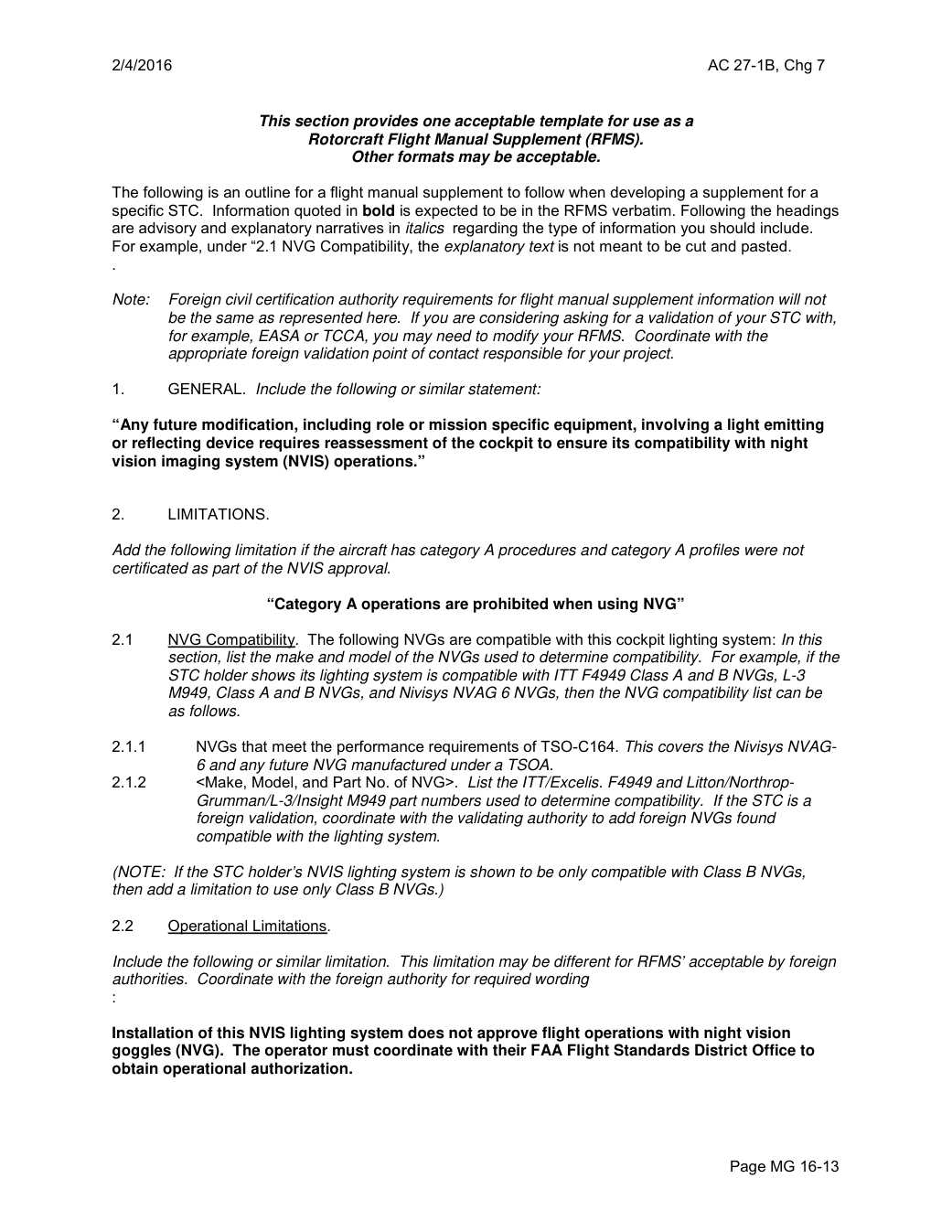
This section provides one acceptable template for use as a
Rotorcraft Flight Manual Supplement (RFMS).
Other formats may be acceptable.
The following is an outline for a flight manual supplement to follow when developing a supplement for a
specific STC. Information quoted in bold is expected to be in the RFMS verbatim. Following the headings
are advisory and explanatory narratives in italics regarding the type of information you should include.
For example, under “2.1 NVG Compatibility, the explanatory text is not meant to be cut and pasted.
.
Note: Foreign civil certification authority requirements for flight manual supplement information will not
be the same as represented here. If you are considering asking for a validation of your STC with,
for example, EASA or TCCA, you may need to modify your RFMS. Coordinate with the
appropriate foreign validation point of contact responsible for your project.
1. GENERAL. Include the following or similar statement:
“Any future modification, including role or mission specific equipment, involving a light emitting
or reflecting device requires reassessment of the cockpit to ensure its compatibility with night
vision imaging system (NVIS) operations.”
2. LIMITATIONS.
Add the following limitation if the aircraft has category A procedures and category A profiles were not
certificated as part of the NVIS approval.
“Category A operations are prohibited when using NVG”
2.1 NVG Compatibility. The following NVGs are compatible with this cockpit lighting system: In this
section, list the make and model of the NVGs used to determine compatibility. For example, if the
STC holder shows its lighting system is compatible with ITT F4949 Class A and B NVGs, L-3
M949, Class A and B NVGs, and Nivisys NVAG 6 NVGs, then the NVG compatibility list can be
as follows.
2.1.1 NVGs that meet the performance requirements of TSO-C164. This covers the Nivisys NVAG
6 and any future NVG manufactured under a TSOA.
2.1.2 <Make, Model, and Part No. of NVG>. List the ITT/Excelis. F4949 and Litton/Northrop-
Grumman/L-3/Insight M949 part numbers used to determine compatibility. If the STC is a
foreign validation, coordinate with the validating authority to add foreign NVGs found
compatible with the lighting system.
(NOTE: If the STC holder’s NVIS lighting system is shown to be only compatible with Class B NVGs,
then add a limitation to use only Class B NVGs.)
2.2 Operational Limitations.
Include the following or similar limitation. This limitation may be different for RFMS’ acceptable by foreign
authorities. Coordinate with the foreign authority for required wording
:
Installation of this NVIS lighting system does not approve flight operations with night vision
goggles (NVG). The operator must coordinate with their FAA Flight Standards District Office to
obtain operational authorization.
Page MG 16-13
Saved from the FAA on November 17, 2026. All original pages are retained. Engineering explanations are presented separately below.
Aerospace Consulting / Engineering perspective
Start with the certification basis and the function.
Identify the applicable amendment before selecting the safety guidance. Connect intended functions and operating conditions to failure conditions, architecture decisions, common-cause considerations, verification and limitations. For flight controls and IFR work, carry the relevant 27.672, 27.1329 and Appendix B assumptions into the system safety and compliance evidence.
1196 original pages. 0 pages have reviewed text reflows. Original-first pages retain the source layout, with extracted text available for finding words.
A focused review, an agreed assessment package or ongoing support alongside your team. We can agree the relevant inputs and scope in the initial conversation.
This opens your email application.
Start a conversation
Tell us about your programme, the system you are developing and the support you need.
We can agree a focused use-case review, a defined evidence package or ongoing programme support.
This opens your email application.
Specialist aerospace expertise
Aerospace Consulting is led by Hussein Khimji, an FAA Designated Engineering Representative in systems and equipment, with a focus on system safety, flight controls and avionics.
We work with aircraft developers and systems suppliers to connect technical decisions, safety assessments and certification evidence.
This is the proposed introduction. The full About page will add your approved biography and associate expertise.
Systems engineering & development assurance
Tell us about the aircraft or system, its intended function, stage of development and the support you need.