Certification of Normal Category Rotorcraft — Changes 1–9
Normal category rotorcraft guidance with Changes 1–9 incorporated. Search the complete AC or start with the system safety, flight controls and instrument-flight guidance.
This source includes guidance for different amendments of Part 27. Match the guidance to the aircraft’s agreed certification basis: the 27.1309 entries for Amendments 27-21, 27-46 and 27-51 are separate. The base AC was issued on 30 September 1999; Change 9 is dated 23 June 2023. The FAA catalogue’s 30 September 2008 date is not the date of the latest change.
The source, within reach.
Search within this AC, jump to a source page, or download the complete saved publication.
This extraction supports search. Read the original page for complete notation and layout.
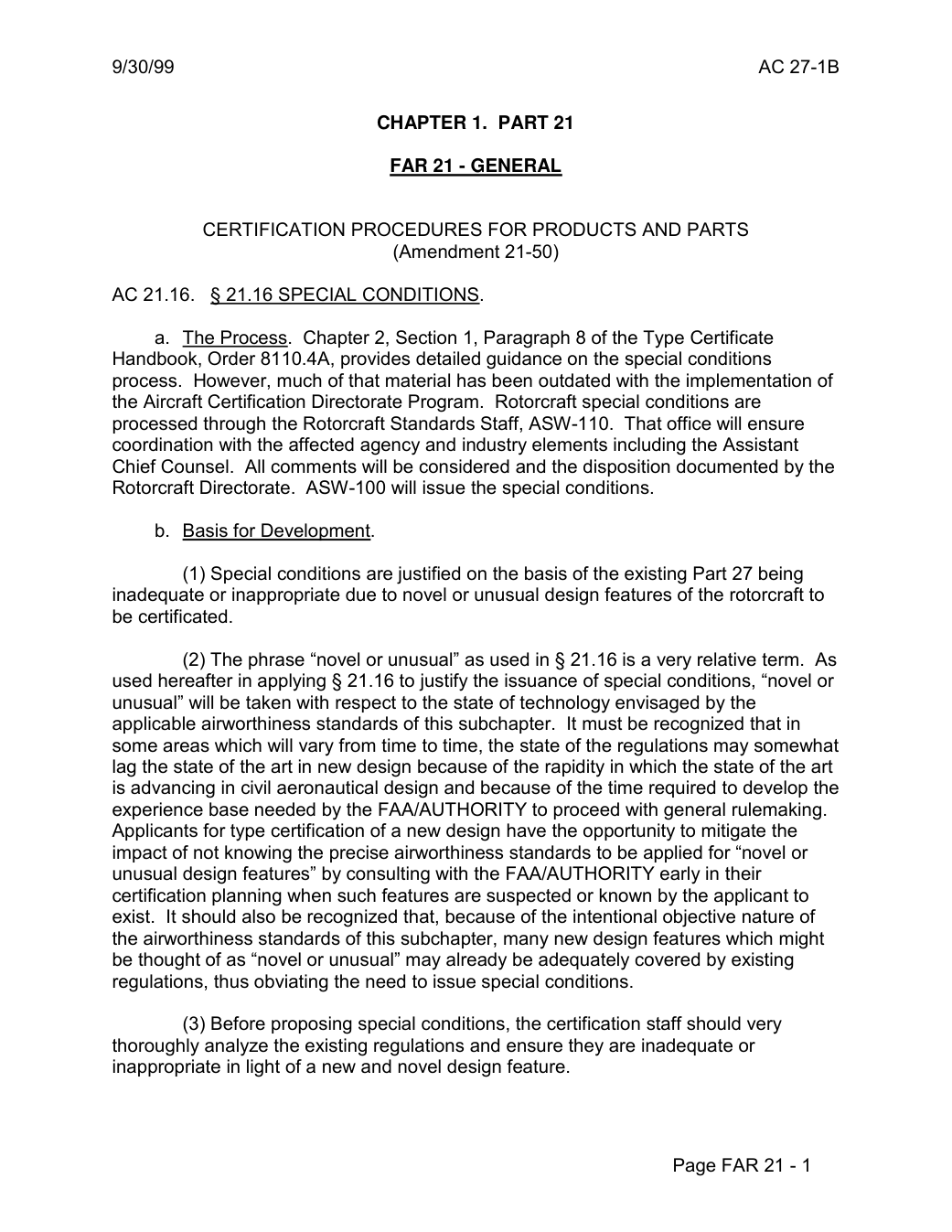
9/30/99                                             AC 27-1B

                     CHAPTER 1. PART 21

                      FAR 21 - GENERAL


        CERTIFICATION PROCEDURES FOR PRODUCTS AND PARTS
                          (Amendment 21-50)

AC 21.16. § 21.16 SPECIAL CONDITIONS.

     a. The Process. Chapter 2, Section 1, Paragraph 8 of the Type Certificate
Handbook, Order 8110.4A, provides detailed guidance on the special conditions
process. However, much of that material has been outdated with the implementation of
the Aircraft Certification Directorate Program. Rotorcraft special conditions are
processed through the Rotorcraft Standards Staff, ASW-110. That office will ensure
coordination with the affected agency and industry elements including the Assistant
Chief Counsel. All comments will be considered and the disposition documented by the
Rotorcraft Directorate. ASW-100 will issue the special conditions.

     b. Basis for Development.

         (1) Special conditions are justified on the basis of the existing Part 27 being
inadequate or inappropriate due to novel or unusual design features of the rotorcraft to
be certificated.

         (2) The phrase “novel or unusual” as used in § 21.16 is a very relative term. As
used hereafter in applying § 21.16 to justify the issuance of special conditions, “novel or
unusual” will be taken with respect to the state of technology envisaged by the
applicable airworthiness standards of this subchapter.  It must be recognized that in
some areas which will vary from time to time, the state of the regulations may somewhat
lag the state of the art in new design because of the rapidity in which the state of the art
is advancing in civil aeronautical design and because of the time required to develop the
experience base needed by the FAA/AUTHORITY to proceed with general rulemaking.
Applicants for type certification of a new design have the opportunity to mitigate the
impact of not knowing the precise airworthiness standards to be applied for “novel or
unusual design features” by consulting with the FAA/AUTHORITY early in their
certification planning when such features are suspected or known by the applicant to
exist.  It should also be recognized that, because of the intentional objective nature of
the airworthiness standards of this subchapter, many new design features which might
be thought of as “novel or unusual” may already be adequately covered by existing
regulations, thus obviating the need to issue special conditions.

         (3) Before proposing special conditions, the certification staff should very
thoroughly analyze the existing regulations and ensure they are inadequate or
inappropriate in light of a new and novel design feature.


                                                   Page FAR 21 - 1
Saved from the FAA on November 17, 2026. All original pages are retained. Engineering explanations are presented separately below.
Aerospace Consulting / Engineering perspective
Start with the certification basis and the function.
Identify the applicable amendment before selecting the safety guidance. Connect intended functions and operating conditions to failure conditions, architecture decisions, common-cause considerations, verification and limitations. For flight controls and IFR work, carry the relevant 27.672, 27.1329 and Appendix B assumptions into the system safety and compliance evidence.
1196 original pages. 0 pages have reviewed text reflows. Original-first pages retain the source layout, with extracted text available for finding words.
A focused review, an agreed assessment package or ongoing support alongside your team. We can agree the relevant inputs and scope in the initial conversation.
This opens your email application.
Start a conversation
Tell us about your programme, the system you are developing and the support you need.
We can agree a focused use-case review, a defined evidence package or ongoing programme support.
This opens your email application.
Specialist aerospace expertise
Aerospace Consulting is led by Hussein Khimji, an FAA Designated Engineering Representative in systems and equipment, with a focus on system safety, flight controls and avionics.
We work with aircraft developers and systems suppliers to connect technical decisions, safety assessments and certification evidence.
This is the proposed introduction. The full About page will add your approved biography and associate expertise.
Systems engineering & development assurance
Tell us about the aircraft or system, its intended function, stage of development and the support you need.