
Original FAA page, including its printed amendment and change markings. Extracted words support search; text reflow has not been reviewed.
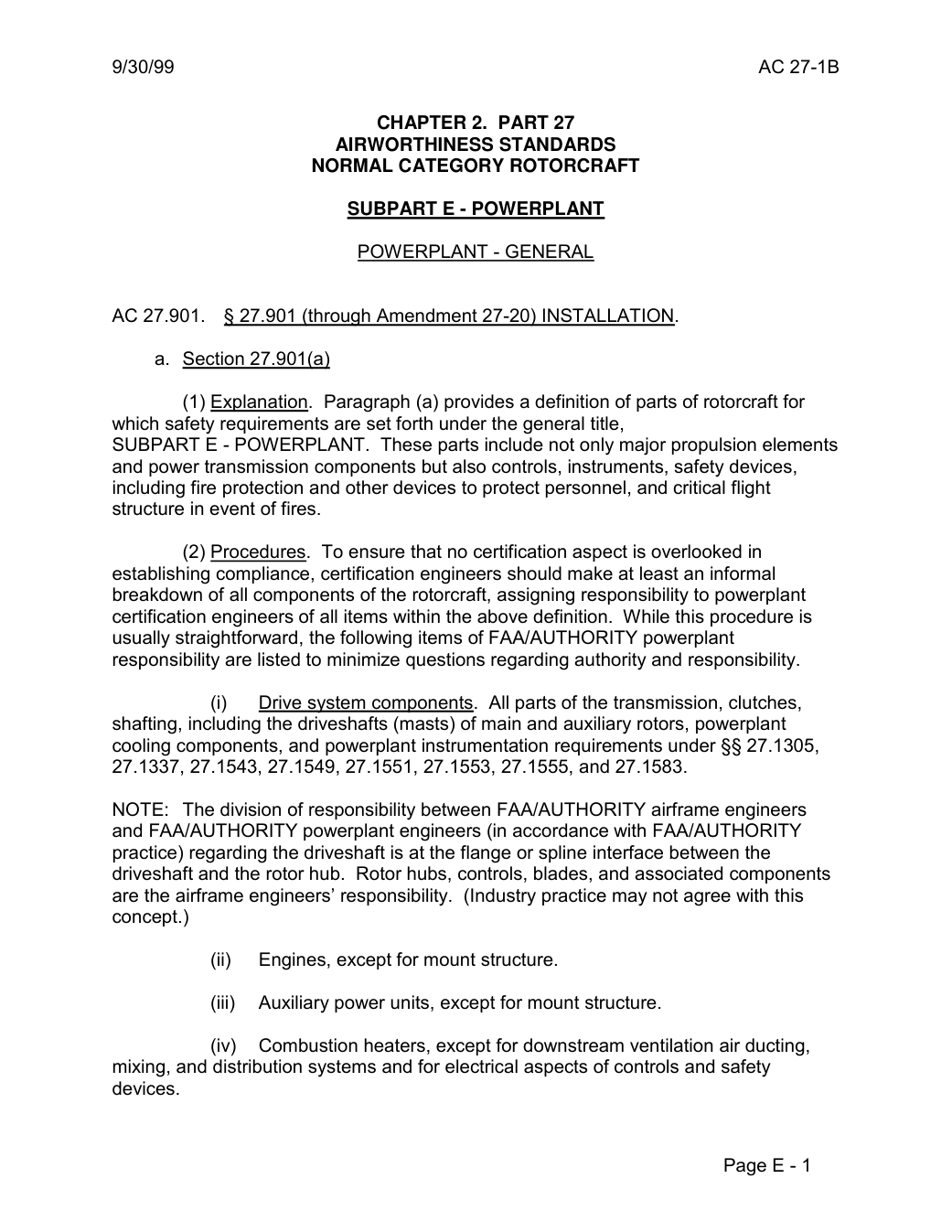
AC 27-1B · E-1Open saved PDF here ↗
Extracted text for finding words
This extraction supports search. Read the original page for complete notation and layout.
9/30/99                                             AC 27-1B

                     CHAPTER 2. PART 27
                  AIRWORTHINESS STANDARDS
               NORMAL CATEGORY ROTORCRAFT

                  SUBPART E - POWERPLANT

                   POWERPLANT - GENERAL


AC 27.901.  § 27.901 (through Amendment 27-20) INSTALLATION.

     a. Section 27.901(a)

         (1) Explanation. Paragraph (a) provides a definition of parts of rotorcraft for
which safety requirements are set forth under the general title,
SUBPART E - POWERPLANT. These parts include not only major propulsion elements
and power transmission components but also controls, instruments, safety devices,
including fire protection and other devices to protect personnel, and critical flight
structure in event of fires.

         (2) Procedures. To ensure that no certification aspect is overlooked in
establishing compliance, certification engineers should make at least an informal
breakdown of all components of the rotorcraft, assigning responsibility to powerplant
certification engineers of all items within the above definition. While this procedure is
usually straightforward, the following items of FAA/AUTHORITY powerplant
responsibility are listed to minimize questions regarding authority and responsibility.

                  (i)    Drive system components. All parts of the transmission, clutches,
shafting, including the driveshafts (masts) of main and auxiliary rotors, powerplant
cooling components, and powerplant instrumentation requirements under §§ 27.1305,
27.1337, 27.1543, 27.1549, 27.1551, 27.1553, 27.1555, and 27.1583.

NOTE: The division of responsibility between FAA/AUTHORITY airframe engineers
and FAA/AUTHORITY powerplant engineers (in accordance with FAA/AUTHORITY
practice) regarding the driveshaft is at the flange or spline interface between the
driveshaft and the rotor hub. Rotor hubs, controls, blades, and associated components
are the airframe engineers’ responsibility. (Industry practice may not agree with this
concept.)

                   (ii)   Engines, except for mount structure.

                    (iii)   Auxiliary power units, except for mount structure.

               (iv)  Combustion heaters, except for downstream ventilation air ducting,
mixing, and distribution systems and for electrical aspects of controls and safety
devices.


                                                        Page E - 1