Certification of Normal Category Rotorcraft — Changes 1–9
Normal category rotorcraft guidance with Changes 1–9 incorporated. Search the complete AC or start with the system safety, flight controls and instrument-flight guidance.
This source includes guidance for different amendments of Part 27. Match the guidance to the aircraft’s agreed certification basis: the 27.1309 entries for Amendments 27-21, 27-46 and 27-51 are separate. The base AC was issued on 30 September 1999; Change 9 is dated 23 June 2023. The FAA catalogue’s 30 September 2008 date is not the date of the latest change.
The source, within reach.
Search within this AC, jump to a source page, or download the complete saved publication.
This extraction supports search. Read the original page for complete notation and layout.
2/4/2016                                                  AC 27-1B, Chg 7


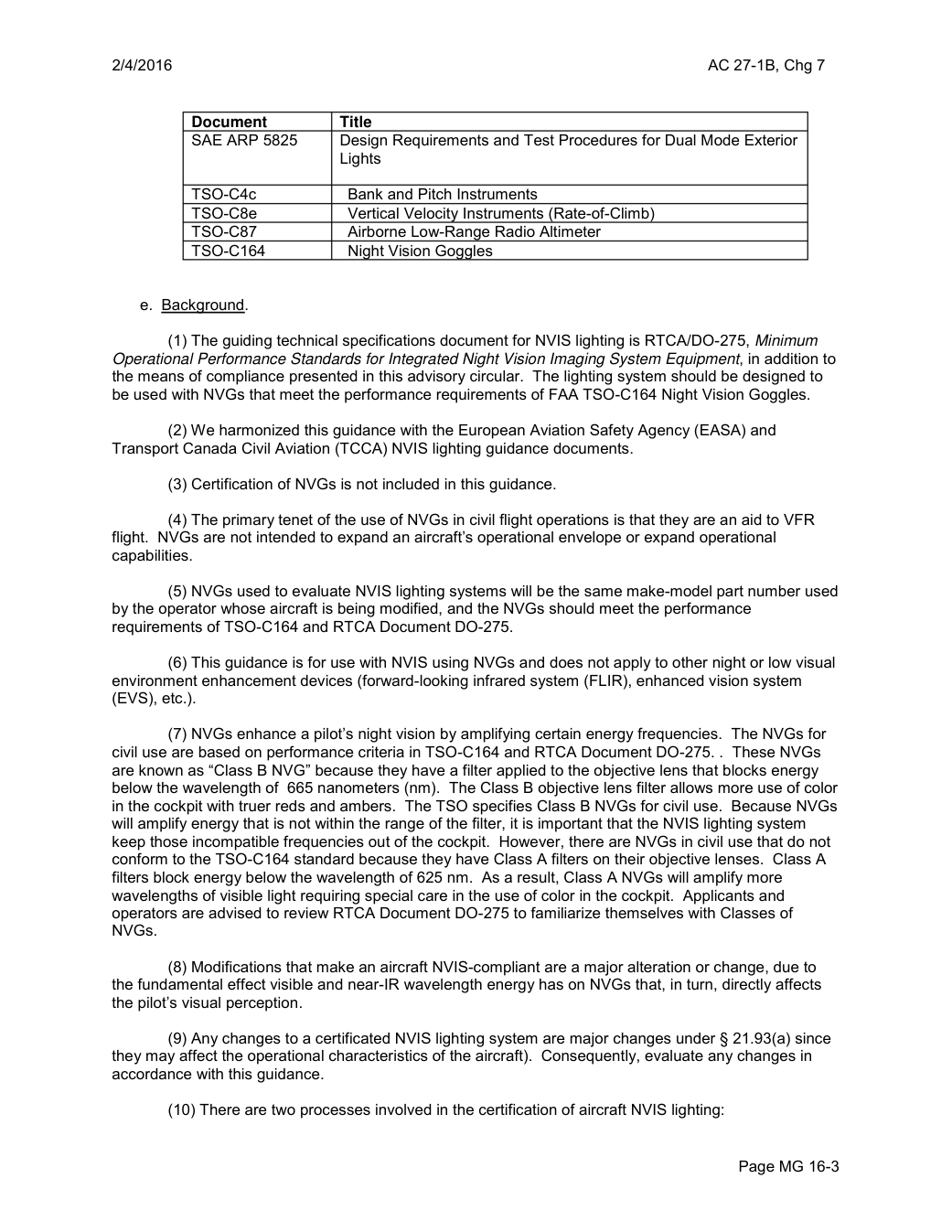
        Document           Title
        SAE ARP 5825     Design Requirements and Test Procedures for Dual Mode Exterior
                                 Lights

         TSO-C4c          Bank and Pitch Instruments
        TSO-C8e              Vertical Velocity Instruments (Rate-of-Climb)
        TSO-C87            Airborne Low-Range Radio Altimeter
         TSO-C164           Night Vision Goggles


    e. Background.

         (1) The guiding technical specifications document for NVIS lighting is RTCA/DO-275, Minimum
Operational Performance Standards for Integrated Night Vision Imaging System Equipment, in addition to
the means of compliance presented in this advisory circular. The lighting system should be designed to
be used with NVGs that meet the performance requirements of FAA TSO-C164 Night Vision Goggles.

         (2) We harmonized this guidance with the European Aviation Safety Agency (EASA) and
Transport Canada Civil Aviation (TCCA) NVIS lighting guidance documents.

         (3) Certification of NVGs is not included in this guidance.

         (4) The primary tenet of the use of NVGs in civil flight operations is that they are an aid to VFR
flight. NVGs are not intended to expand an aircraft’s operational envelope or expand operational
capabilities.

         (5) NVGs used to evaluate NVIS lighting systems will be the same make-model part number used
by the operator whose aircraft is being modified, and the NVGs should meet the performance
requirements of TSO-C164 and RTCA Document DO-275.

         (6) This guidance is for use with NVIS using NVGs and does not apply to other night or low visual
environment enhancement devices (forward-looking infrared system (FLIR), enhanced vision system
(EVS), etc.).

         (7) NVGs enhance a pilot’s night vision by amplifying certain energy frequencies. The NVGs for
civil use are based on performance criteria in TSO-C164 and RTCA Document DO-275. . These NVGs
are known as “Class B NVG” because they have a filter applied to the objective lens that blocks energy
below the wavelength of 665 nanometers (nm). The Class B objective lens filter allows more use of color
in the cockpit with truer reds and ambers. The TSO specifies Class B NVGs for civil use. Because NVGs
will amplify energy that is not within the range of the filter, it is important that the NVIS lighting system
keep those incompatible frequencies out of the cockpit. However, there are NVGs in civil use that do not
conform to the TSO-C164 standard because they have Class A filters on their objective lenses. Class A
filters block energy below the wavelength of 625 nm. As a result, Class A NVGs will amplify more
wavelengths of visible light requiring special care in the use of color in the cockpit. Applicants and
operators are advised to review RTCA Document DO-275 to familiarize themselves with Classes of
NVGs.

         (8) Modifications that make an aircraft NVIS-compliant are a major alteration or change, due to
the fundamental effect visible and near-IR wavelength energy has on NVGs that, in turn, directly affects
the pilot’s visual perception.

         (9) Any changes to a certificated NVIS lighting system are major changes under § 21.93(a) since
they may affect the operational characteristics of the aircraft). Consequently, evaluate any changes in
accordance with this guidance.

        (10) There are two processes involved in the certification of aircraft NVIS lighting:


                                                                     Page MG 16-3
Saved from the FAA on November 17, 2026. All original pages are retained. Engineering explanations are presented separately below.
Aerospace Consulting / Engineering perspective
Start with the certification basis and the function.
Identify the applicable amendment before selecting the safety guidance. Connect intended functions and operating conditions to failure conditions, architecture decisions, common-cause considerations, verification and limitations. For flight controls and IFR work, carry the relevant 27.672, 27.1329 and Appendix B assumptions into the system safety and compliance evidence.
1196 original pages. 0 pages have reviewed text reflows. Original-first pages retain the source layout, with extracted text available for finding words.
A focused review, an agreed assessment package or ongoing support alongside your team. We can agree the relevant inputs and scope in the initial conversation.
This opens your email application.
Start a conversation
Tell us about your programme, the system you are developing and the support you need.
We can agree a focused use-case review, a defined evidence package or ongoing programme support.
This opens your email application.
Specialist aerospace expertise
Aerospace Consulting is led by Hussein Khimji, an FAA Designated Engineering Representative in systems and equipment, with a focus on system safety, flight controls and avionics.
We work with aircraft developers and systems suppliers to connect technical decisions, safety assessments and certification evidence.
This is the proposed introduction. The full About page will add your approved biography and associate expertise.
Systems engineering & development assurance
Tell us about the aircraft or system, its intended function, stage of development and the support you need.