Certification of Normal Category Rotorcraft — Changes 1–9
Normal category rotorcraft guidance with Changes 1–9 incorporated. Search the complete AC or start with the system safety, flight controls and instrument-flight guidance.
This source includes guidance for different amendments of Part 27. Match the guidance to the aircraft’s agreed certification basis: the 27.1309 entries for Amendments 27-21, 27-46 and 27-51 are separate. The base AC was issued on 30 September 1999; Change 9 is dated 23 June 2023. The FAA catalogue’s 30 September 2008 date is not the date of the latest change.
The source, within reach.
Search within this AC, jump to a source page, or download the complete saved publication.
This extraction supports search. Read the original page for complete notation and layout.
AC 27-1B, Chg 7                                                                       2/4/2016


         (7) Aided flight. A flight in which the flight crew references NVG imagery to assist visual flight.

         (8) Unaided flight. A flight in which the flight crew does not reference NVG imagery.

         (9) Transparencies. Windshields, windows, chin bubbles, and overhead windows through which
the crew views the outside scene with NVGs.

        (10) Inadvertent instrument meteorological conditions (IMC). An unplanned encounter with visual
conditions that do not permit continued flight under VFR where conditions do not allow for the visual
determination of a usable horizon (e.g., fog, snow showers, or night operations over unlit surfaces such
as water). Some examples where inadvertent IMC may occur are flight into areas with no lights or other
features that allow for visual contact with the ground or horizon; actual IMC-like entering clouds; brownout
or white out during approaches or takeoffs from dusty or snow covered unimproved landing zones; or
whiteout because of blowing and falling snow.

        (11) Unimproved landing area. Any site that is not an airport, heliport, or other civil aviation
authority approved landing site.

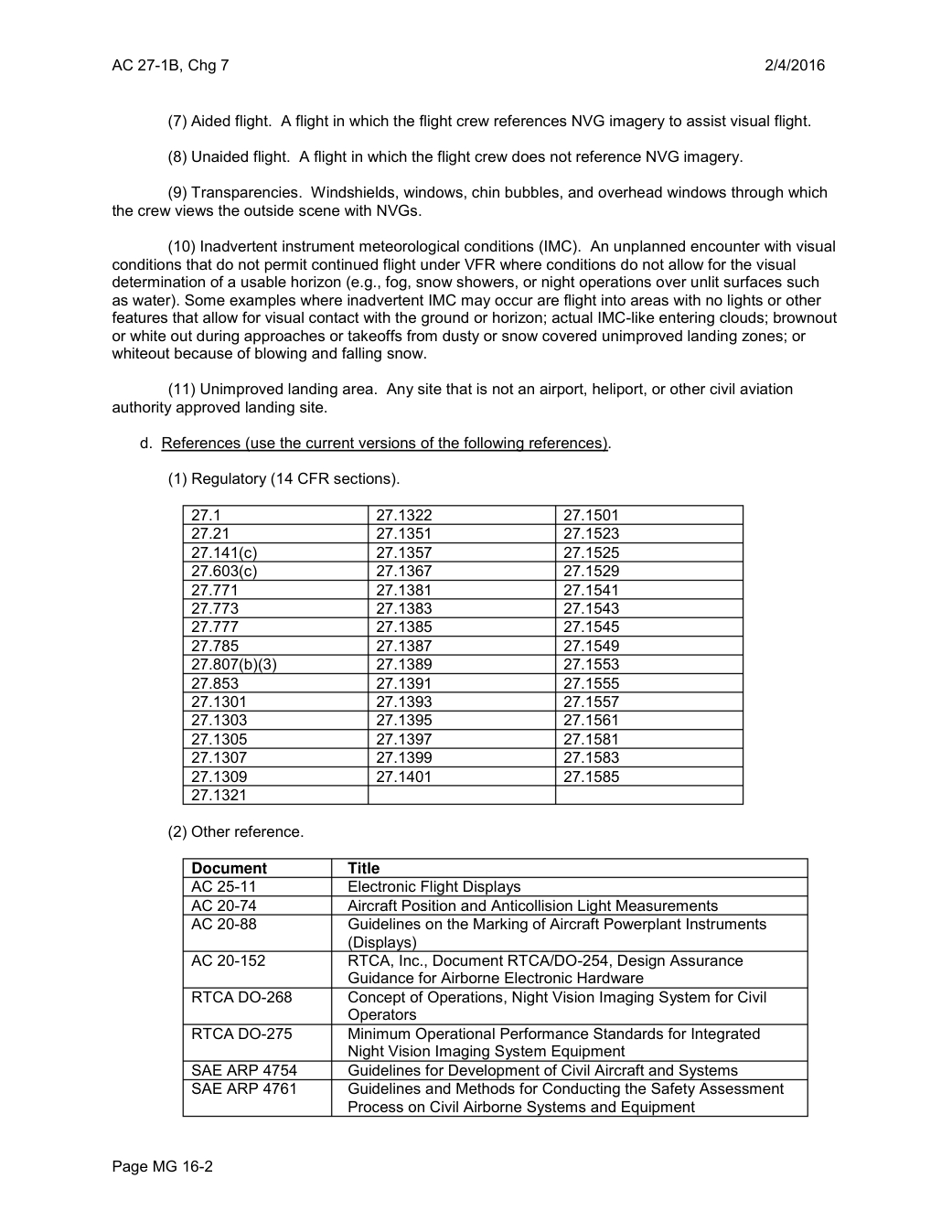
    d. References (use the current versions of the following references).

         (1) Regulatory (14 CFR sections).

           27.1                   27.1322                27.1501
          27.21                  27.1351                27.1523
           27.141(c)               27.1357                27.1525
           27.603(c)               27.1367                27.1529
          27.771                 27.1381                27.1541
          27.773                 27.1383                27.1543
          27.777                 27.1385                27.1545
          27.785                 27.1387                27.1549
           27.807(b)(3)            27.1389                27.1553
          27.853                 27.1391                27.1555
          27.1301                27.1393                27.1557
          27.1303                27.1395                27.1561
          27.1305                27.1397                27.1581
          27.1307                27.1399                27.1583
          27.1309                27.1401                27.1585
          27.1321

         (2) Other reference.

        Document             Title
       AC 25-11             Electronic Flight Displays
       AC 20-74               Aircraft Position and Anticollision Light Measurements
       AC 20-88            Guidelines on the Marking of Aircraft Powerplant Instruments
                                  (Displays)
       AC 20-152         RTCA, Inc., Document RTCA/DO-254, Design Assurance
                            Guidance for Airborne Electronic Hardware
       RTCA DO-268       Concept of Operations, Night Vision Imaging System for Civil
                               Operators
       RTCA DO-275      Minimum Operational Performance Standards for Integrated
                                 Night Vision Imaging System Equipment
        SAE ARP 4754       Guidelines for Development of Civil Aircraft and Systems
        SAE ARP 4761       Guidelines and Methods for Conducting the Safety Assessment
                             Process on Civil Airborne Systems and Equipment


Page MG 16-2
Saved from the FAA on November 17, 2026. All original pages are retained. Engineering explanations are presented separately below.
Aerospace Consulting / Engineering perspective
Start with the certification basis and the function.
Identify the applicable amendment before selecting the safety guidance. Connect intended functions and operating conditions to failure conditions, architecture decisions, common-cause considerations, verification and limitations. For flight controls and IFR work, carry the relevant 27.672, 27.1329 and Appendix B assumptions into the system safety and compliance evidence.
1196 original pages. 0 pages have reviewed text reflows. Original-first pages retain the source layout, with extracted text available for finding words.
A focused review, an agreed assessment package or ongoing support alongside your team. We can agree the relevant inputs and scope in the initial conversation.
This opens your email application.
Start a conversation
Tell us about your programme, the system you are developing and the support you need.
We can agree a focused use-case review, a defined evidence package or ongoing programme support.
This opens your email application.
Specialist aerospace expertise
Aerospace Consulting is led by Hussein Khimji, an FAA Designated Engineering Representative in systems and equipment, with a focus on system safety, flight controls and avionics.
We work with aircraft developers and systems suppliers to connect technical decisions, safety assessments and certification evidence.
This is the proposed introduction. The full About page will add your approved biography and associate expertise.
Systems engineering & development assurance
Tell us about the aircraft or system, its intended function, stage of development and the support you need.