Certification of Normal Category Rotorcraft — Changes 1–9
Normal category rotorcraft guidance with Changes 1–9 incorporated. Search the complete AC or start with the system safety, flight controls and instrument-flight guidance.
This source includes guidance for different amendments of Part 27. Match the guidance to the aircraft’s agreed certification basis: the 27.1309 entries for Amendments 27-21, 27-46 and 27-51 are separate. The base AC was issued on 30 September 1999; Change 9 is dated 23 June 2023. The FAA catalogue’s 30 September 2008 date is not the date of the latest change.
The source, within reach.
Search within this AC, jump to a source page, or download the complete saved publication.
This extraction supports search. Read the original page for complete notation and layout.
2/12/03                                       AC 27-1B, Chg 1

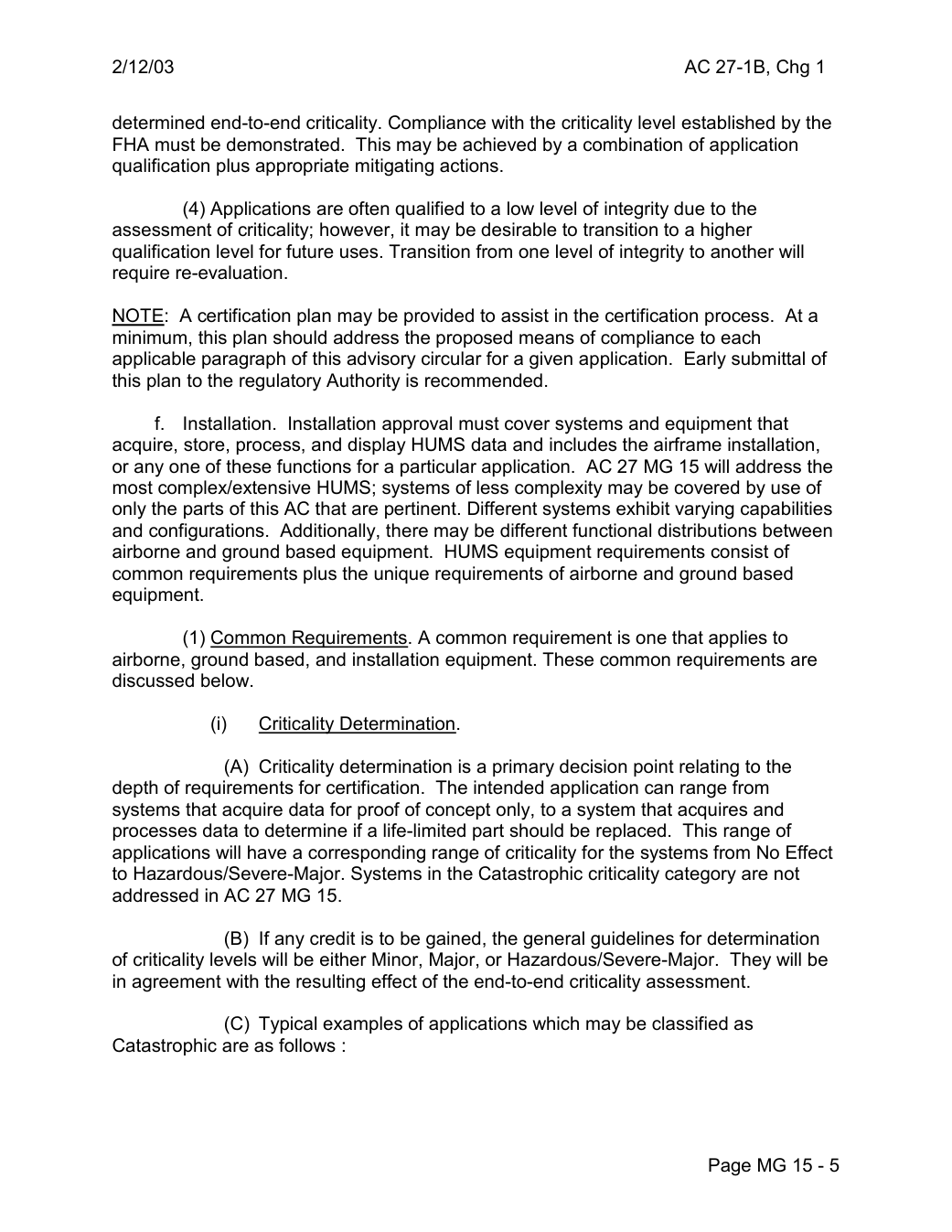
determined end-to-end criticality. Compliance with the criticality level established by the
FHA must be demonstrated. This may be achieved by a combination of application
qualification plus appropriate mitigating actions.

         (4) Applications are often qualified to a low level of integrity due to the
assessment of criticality; however, it may be desirable to transition to a higher
qualification level for future uses. Transition from one level of integrity to another will
require re-evaluation.

NOTE: A certification plan may be provided to assist in the certification process. At a
minimum, this plan should address the proposed means of compliance to each
applicable paragraph of this advisory circular for a given application. Early submittal of
this plan to the regulatory Authority is recommended.

        f.  Installation. Installation approval must cover systems and equipment that
acquire, store, process, and display HUMS data and includes the airframe installation,
or any one of these functions for a particular application. AC 27 MG 15 will address the
most complex/extensive HUMS; systems of less complexity may be covered by use of
only the parts of this AC that are pertinent. Different systems exhibit varying capabilities
and configurations. Additionally, there may be different functional distributions between
airborne and ground based equipment. HUMS equipment requirements consist of
common requirements plus the unique requirements of airborne and ground based
equipment.

         (1) Common Requirements. A common requirement is one that applies to
airborne, ground based, and installation equipment. These common requirements are
discussed below.

                  (i)     Criticality Determination.

              (A) Criticality determination is a primary decision point relating to the
depth of requirements for certification. The intended application can range from
systems that acquire data for proof of concept only, to a system that acquires and
processes data to determine if a life-limited part should be replaced. This range of
applications will have a corresponding range of criticality for the systems from No Effect
to Hazardous/Severe-Major. Systems in the Catastrophic criticality category are not
addressed in AC 27 MG 15.

              (B)  If any credit is to be gained, the general guidelines for determination
of criticality levels will be either Minor, Major, or Hazardous/Severe-Major. They will be
in agreement with the resulting effect of the end-to-end criticality assessment.

             (C) Typical examples of applications which may be classified as
Catastrophic are as follows :


                                                       Page MG 15 - 5
Saved from the FAA on November 17, 2026. All original pages are retained. Engineering explanations are presented separately below.
Aerospace Consulting / Engineering perspective
Start with the certification basis and the function.
Identify the applicable amendment before selecting the safety guidance. Connect intended functions and operating conditions to failure conditions, architecture decisions, common-cause considerations, verification and limitations. For flight controls and IFR work, carry the relevant 27.672, 27.1329 and Appendix B assumptions into the system safety and compliance evidence.
1196 original pages. 0 pages have reviewed text reflows. Original-first pages retain the source layout, with extracted text available for finding words.
A focused review, an agreed assessment package or ongoing support alongside your team. We can agree the relevant inputs and scope in the initial conversation.
This opens your email application.
Start a conversation
Tell us about your programme, the system you are developing and the support you need.
We can agree a focused use-case review, a defined evidence package or ongoing programme support.
This opens your email application.
Specialist aerospace expertise
Aerospace Consulting is led by Hussein Khimji, an FAA Designated Engineering Representative in systems and equipment, with a focus on system safety, flight controls and avionics.
We work with aircraft developers and systems suppliers to connect technical decisions, safety assessments and certification evidence.
This is the proposed introduction. The full About page will add your approved biography and associate expertise.
Systems engineering & development assurance
Tell us about the aircraft or system, its intended function, stage of development and the support you need.