Certification of Normal Category Rotorcraft — Changes 1–9
Normal category rotorcraft guidance with Changes 1–9 incorporated. Search the complete AC or start with the system safety, flight controls and instrument-flight guidance.
This source includes guidance for different amendments of Part 27. Match the guidance to the aircraft’s agreed certification basis: the 27.1309 entries for Amendments 27-21, 27-46 and 27-51 are separate. The base AC was issued on 30 September 1999; Change 9 is dated 23 June 2023. The FAA catalogue’s 30 September 2008 date is not the date of the latest change.
The source, within reach.
Search within this AC, jump to a source page, or download the complete saved publication.
This extraction supports search. Read the original page for complete notation and layout.
2/12/03                                       AC 27-1B, Chg 1


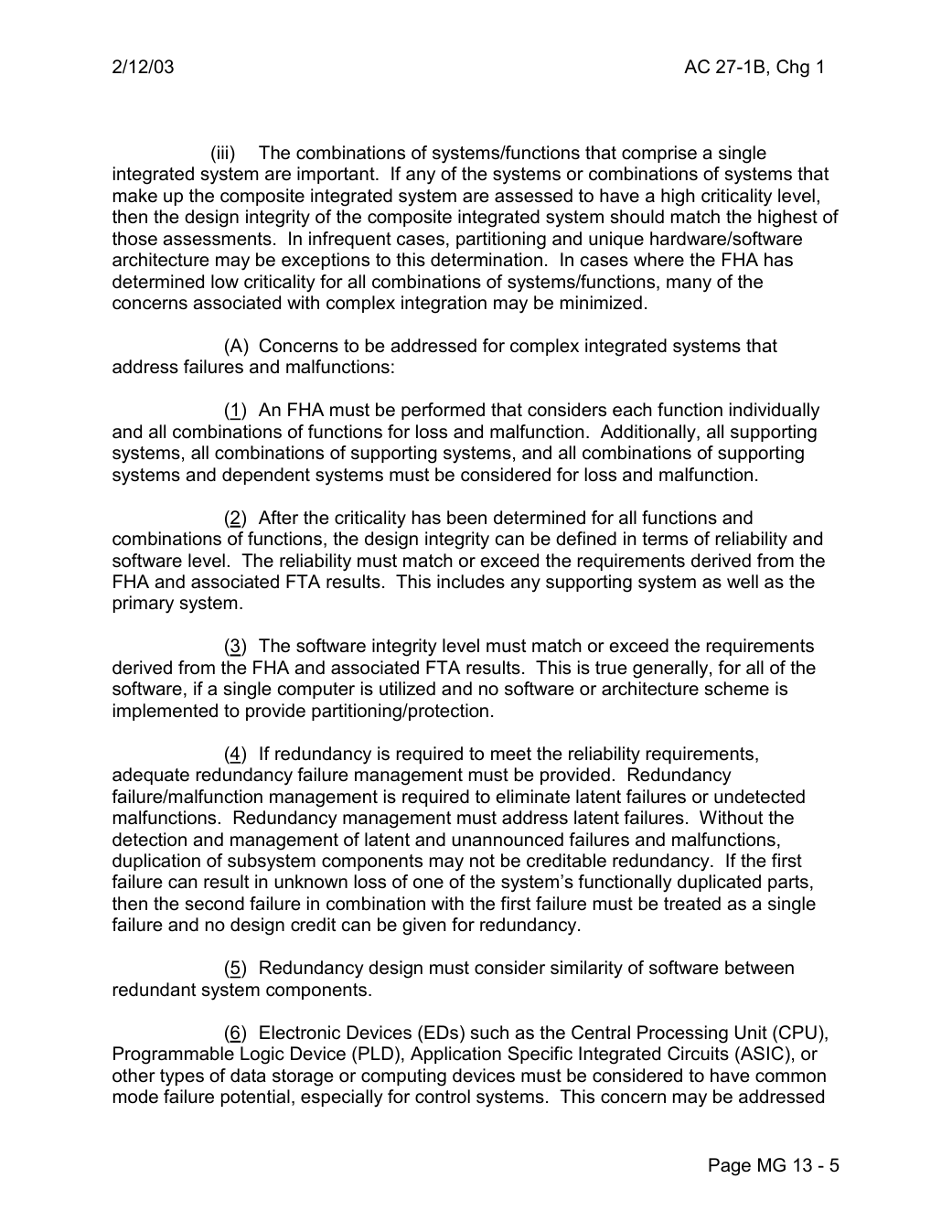
                    (iii)  The combinations of systems/functions that comprise a single
integrated system are important.  If any of the systems or combinations of systems that
make up the composite integrated system are assessed to have a high criticality level,
then the design integrity of the composite integrated system should match the highest of
those assessments. In infrequent cases, partitioning and unique hardware/software
architecture may be exceptions to this determination. In cases where the FHA has
determined low criticality for all combinations of systems/functions, many of the
concerns associated with complex integration may be minimized.

              (A) Concerns to be addressed for complex integrated systems that
address failures and malfunctions:

               (1) An FHA must be performed that considers each function individually
and all combinations of functions for loss and malfunction. Additionally, all supporting
systems, all combinations of supporting systems, and all combinations of supporting
systems and dependent systems must be considered for loss and malfunction.

               (2)  After the criticality has been determined for all functions and
combinations of functions, the design integrity can be defined in terms of reliability and
software level. The reliability must match or exceed the requirements derived from the
FHA and associated FTA results. This includes any supporting system as well as the
primary system.

               (3) The software integrity level must match or exceed the requirements
derived from the FHA and associated FTA results. This is true generally, for all of the
software, if a single computer is utilized and no software or architecture scheme is
implemented to provide partitioning/protection.

               (4)  If redundancy is required to meet the reliability requirements,
adequate redundancy failure management must be provided. Redundancy
failure/malfunction management is required to eliminate latent failures or undetected
malfunctions. Redundancy management must address latent failures. Without the
detection and management of latent and unannounced failures and malfunctions,
duplication of subsystem components may not be creditable redundancy.  If the first
failure can result in unknown loss of one of the system’s functionally duplicated parts,
then the second failure in combination with the first failure must be treated as a single
failure and no design credit can be given for redundancy.

               (5) Redundancy design must consider similarity of software between
redundant system components.

               (6) Electronic Devices (EDs) such as the Central Processing Unit (CPU),
Programmable Logic Device (PLD), Application Specific Integrated Circuits (ASIC), or
other types of data storage or computing devices must be considered to have common
mode failure potential, especially for control systems. This concern may be addressed


                                                       Page MG 13 - 5
Saved from the FAA on November 17, 2026. All original pages are retained. Engineering explanations are presented separately below.
Aerospace Consulting / Engineering perspective
Start with the certification basis and the function.
Identify the applicable amendment before selecting the safety guidance. Connect intended functions and operating conditions to failure conditions, architecture decisions, common-cause considerations, verification and limitations. For flight controls and IFR work, carry the relevant 27.672, 27.1329 and Appendix B assumptions into the system safety and compliance evidence.
1196 original pages. 0 pages have reviewed text reflows. Original-first pages retain the source layout, with extracted text available for finding words.
A focused review, an agreed assessment package or ongoing support alongside your team. We can agree the relevant inputs and scope in the initial conversation.
This opens your email application.
Start a conversation
Tell us about your programme, the system you are developing and the support you need.
We can agree a focused use-case review, a defined evidence package or ongoing programme support.
This opens your email application.
Specialist aerospace expertise
Aerospace Consulting is led by Hussein Khimji, an FAA Designated Engineering Representative in systems and equipment, with a focus on system safety, flight controls and avionics.
We work with aircraft developers and systems suppliers to connect technical decisions, safety assessments and certification evidence.
This is the proposed introduction. The full About page will add your approved biography and associate expertise.
Systems engineering & development assurance
Tell us about the aircraft or system, its intended function, stage of development and the support you need.