Certification of Normal Category Rotorcraft — Changes 1–9
Normal category rotorcraft guidance with Changes 1–9 incorporated. Search the complete AC or start with the system safety, flight controls and instrument-flight guidance.
This source includes guidance for different amendments of Part 27. Match the guidance to the aircraft’s agreed certification basis: the 27.1309 entries for Amendments 27-21, 27-46 and 27-51 are separate. The base AC was issued on 30 September 1999; Change 9 is dated 23 June 2023. The FAA catalogue’s 30 September 2008 date is not the date of the latest change.
The source, within reach.
Search within this AC, jump to a source page, or download the complete saved publication.
This extraction supports search. Read the original page for complete notation and layout.
AC 27-1B, Chg 1                                                           2/12/03

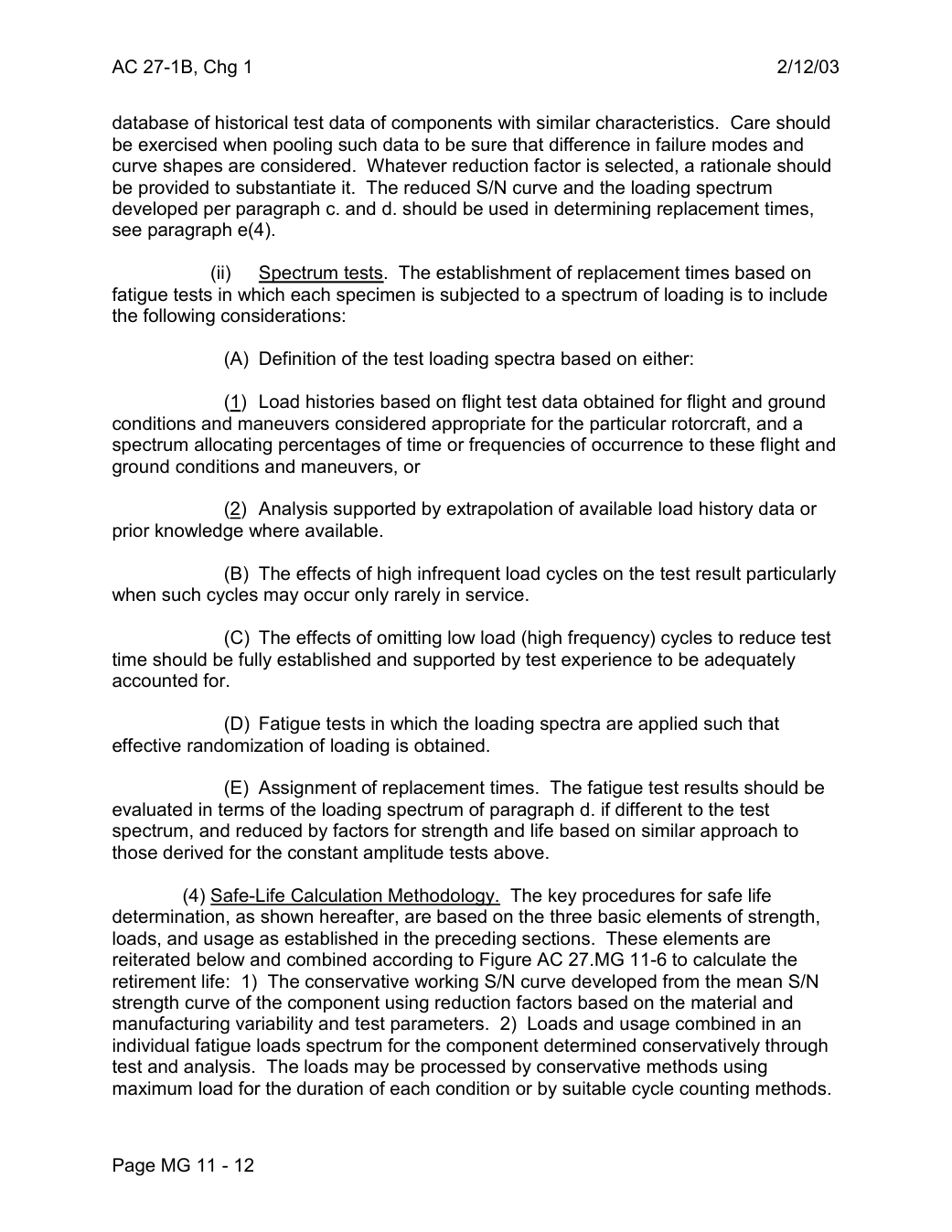
database of historical test data of components with similar characteristics. Care should
be exercised when pooling such data to be sure that difference in failure modes and
curve shapes are considered. Whatever reduction factor is selected, a rationale should
be provided to substantiate it. The reduced S/N curve and the loading spectrum
developed per paragraph c. and d. should be used in determining replacement times,
see paragraph e(4).

                   (ii)   Spectrum tests. The establishment of replacement times based on
fatigue tests in which each specimen is subjected to a spectrum of loading is to include
the following considerations:

              (A) Definition of the test loading spectra based on either:

               (1) Load histories based on flight test data obtained for flight and ground
conditions and maneuvers considered appropriate for the particular rotorcraft, and a
spectrum allocating percentages of time or frequencies of occurrence to these flight and
ground conditions and maneuvers, or

               (2) Analysis supported by extrapolation of available load history data or
prior knowledge where available.

              (B) The effects of high infrequent load cycles on the test result particularly
when such cycles may occur only rarely in service.

             (C) The effects of omitting low load (high frequency) cycles to reduce test
time should be fully established and supported by test experience to be adequately
accounted for.

             (D) Fatigue tests in which the loading spectra are applied such that
effective randomization of loading is obtained.

              (E) Assignment of replacement times. The fatigue test results should be
evaluated in terms of the loading spectrum of paragraph d. if different to the test
spectrum, and reduced by factors for strength and life based on similar approach to
those derived for the constant amplitude tests above.

         (4) Safe-Life Calculation Methodology. The key procedures for safe life
determination, as shown hereafter, are based on the three basic elements of strength,
loads, and usage as established in the preceding sections. These elements are
reiterated below and combined according to Figure AC 27.MG 11-6 to calculate the
retirement life: 1) The conservative working S/N curve developed from the mean S/N
strength curve of the component using reduction factors based on the material and
manufacturing variability and test parameters. 2) Loads and usage combined in an
individual fatigue loads spectrum for the component determined conservatively through
test and analysis. The loads may be processed by conservative methods using
maximum load for the duration of each condition or by suitable cycle counting methods.


Page MG 11 - 12
Saved from the FAA on November 17, 2026. All original pages are retained. Engineering explanations are presented separately below.
Aerospace Consulting / Engineering perspective
Start with the certification basis and the function.
Identify the applicable amendment before selecting the safety guidance. Connect intended functions and operating conditions to failure conditions, architecture decisions, common-cause considerations, verification and limitations. For flight controls and IFR work, carry the relevant 27.672, 27.1329 and Appendix B assumptions into the system safety and compliance evidence.
1196 original pages. 0 pages have reviewed text reflows. Original-first pages retain the source layout, with extracted text available for finding words.
A focused review, an agreed assessment package or ongoing support alongside your team. We can agree the relevant inputs and scope in the initial conversation.
This opens your email application.
Start a conversation
Tell us about your programme, the system you are developing and the support you need.
We can agree a focused use-case review, a defined evidence package or ongoing programme support.
This opens your email application.
Specialist aerospace expertise
Aerospace Consulting is led by Hussein Khimji, an FAA Designated Engineering Representative in systems and equipment, with a focus on system safety, flight controls and avionics.
We work with aircraft developers and systems suppliers to connect technical decisions, safety assessments and certification evidence.
This is the proposed introduction. The full About page will add your approved biography and associate expertise.
Systems engineering & development assurance
Tell us about the aircraft or system, its intended function, stage of development and the support you need.