Certification of Normal Category Rotorcraft — Changes 1–9
Normal category rotorcraft guidance with Changes 1–9 incorporated. Search the complete AC or start with the system safety, flight controls and instrument-flight guidance.
This source includes guidance for different amendments of Part 27. Match the guidance to the aircraft’s agreed certification basis: the 27.1309 entries for Amendments 27-21, 27-46 and 27-51 are separate. The base AC was issued on 30 September 1999; Change 9 is dated 23 June 2023. The FAA catalogue’s 30 September 2008 date is not the date of the latest change.
The source, within reach.
Search within this AC, jump to a source page, or download the complete saved publication.
This extraction supports search. Read the original page for complete notation and layout.
2/12/03                                        AC 27-1B, Chg 1

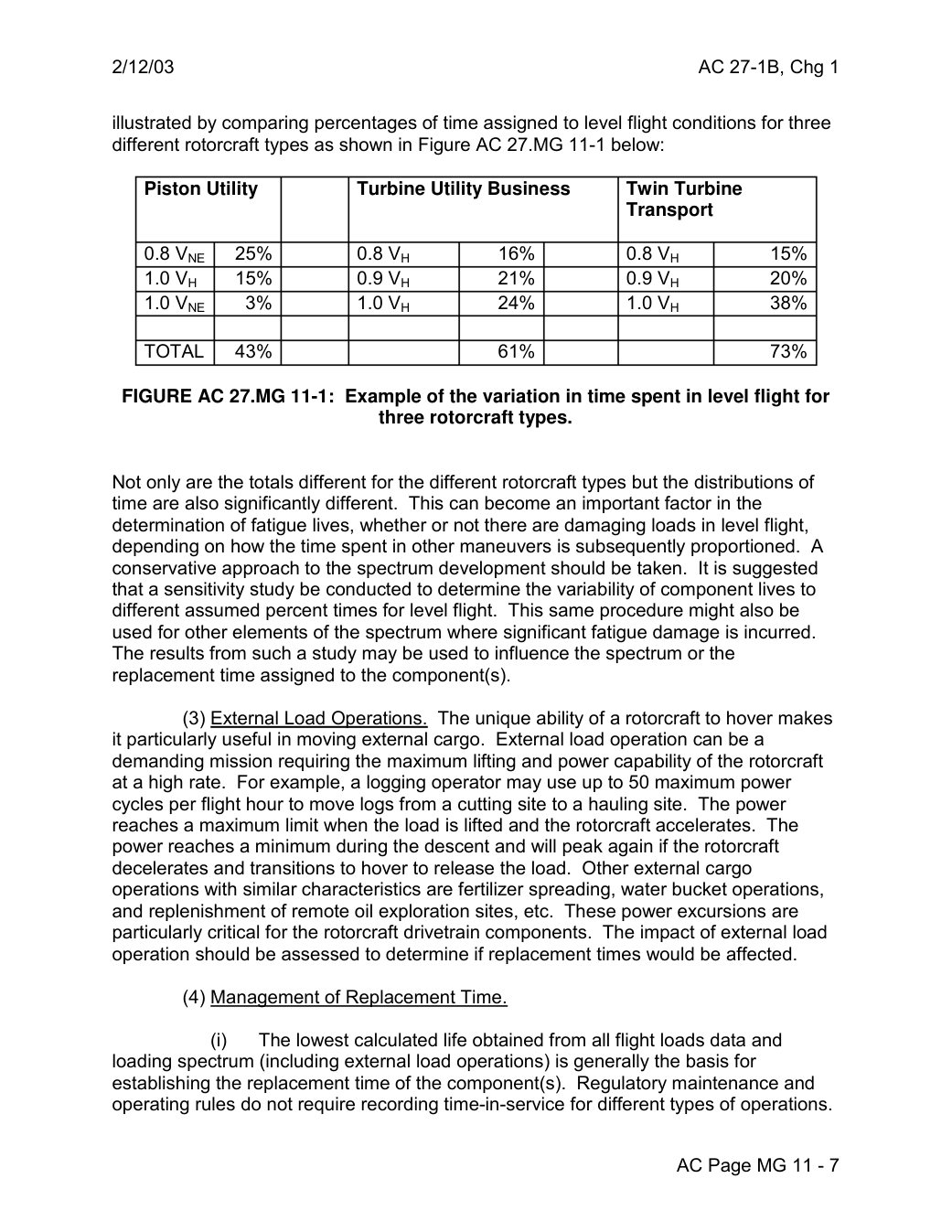
illustrated by comparing percentages of time assigned to level flight conditions for three
different rotorcraft types as shown in Figure AC 27.MG 11-1 below:

   Piston Utility          Turbine Utility Business     Twin Turbine
                                                     Transport

    0.8 VNE  25%          0.8 VH       16%          0.8 VH       15%
    1.0 VH   15%          0.9 VH       21%          0.9 VH       20%
    1.0 VNE   3%          1.0 VH       24%          1.0 VH       38%

   TOTAL  43%                  61%                   73%

 FIGURE AC 27.MG 11-1: Example of the variation in time spent in level flight for
                             three rotorcraft types.


Not only are the totals different for the different rotorcraft types but the distributions of
time are also significantly different. This can become an important factor in the
determination of fatigue lives, whether or not there are damaging loads in level flight,
depending on how the time spent in other maneuvers is subsequently proportioned. A
conservative approach to the spectrum development should be taken.  It is suggested
that a sensitivity study be conducted to determine the variability of component lives to
different assumed percent times for level flight. This same procedure might also be
used for other elements of the spectrum where significant fatigue damage is incurred.
The results from such a study may be used to influence the spectrum or the
replacement time assigned to the component(s).

         (3) External Load Operations. The unique ability of a rotorcraft to hover makes
it particularly useful in moving external cargo. External load operation can be a
demanding mission requiring the maximum lifting and power capability of the rotorcraft
at a high rate. For example, a logging operator may use up to 50 maximum power
cycles per flight hour to move logs from a cutting site to a hauling site. The power
reaches a maximum limit when the load is lifted and the rotorcraft accelerates. The
power reaches a minimum during the descent and will peak again if the rotorcraft
decelerates and transitions to hover to release the load. Other external cargo
operations with similar characteristics are fertilizer spreading, water bucket operations,
and replenishment of remote oil exploration sites, etc. These power excursions are
particularly critical for the rotorcraft drivetrain components. The impact of external load
operation should be assessed to determine if replacement times would be affected.

         (4) Management of Replacement Time.

                  (i)   The lowest calculated life obtained from all flight loads data and
loading spectrum (including external load operations) is generally the basis for
establishing the replacement time of the component(s). Regulatory maintenance and
operating rules do not require recording time-in-service for different types of operations.

                                           AC Page MG 11 - 7
Saved from the FAA on November 17, 2026. All original pages are retained. Engineering explanations are presented separately below.
Aerospace Consulting / Engineering perspective
Start with the certification basis and the function.
Identify the applicable amendment before selecting the safety guidance. Connect intended functions and operating conditions to failure conditions, architecture decisions, common-cause considerations, verification and limitations. For flight controls and IFR work, carry the relevant 27.672, 27.1329 and Appendix B assumptions into the system safety and compliance evidence.
1196 original pages. 0 pages have reviewed text reflows. Original-first pages retain the source layout, with extracted text available for finding words.
A focused review, an agreed assessment package or ongoing support alongside your team. We can agree the relevant inputs and scope in the initial conversation.
This opens your email application.
Start a conversation
Tell us about your programme, the system you are developing and the support you need.
We can agree a focused use-case review, a defined evidence package or ongoing programme support.
This opens your email application.
Specialist aerospace expertise
Aerospace Consulting is led by Hussein Khimji, an FAA Designated Engineering Representative in systems and equipment, with a focus on system safety, flight controls and avionics.
We work with aircraft developers and systems suppliers to connect technical decisions, safety assessments and certification evidence.
This is the proposed introduction. The full About page will add your approved biography and associate expertise.
Systems engineering & development assurance
Tell us about the aircraft or system, its intended function, stage of development and the support you need.