Certification of Normal Category Rotorcraft — Changes 1–9
Normal category rotorcraft guidance with Changes 1–9 incorporated. Search the complete AC or start with the system safety, flight controls and instrument-flight guidance.
This source includes guidance for different amendments of Part 27. Match the guidance to the aircraft’s agreed certification basis: the 27.1309 entries for Amendments 27-21, 27-46 and 27-51 are separate. The base AC was issued on 30 September 1999; Change 9 is dated 23 June 2023. The FAA catalogue’s 30 September 2008 date is not the date of the latest change.
The source, within reach.
Search within this AC, jump to a source page, or download the complete saved publication.
This extraction supports search. Read the original page for complete notation and layout.
9/30/99                                             AC 27-1B

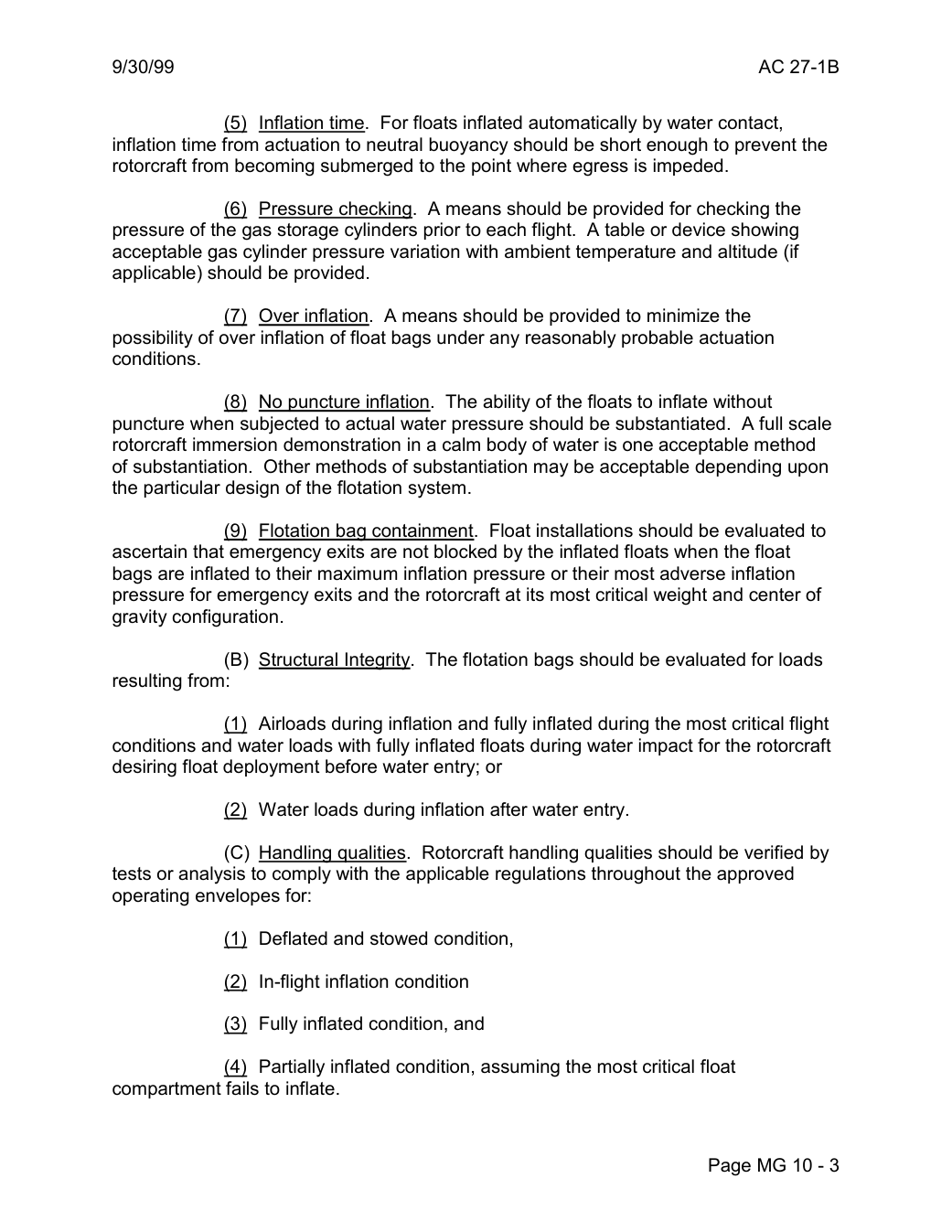
               (5)  Inflation time. For floats inflated automatically by water contact,
inflation time from actuation to neutral buoyancy should be short enough to prevent the
rotorcraft from becoming submerged to the point where egress is impeded.

               (6) Pressure checking. A means should be provided for checking the
pressure of the gas storage cylinders prior to each flight. A table or device showing
acceptable gas cylinder pressure variation with ambient temperature and altitude (if
applicable) should be provided.

               (7) Over inflation. A means should be provided to minimize the
possibility of over inflation of float bags under any reasonably probable actuation
conditions.

               (8) No puncture inflation. The ability of the floats to inflate without
puncture when subjected to actual water pressure should be substantiated. A full scale
rotorcraft immersion demonstration in a calm body of water is one acceptable method
of substantiation. Other methods of substantiation may be acceptable depending upon
the particular design of the flotation system.

               (9) Flotation bag containment. Float installations should be evaluated to
ascertain that emergency exits are not blocked by the inflated floats when the float
bags are inflated to their maximum inflation pressure or their most adverse inflation
pressure for emergency exits and the rotorcraft at its most critical weight and center of
gravity configuration.

              (B) Structural Integrity. The flotation bags should be evaluated for loads
resulting from:

               (1) Airloads during inflation and fully inflated during the most critical flight
conditions and water loads with fully inflated floats during water impact for the rotorcraft
desiring float deployment before water entry; or

               (2) Water loads during inflation after water entry.

             (C) Handling qualities. Rotorcraft handling qualities should be verified by
tests or analysis to comply with the applicable regulations throughout the approved
operating envelopes for:

               (1) Deflated and stowed condition,

               (2)  In-flight inflation condition

               (3)  Fully inflated condition, and

               (4)  Partially inflated condition, assuming the most critical float
compartment fails to inflate.


                                                       Page MG 10 - 3
Saved from the FAA on November 17, 2026. All original pages are retained. Engineering explanations are presented separately below.
Aerospace Consulting / Engineering perspective
Start with the certification basis and the function.
Identify the applicable amendment before selecting the safety guidance. Connect intended functions and operating conditions to failure conditions, architecture decisions, common-cause considerations, verification and limitations. For flight controls and IFR work, carry the relevant 27.672, 27.1329 and Appendix B assumptions into the system safety and compliance evidence.
1196 original pages. 0 pages have reviewed text reflows. Original-first pages retain the source layout, with extracted text available for finding words.
A focused review, an agreed assessment package or ongoing support alongside your team. We can agree the relevant inputs and scope in the initial conversation.
This opens your email application.
Start a conversation
Tell us about your programme, the system you are developing and the support you need.
We can agree a focused use-case review, a defined evidence package or ongoing programme support.
This opens your email application.
Specialist aerospace expertise
Aerospace Consulting is led by Hussein Khimji, an FAA Designated Engineering Representative in systems and equipment, with a focus on system safety, flight controls and avionics.
We work with aircraft developers and systems suppliers to connect technical decisions, safety assessments and certification evidence.
This is the proposed introduction. The full About page will add your approved biography and associate expertise.
Systems engineering & development assurance
Tell us about the aircraft or system, its intended function, stage of development and the support you need.