
Original FAA page, including its printed amendment and change markings. Extracted words support search; text reflow has not been reviewed.
AC 27-1B · 864Open saved PDF here ↗
Extracted text for finding words
This extraction supports search. Read the original page for complete notation and layout.
AC 27-1B, Chg 2                                                           4/25/06


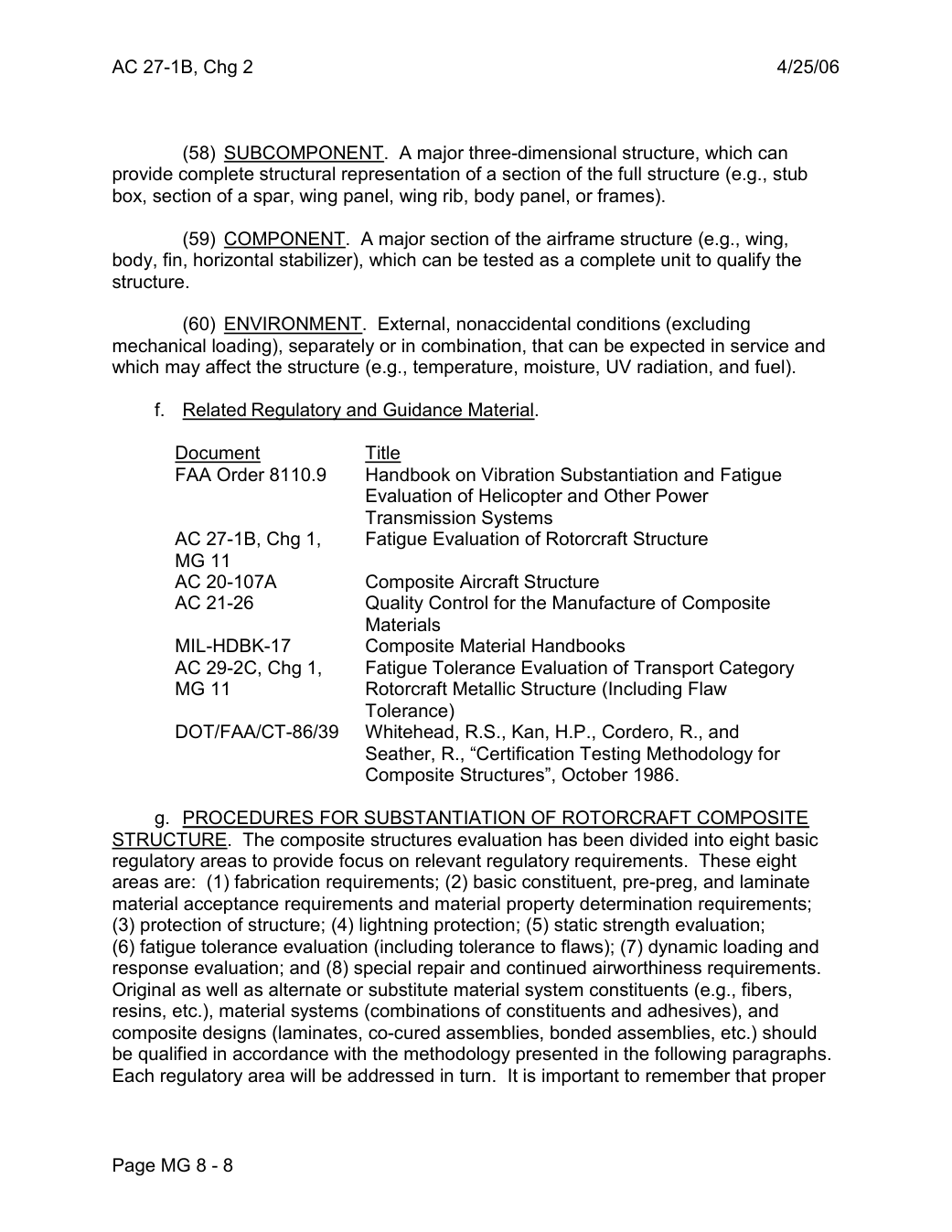
        (58) SUBCOMPONENT. A major three-dimensional structure, which can
provide complete structural representation of a section of the full structure (e.g., stub
box, section of a spar, wing panel, wing rib, body panel, or frames).

        (59) COMPONENT. A major section of the airframe structure (e.g., wing,
body, fin, horizontal stabilizer), which can be tested as a complete unit to qualify the
structure.

        (60) ENVIRONMENT. External, nonaccidental conditions (excluding
mechanical loading), separately or in combination, that can be expected in service and
which may affect the structure (e.g., temperature, moisture, UV radiation, and fuel).

        f.  Related Regulatory and Guidance Material.

      Document               Title
     FAA Order 8110.9    Handbook on Vibration Substantiation and Fatigue
                             Evaluation of Helicopter and Other Power
                           Transmission Systems
     AC 27-1B, Chg 1,     Fatigue Evaluation of Rotorcraft Structure
    MG 11
     AC 20-107A         Composite Aircraft Structure
     AC 21-26             Quality Control for the Manufacture of Composite
                              Materials
      MIL-HDBK-17       Composite Material Handbooks
     AC 29-2C, Chg 1,     Fatigue Tolerance Evaluation of Transport Category
    MG 11                Rotorcraft Metallic Structure (Including Flaw
                            Tolerance)
      DOT/FAA/CT-86/39   Whitehead, R.S., Kan, H.P., Cordero, R., and
                             Seather, R., “Certification Testing Methodology for
                          Composite Structures”, October 1986.

      g. PROCEDURES FOR SUBSTANTIATION OF ROTORCRAFT COMPOSITE
STRUCTURE. The composite structures evaluation has been divided into eight basic
regulatory areas to provide focus on relevant regulatory requirements. These eight
areas are: (1) fabrication requirements; (2) basic constituent, pre-preg, and laminate
material acceptance requirements and material property determination requirements;
(3) protection of structure; (4) lightning protection; (5) static strength evaluation;
(6) fatigue tolerance evaluation (including tolerance to flaws); (7) dynamic loading and
response evaluation; and (8) special repair and continued airworthiness requirements.
Original as well as alternate or substitute material system constituents (e.g., fibers,
resins, etc.), material systems (combinations of constituents and adhesives), and
composite designs (laminates, co-cured assemblies, bonded assemblies, etc.) should
be qualified in accordance with the methodology presented in the following paragraphs.
Each regulatory area will be addressed in turn.  It is important to remember that proper


Page MG 8 - 8