Certification of Normal Category Rotorcraft — Changes 1–9
Normal category rotorcraft guidance with Changes 1–9 incorporated. Search the complete AC or start with the system safety, flight controls and instrument-flight guidance.
This source includes guidance for different amendments of Part 27. Match the guidance to the aircraft’s agreed certification basis: the 27.1309 entries for Amendments 27-21, 27-46 and 27-51 are separate. The base AC was issued on 30 September 1999; Change 9 is dated 23 June 2023. The FAA catalogue’s 30 September 2008 date is not the date of the latest change.
The source, within reach.
Search within this AC, jump to a source page, or download the complete saved publication.
This extraction supports search. Read the original page for complete notation and layout.
AC 27-1B, Chg 2                                                         4/25/06


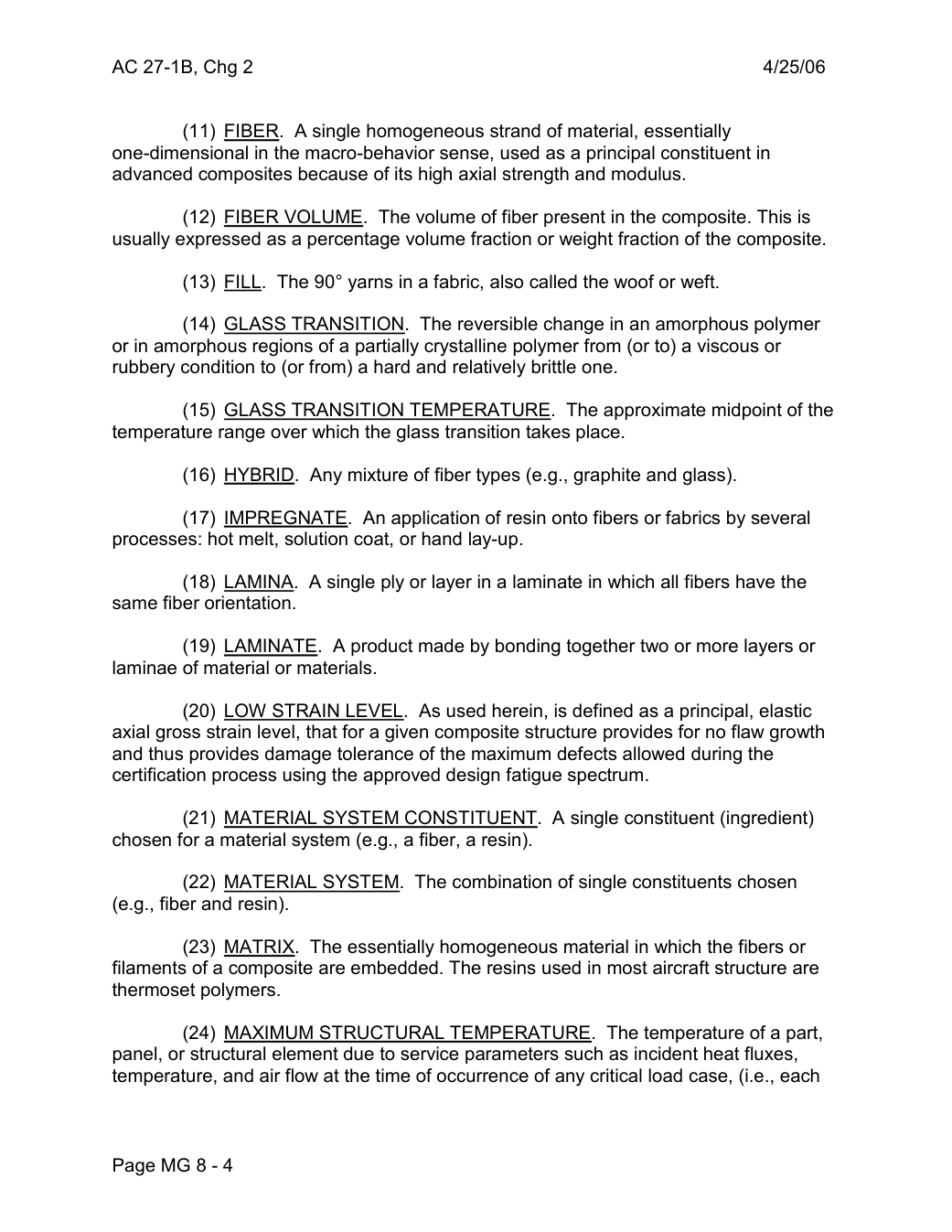
        (11) FIBER. A single homogeneous strand of material, essentially
one-dimensional in the macro-behavior sense, used as a principal constituent in
advanced composites because of its high axial strength and modulus.

        (12) FIBER VOLUME. The volume of fiber present in the composite. This is
usually expressed as a percentage volume fraction or weight fraction of the composite.

        (13) FILL. The 90° yarns in a fabric, also called the woof or weft.

        (14) GLASS TRANSITION. The reversible change in an amorphous polymer
or in amorphous regions of a partially crystalline polymer from (or to) a viscous or
rubbery condition to (or from) a hard and relatively brittle one.

        (15) GLASS TRANSITION TEMPERATURE. The approximate midpoint of the
temperature range over which the glass transition takes place.

        (16) HYBRID. Any mixture of fiber types (e.g., graphite and glass).

        (17) IMPREGNATE. An application of resin onto fibers or fabrics by several
processes: hot melt, solution coat, or hand lay-up.

        (18) LAMINA. A single ply or layer in a laminate in which all fibers have the
same fiber orientation.

        (19) LAMINATE. A product made by bonding together two or more layers or
laminae of material or materials.

        (20) LOW STRAIN LEVEL. As used herein, is defined as a principal, elastic
axial gross strain level, that for a given composite structure provides for no flaw growth
and thus provides damage tolerance of the maximum defects allowed during the
certification process using the approved design fatigue spectrum.

        (21) MATERIAL SYSTEM CONSTITUENT. A single constituent (ingredient)
chosen for a material system (e.g., a fiber, a resin).

        (22) MATERIAL SYSTEM. The combination of single constituents chosen
(e.g., fiber and resin).

        (23) MATRIX. The essentially homogeneous material in which the fibers or
filaments of a composite are embedded. The resins used in most aircraft structure are
thermoset polymers.

        (24) MAXIMUM STRUCTURAL TEMPERATURE. The temperature of a part,
panel, or structural element due to service parameters such as incident heat fluxes,
temperature, and air flow at the time of occurrence of any critical load case, (i.e., each


Page MG 8 - 4
Saved from the FAA on November 17, 2026. All original pages are retained. Engineering explanations are presented separately below.
Aerospace Consulting / Engineering perspective
Start with the certification basis and the function.
Identify the applicable amendment before selecting the safety guidance. Connect intended functions and operating conditions to failure conditions, architecture decisions, common-cause considerations, verification and limitations. For flight controls and IFR work, carry the relevant 27.672, 27.1329 and Appendix B assumptions into the system safety and compliance evidence.
1196 original pages. 0 pages have reviewed text reflows. Original-first pages retain the source layout, with extracted text available for finding words.
A focused review, an agreed assessment package or ongoing support alongside your team. We can agree the relevant inputs and scope in the initial conversation.
This opens your email application.
Start a conversation
Tell us about your programme, the system you are developing and the support you need.
We can agree a focused use-case review, a defined evidence package or ongoing programme support.
This opens your email application.
Specialist aerospace expertise
Aerospace Consulting is led by Hussein Khimji, an FAA Designated Engineering Representative in systems and equipment, with a focus on system safety, flight controls and avionics.
We work with aircraft developers and systems suppliers to connect technical decisions, safety assessments and certification evidence.
This is the proposed introduction. The full About page will add your approved biography and associate expertise.
Systems engineering & development assurance
Tell us about the aircraft or system, its intended function, stage of development and the support you need.