Certification of Normal Category Rotorcraft — Changes 1–9
Normal category rotorcraft guidance with Changes 1–9 incorporated. Search the complete AC or start with the system safety, flight controls and instrument-flight guidance.
This source includes guidance for different amendments of Part 27. Match the guidance to the aircraft’s agreed certification basis: the 27.1309 entries for Amendments 27-21, 27-46 and 27-51 are separate. The base AC was issued on 30 September 1999; Change 9 is dated 23 June 2023. The FAA catalogue’s 30 September 2008 date is not the date of the latest change.
The source, within reach.
Search within this AC, jump to a source page, or download the complete saved publication.
This extraction supports search. Read the original page for complete notation and layout.
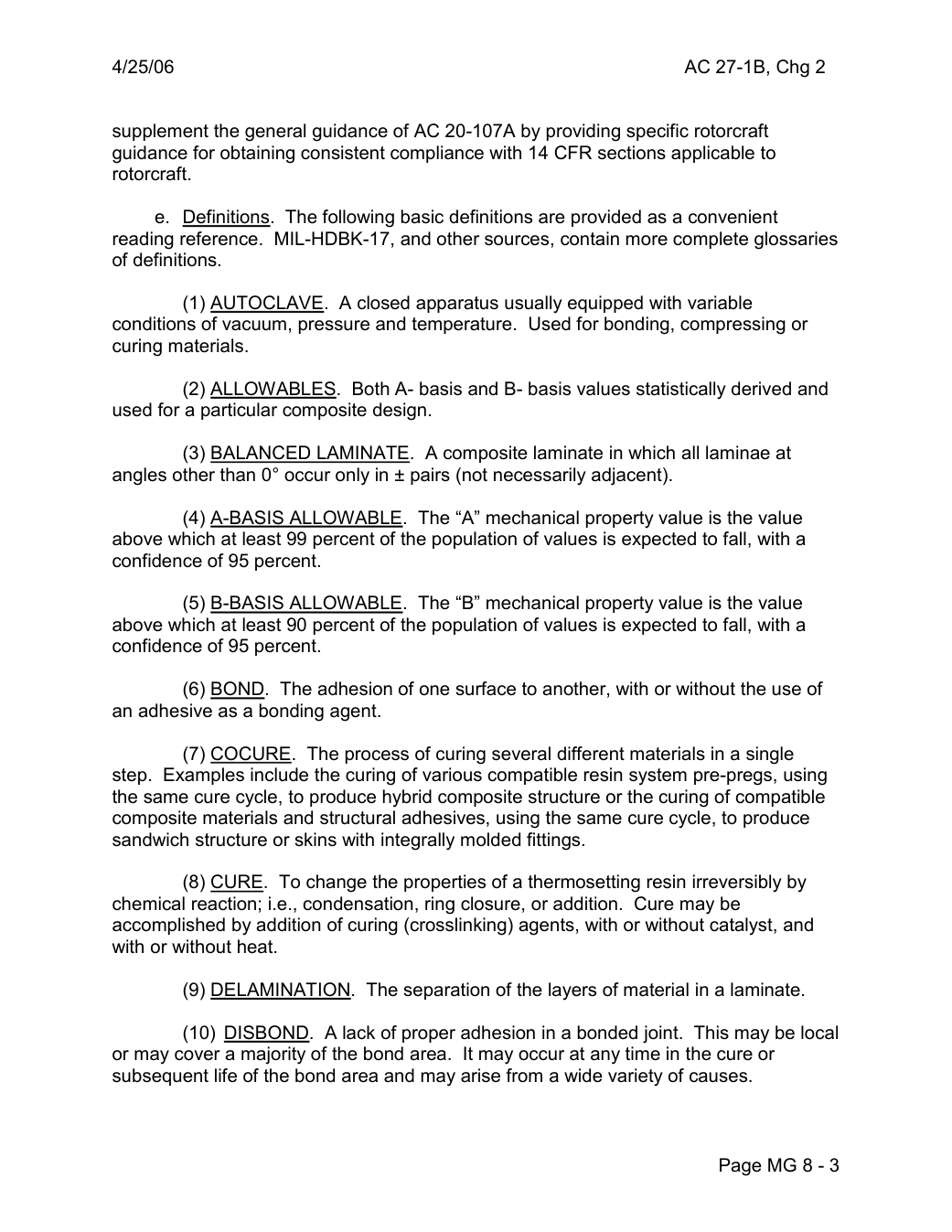
4/25/06                                       AC 27-1B, Chg 2


supplement the general guidance of AC 20-107A by providing specific rotorcraft
guidance for obtaining consistent compliance with 14 CFR sections applicable to
rotorcraft.

     e.  Definitions. The following basic definitions are provided as a convenient
reading reference. MIL-HDBK-17, and other sources, contain more complete glossaries
of definitions.

         (1) AUTOCLAVE. A closed apparatus usually equipped with variable
conditions of vacuum, pressure and temperature. Used for bonding, compressing or
curing materials.

         (2) ALLOWABLES. Both A- basis and B- basis values statistically derived and
used for a particular composite design.

         (3) BALANCED LAMINATE. A composite laminate in which all laminae at
angles other than 0° occur only in ± pairs (not necessarily adjacent).

         (4) A-BASIS ALLOWABLE. The “A” mechanical property value is the value
above which at least 99 percent of the population of values is expected to fall, with a
confidence of 95 percent.

         (5) B-BASIS ALLOWABLE. The “B” mechanical property value is the value
above which at least 90 percent of the population of values is expected to fall, with a
confidence of 95 percent.

         (6) BOND. The adhesion of one surface to another, with or without the use of
an adhesive as a bonding agent.

         (7) COCURE. The process of curing several different materials in a single
step. Examples include the curing of various compatible resin system pre-pregs, using
the same cure cycle, to produce hybrid composite structure or the curing of compatible
composite materials and structural adhesives, using the same cure cycle, to produce
sandwich structure or skins with integrally molded fittings.

         (8) CURE. To change the properties of a thermosetting resin irreversibly by
chemical reaction; i.e., condensation, ring closure, or addition. Cure may be
accomplished by addition of curing (crosslinking) agents, with or without catalyst, and
with or without heat.

         (9) DELAMINATION. The separation of the layers of material in a laminate.

        (10) DISBOND. A lack of proper adhesion in a bonded joint. This may be local
or may cover a majority of the bond area.  It may occur at any time in the cure or
subsequent life of the bond area and may arise from a wide variety of causes.


                                                        Page MG 8 - 3
Saved from the FAA on November 17, 2026. All original pages are retained. Engineering explanations are presented separately below.
Aerospace Consulting / Engineering perspective
Start with the certification basis and the function.
Identify the applicable amendment before selecting the safety guidance. Connect intended functions and operating conditions to failure conditions, architecture decisions, common-cause considerations, verification and limitations. For flight controls and IFR work, carry the relevant 27.672, 27.1329 and Appendix B assumptions into the system safety and compliance evidence.
1196 original pages. 0 pages have reviewed text reflows. Original-first pages retain the source layout, with extracted text available for finding words.
A focused review, an agreed assessment package or ongoing support alongside your team. We can agree the relevant inputs and scope in the initial conversation.
This opens your email application.
Start a conversation
Tell us about your programme, the system you are developing and the support you need.
We can agree a focused use-case review, a defined evidence package or ongoing programme support.
This opens your email application.
Specialist aerospace expertise
Aerospace Consulting is led by Hussein Khimji, an FAA Designated Engineering Representative in systems and equipment, with a focus on system safety, flight controls and avionics.
We work with aircraft developers and systems suppliers to connect technical decisions, safety assessments and certification evidence.
This is the proposed introduction. The full About page will add your approved biography and associate expertise.
Systems engineering & development assurance
Tell us about the aircraft or system, its intended function, stage of development and the support you need.