Certification of Normal Category Rotorcraft — Changes 1–9
Normal category rotorcraft guidance with Changes 1–9 incorporated. Search the complete AC or start with the system safety, flight controls and instrument-flight guidance.
This source includes guidance for different amendments of Part 27. Match the guidance to the aircraft’s agreed certification basis: the 27.1309 entries for Amendments 27-21, 27-46 and 27-51 are separate. The base AC was issued on 30 September 1999; Change 9 is dated 23 June 2023. The FAA catalogue’s 30 September 2008 date is not the date of the latest change.
The source, within reach.
Search within this AC, jump to a source page, or download the complete saved publication.
This extraction supports search. Read the original page for complete notation and layout.
AC 27-1B, Chg 4                                                     2/27/2014


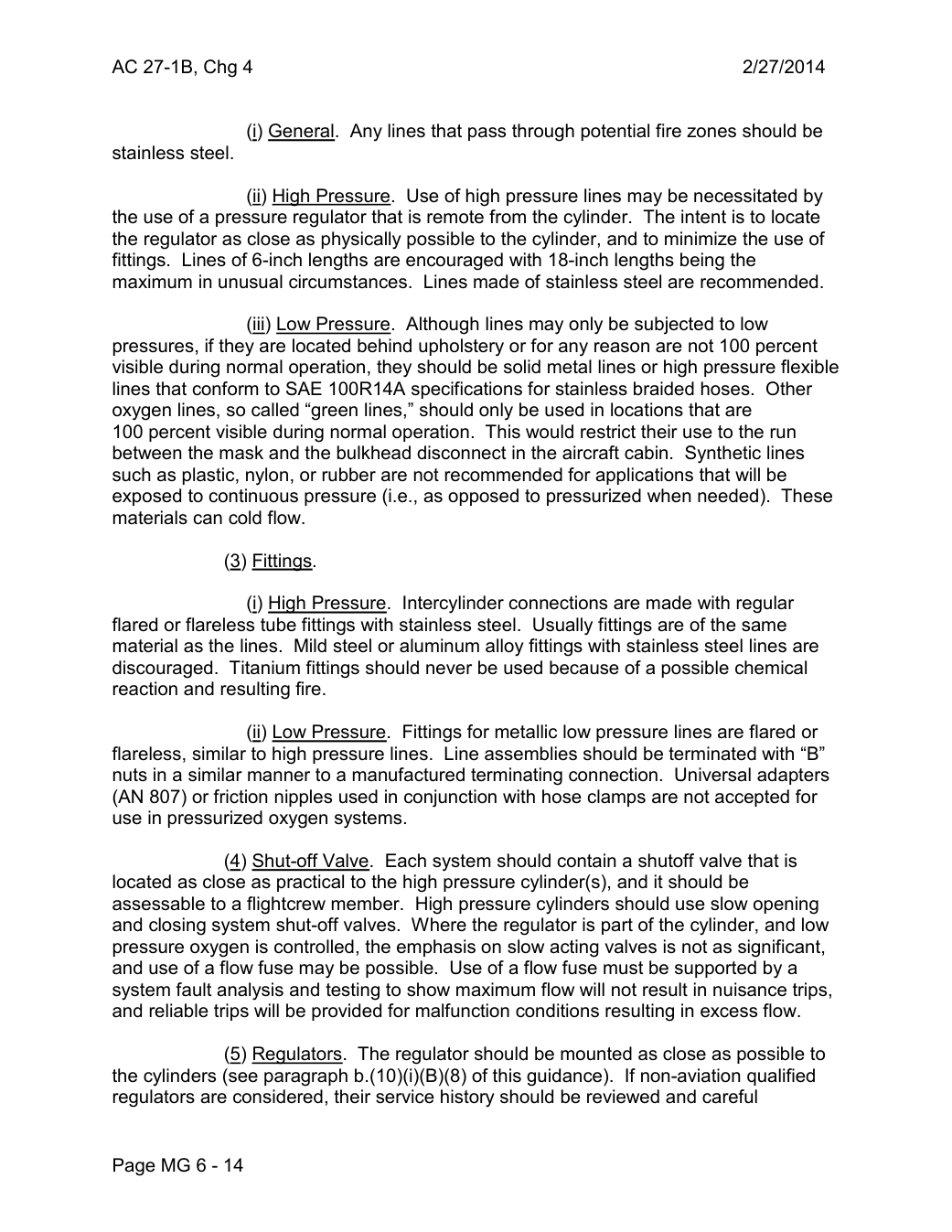
                        (i) General. Any lines that pass through potential fire zones should be
stainless steel.

                          (ii) High Pressure. Use of high pressure lines may be necessitated by
the use of a pressure regulator that is remote from the cylinder. The intent is to locate
the regulator as close as physically possible to the cylinder, and to minimize the use of
fittings. Lines of 6-inch lengths are encouraged with 18-inch lengths being the
maximum in unusual circumstances. Lines made of stainless steel are recommended.

                           (iii) Low Pressure. Although lines may only be subjected to low
pressures, if they are located behind upholstery or for any reason are not 100 percent
visible during normal operation, they should be solid metal lines or high pressure flexible
lines that conform to SAE 100R14A specifications for stainless braided hoses. Other
oxygen lines, so called “green lines,” should only be used in locations that are
100 percent visible during normal operation. This would restrict their use to the run
between the mask and the bulkhead disconnect in the aircraft cabin. Synthetic lines
such as plastic, nylon, or rubber are not recommended for applications that will be
exposed to continuous pressure (i.e., as opposed to pressurized when needed). These
materials can cold flow.

               (3) Fittings.

                        (i) High Pressure. Intercylinder connections are made with regular
flared or flareless tube fittings with stainless steel. Usually fittings are of the same
material as the lines. Mild steel or aluminum alloy fittings with stainless steel lines are
discouraged. Titanium fittings should never be used because of a possible chemical
reaction and resulting fire.

                          (ii) Low Pressure. Fittings for metallic low pressure lines are flared or
flareless, similar to high pressure lines. Line assemblies should be terminated with “B”
nuts in a similar manner to a manufactured terminating connection. Universal adapters
(AN 807) or friction nipples used in conjunction with hose clamps are not accepted for
use in pressurized oxygen systems.

               (4) Shut-off Valve. Each system should contain a shutoff valve that is
located as close as practical to the high pressure cylinder(s), and it should be
assessable to a flightcrew member. High pressure cylinders should use slow opening
and closing system shut-off valves. Where the regulator is part of the cylinder, and low
pressure oxygen is controlled, the emphasis on slow acting valves is not as significant,
and use of a flow fuse may be possible. Use of a flow fuse must be supported by a
system fault analysis and testing to show maximum flow will not result in nuisance trips,
and reliable trips will be provided for malfunction conditions resulting in excess flow.

               (5) Regulators. The regulator should be mounted as close as possible to
the cylinders (see paragraph b.(10)(i)(B)(8) of this guidance).  If non-aviation qualified
regulators are considered, their service history should be reviewed and careful


Page MG 6 - 14
Saved from the FAA on November 17, 2026. All original pages are retained. Engineering explanations are presented separately below.
Aerospace Consulting / Engineering perspective
Start with the certification basis and the function.
Identify the applicable amendment before selecting the safety guidance. Connect intended functions and operating conditions to failure conditions, architecture decisions, common-cause considerations, verification and limitations. For flight controls and IFR work, carry the relevant 27.672, 27.1329 and Appendix B assumptions into the system safety and compliance evidence.
1196 original pages. 0 pages have reviewed text reflows. Original-first pages retain the source layout, with extracted text available for finding words.
A focused review, an agreed assessment package or ongoing support alongside your team. We can agree the relevant inputs and scope in the initial conversation.
This opens your email application.
Start a conversation
Tell us about your programme, the system you are developing and the support you need.
We can agree a focused use-case review, a defined evidence package or ongoing programme support.
This opens your email application.
Specialist aerospace expertise
Aerospace Consulting is led by Hussein Khimji, an FAA Designated Engineering Representative in systems and equipment, with a focus on system safety, flight controls and avionics.
We work with aircraft developers and systems suppliers to connect technical decisions, safety assessments and certification evidence.
This is the proposed introduction. The full About page will add your approved biography and associate expertise.
Systems engineering & development assurance
Tell us about the aircraft or system, its intended function, stage of development and the support you need.