Certification of Normal Category Rotorcraft — Changes 1–9
Normal category rotorcraft guidance with Changes 1–9 incorporated. Search the complete AC or start with the system safety, flight controls and instrument-flight guidance.
This source includes guidance for different amendments of Part 27. Match the guidance to the aircraft’s agreed certification basis: the 27.1309 entries for Amendments 27-21, 27-46 and 27-51 are separate. The base AC was issued on 30 September 1999; Change 9 is dated 23 June 2023. The FAA catalogue’s 30 September 2008 date is not the date of the latest change.
The source, within reach.
Search within this AC, jump to a source page, or download the complete saved publication.
This extraction supports search. Read the original page for complete notation and layout.
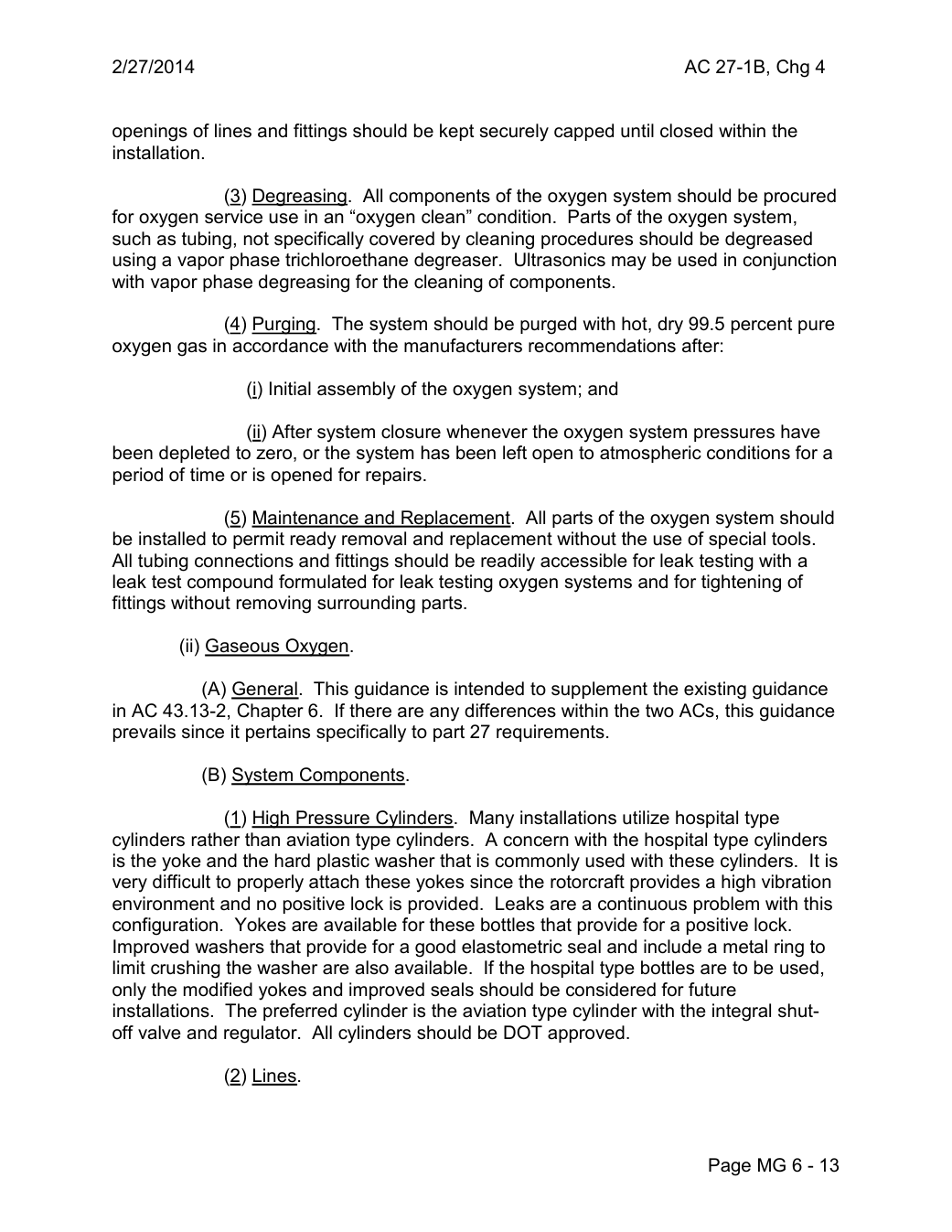
2/27/2014                                      AC 27-1B, Chg 4


openings of lines and fittings should be kept securely capped until closed within the
installation.

               (3) Degreasing.  All components of the oxygen system should be procured
for oxygen service use in an “oxygen clean” condition. Parts of the oxygen system,
such as tubing, not specifically covered by cleaning procedures should be degreased
using a vapor phase trichloroethane degreaser. Ultrasonics may be used in conjunction
with vapor phase degreasing for the cleaning of components.

               (4) Purging. The system should be purged with hot, dry 99.5 percent pure
oxygen gas in accordance with the manufacturers recommendations after:

                        (i) Initial assembly of the oxygen system; and

                          (ii) After system closure whenever the oxygen system pressures have
been depleted to zero, or the system has been left open to atmospheric conditions for a
period of time or is opened for repairs.

               (5) Maintenance and Replacement. All parts of the oxygen system should
be installed to permit ready removal and replacement without the use of special tools.
All tubing connections and fittings should be readily accessible for leak testing with a
leak test compound formulated for leak testing oxygen systems and for tightening of
fittings without removing surrounding parts.

             (ii) Gaseous Oxygen.

           (A) General. This guidance is intended to supplement the existing guidance
in AC 43.13-2, Chapter 6.  If there are any differences within the two ACs, this guidance
prevails since it pertains specifically to part 27 requirements.

           (B) System Components.

               (1) High Pressure Cylinders. Many installations utilize hospital type
cylinders rather than aviation type cylinders. A concern with the hospital type cylinders
is the yoke and the hard plastic washer that is commonly used with these cylinders.  It is
very difficult to properly attach these yokes since the rotorcraft provides a high vibration
environment and no positive lock is provided. Leaks are a continuous problem with this
configuration. Yokes are available for these bottles that provide for a positive lock.
Improved washers that provide for a good elastometric seal and include a metal ring to
limit crushing the washer are also available.  If the hospital type bottles are to be used,
only the modified yokes and improved seals should be considered for future
installations. The preferred cylinder is the aviation type cylinder with the integral shut-
off valve and regulator. All cylinders should be DOT approved.

               (2) Lines.


                                                       Page MG 6 - 13
Saved from the FAA on November 17, 2026. All original pages are retained. Engineering explanations are presented separately below.
Aerospace Consulting / Engineering perspective
Start with the certification basis and the function.
Identify the applicable amendment before selecting the safety guidance. Connect intended functions and operating conditions to failure conditions, architecture decisions, common-cause considerations, verification and limitations. For flight controls and IFR work, carry the relevant 27.672, 27.1329 and Appendix B assumptions into the system safety and compliance evidence.
1196 original pages. 0 pages have reviewed text reflows. Original-first pages retain the source layout, with extracted text available for finding words.
A focused review, an agreed assessment package or ongoing support alongside your team. We can agree the relevant inputs and scope in the initial conversation.
This opens your email application.
Start a conversation
Tell us about your programme, the system you are developing and the support you need.
We can agree a focused use-case review, a defined evidence package or ongoing programme support.
This opens your email application.
Specialist aerospace expertise
Aerospace Consulting is led by Hussein Khimji, an FAA Designated Engineering Representative in systems and equipment, with a focus on system safety, flight controls and avionics.
We work with aircraft developers and systems suppliers to connect technical decisions, safety assessments and certification evidence.
This is the proposed introduction. The full About page will add your approved biography and associate expertise.
Systems engineering & development assurance
Tell us about the aircraft or system, its intended function, stage of development and the support you need.