Certification of Normal Category Rotorcraft — Changes 1–9
Normal category rotorcraft guidance with Changes 1–9 incorporated. Search the complete AC or start with the system safety, flight controls and instrument-flight guidance.
This source includes guidance for different amendments of Part 27. Match the guidance to the aircraft’s agreed certification basis: the 27.1309 entries for Amendments 27-21, 27-46 and 27-51 are separate. The base AC was issued on 30 September 1999; Change 9 is dated 23 June 2023. The FAA catalogue’s 30 September 2008 date is not the date of the latest change.
The source, within reach.
Search within this AC, jump to a source page, or download the complete saved publication.
This extraction supports search. Read the original page for complete notation and layout.
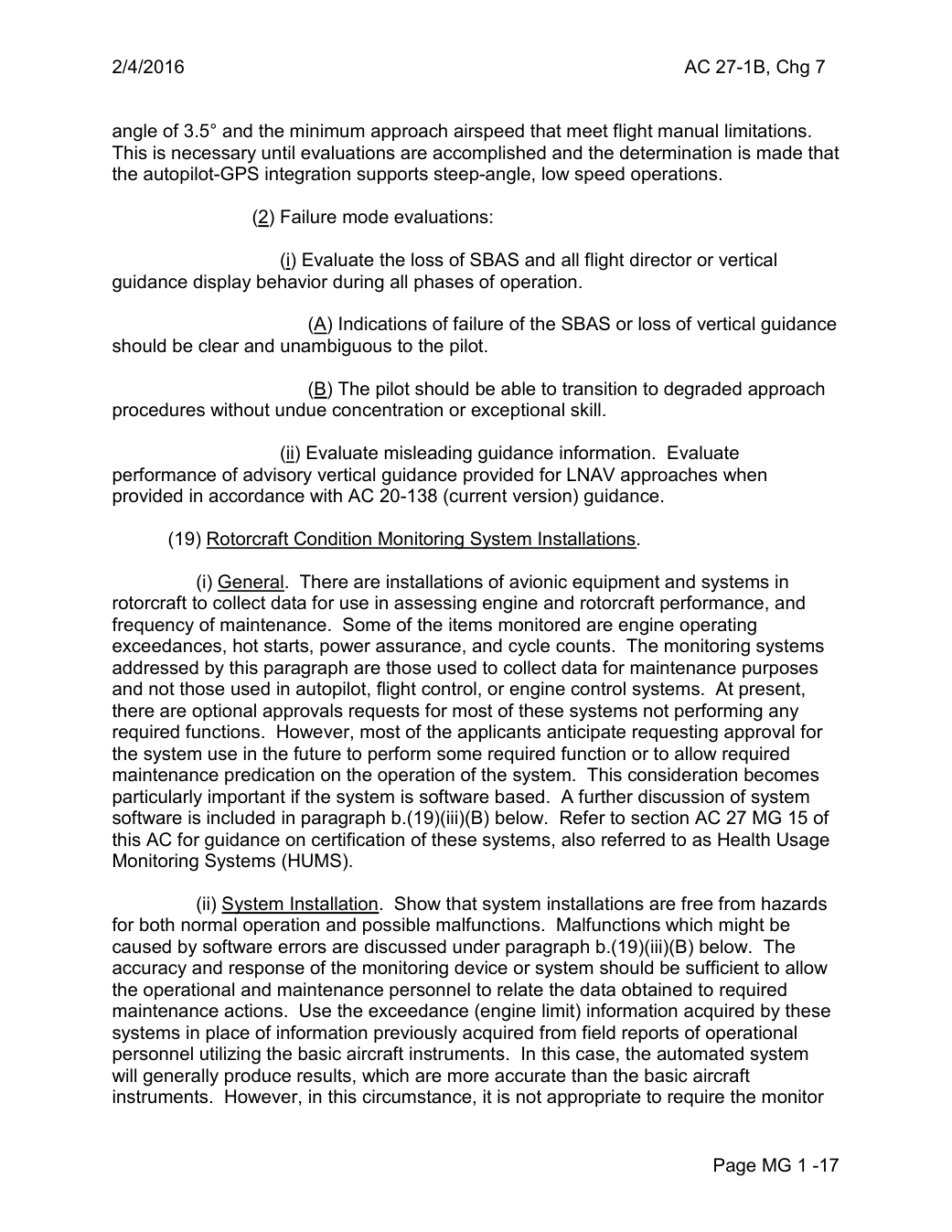
2/4/2016                                      AC 27-1B, Chg 7


angle of 3.5° and the minimum approach airspeed that meet flight manual limitations.
This is necessary until evaluations are accomplished and the determination is made that
the autopilot-GPS integration supports steep-angle, low speed operations.

                  (2) Failure mode evaluations:

                               (i) Evaluate the loss of SBAS and all flight director or vertical
guidance display behavior during all phases of operation.

                        (A) Indications of failure of the SBAS or loss of vertical guidance
should be clear and unambiguous to the pilot.

                        (B) The pilot should be able to transition to degraded approach
procedures without undue concentration or exceptional skill.

                                 (ii) Evaluate misleading guidance information. Evaluate
performance of advisory vertical guidance provided for LNAV approaches when
provided in accordance with AC 20-138 (current version) guidance.

       (19) Rotorcraft Condition Monitoring System Installations.

               (i) General. There are installations of avionic equipment and systems in
rotorcraft to collect data for use in assessing engine and rotorcraft performance, and
frequency of maintenance. Some of the items monitored are engine operating
exceedances, hot starts, power assurance, and cycle counts. The monitoring systems
addressed by this paragraph are those used to collect data for maintenance purposes
and not those used in autopilot, flight control, or engine control systems. At present,
there are optional approvals requests for most of these systems not performing any
required functions. However, most of the applicants anticipate requesting approval for
the system use in the future to perform some required function or to allow required
maintenance predication on the operation of the system. This consideration becomes
particularly important if the system is software based. A further discussion of system
software is included in paragraph b.(19)(iii)(B) below. Refer to section AC 27 MG 15 of
this AC for guidance on certification of these systems, also referred to as Health Usage
Monitoring Systems (HUMS).

                (ii) System Installation. Show that system installations are free from hazards
for both normal operation and possible malfunctions. Malfunctions which might be
caused by software errors are discussed under paragraph b.(19)(iii)(B) below. The
accuracy and response of the monitoring device or system should be sufficient to allow
the operational and maintenance personnel to relate the data obtained to required
maintenance actions. Use the exceedance (engine limit) information acquired by these
systems in place of information previously acquired from field reports of operational
personnel utilizing the basic aircraft instruments. In this case, the automated system
will generally produce results, which are more accurate than the basic aircraft
instruments. However, in this circumstance, it is not appropriate to require the monitor


                                                       Page MG 1 -17
Saved from the FAA on November 17, 2026. All original pages are retained. Engineering explanations are presented separately below.
Aerospace Consulting / Engineering perspective
Start with the certification basis and the function.
Identify the applicable amendment before selecting the safety guidance. Connect intended functions and operating conditions to failure conditions, architecture decisions, common-cause considerations, verification and limitations. For flight controls and IFR work, carry the relevant 27.672, 27.1329 and Appendix B assumptions into the system safety and compliance evidence.
1196 original pages. 0 pages have reviewed text reflows. Original-first pages retain the source layout, with extracted text available for finding words.
A focused review, an agreed assessment package or ongoing support alongside your team. We can agree the relevant inputs and scope in the initial conversation.
This opens your email application.
Start a conversation
Tell us about your programme, the system you are developing and the support you need.
We can agree a focused use-case review, a defined evidence package or ongoing programme support.
This opens your email application.
Specialist aerospace expertise
Aerospace Consulting is led by Hussein Khimji, an FAA Designated Engineering Representative in systems and equipment, with a focus on system safety, flight controls and avionics.
We work with aircraft developers and systems suppliers to connect technical decisions, safety assessments and certification evidence.
This is the proposed introduction. The full About page will add your approved biography and associate expertise.
Systems engineering & development assurance
Tell us about the aircraft or system, its intended function, stage of development and the support you need.