Certification of Normal Category Rotorcraft — Changes 1–9
Normal category rotorcraft guidance with Changes 1–9 incorporated. Search the complete AC or start with the system safety, flight controls and instrument-flight guidance.
This source includes guidance for different amendments of Part 27. Match the guidance to the aircraft’s agreed certification basis: the 27.1309 entries for Amendments 27-21, 27-46 and 27-51 are separate. The base AC was issued on 30 September 1999; Change 9 is dated 23 June 2023. The FAA catalogue’s 30 September 2008 date is not the date of the latest change.
The source, within reach.
Search within this AC, jump to a source page, or download the complete saved publication.
This extraction supports search. Read the original page for complete notation and layout.
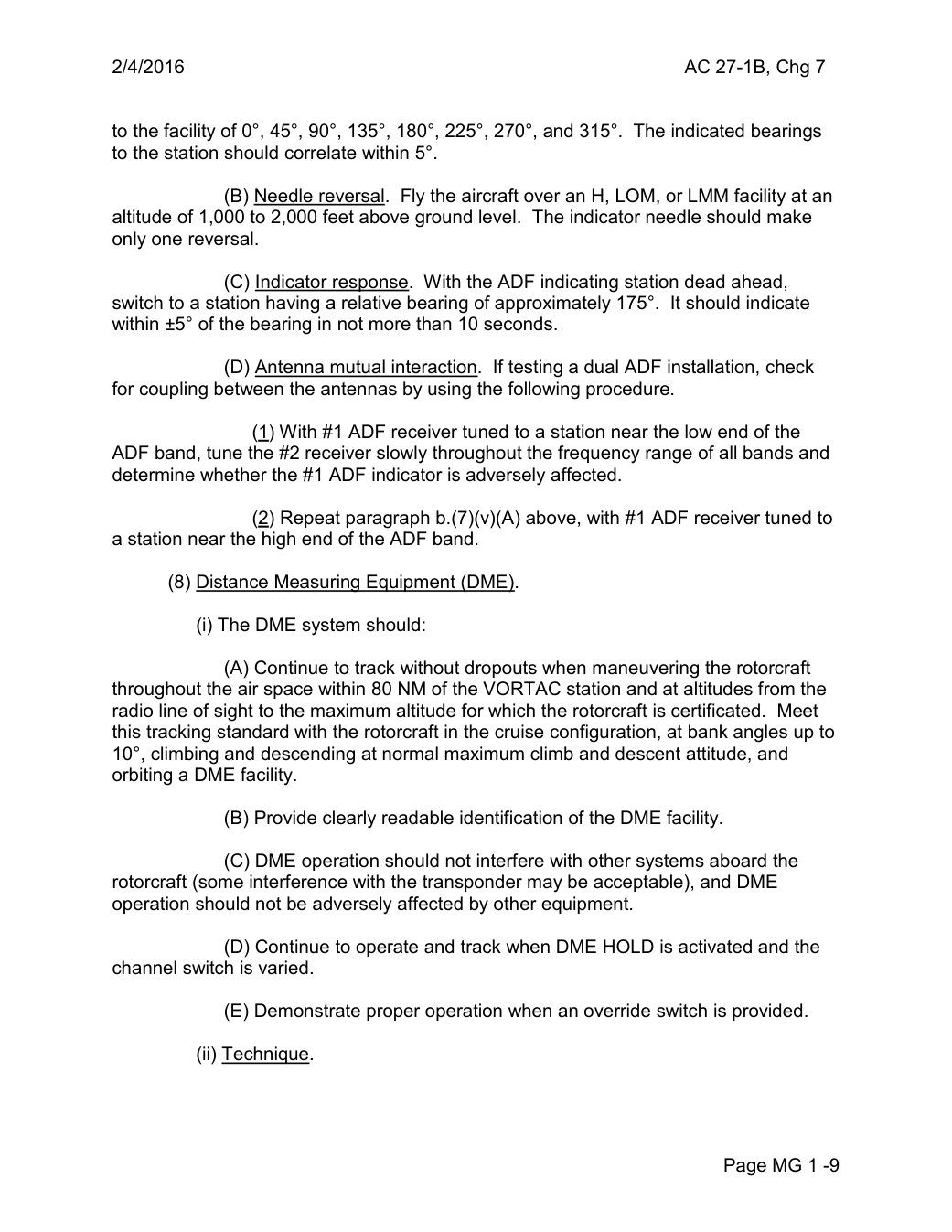
2/4/2016                                      AC 27-1B, Chg 7


to the facility of 0°, 45°, 90°, 135°, 180°, 225°, 270°, and 315°. The indicated bearings
to the station should correlate within 5°.

              (B) Needle reversal. Fly the aircraft over an H, LOM, or LMM facility at an
altitude of 1,000 to 2,000 feet above ground level. The indicator needle should make
only one reversal.

             (C) Indicator response. With the ADF indicating station dead ahead,
switch to a station having a relative bearing of approximately 175°.  It should indicate
within ±5° of the bearing in not more than 10 seconds.

             (D) Antenna mutual interaction.  If testing a dual ADF installation, check
for coupling between the antennas by using the following procedure.

                  (1) With #1 ADF receiver tuned to a station near the low end of the
ADF band, tune the #2 receiver slowly throughout the frequency range of all bands and
determine whether the #1 ADF indicator is adversely affected.

                  (2) Repeat paragraph b.(7)(v)(A) above, with #1 ADF receiver tuned to
a station near the high end of the ADF band.

       (8) Distance Measuring Equipment (DME).

               (i) The DME system should:

              (A) Continue to track without dropouts when maneuvering the rotorcraft
throughout the air space within 80 NM of the VORTAC station and at altitudes from the
radio line of sight to the maximum altitude for which the rotorcraft is certificated. Meet
this tracking standard with the rotorcraft in the cruise configuration, at bank angles up to
10°, climbing and descending at normal maximum climb and descent attitude, and
orbiting a DME facility.

              (B) Provide clearly readable identification of the DME facility.

             (C) DME operation should not interfere with other systems aboard the
rotorcraft (some interference with the transponder may be acceptable), and DME
operation should not be adversely affected by other equipment.

             (D) Continue to operate and track when DME HOLD is activated and the
channel switch is varied.

              (E) Demonstrate proper operation when an override switch is provided.

                (ii) Technique.


                                                        Page MG 1 -9
Saved from the FAA on November 17, 2026. All original pages are retained. Engineering explanations are presented separately below.
Aerospace Consulting / Engineering perspective
Start with the certification basis and the function.
Identify the applicable amendment before selecting the safety guidance. Connect intended functions and operating conditions to failure conditions, architecture decisions, common-cause considerations, verification and limitations. For flight controls and IFR work, carry the relevant 27.672, 27.1329 and Appendix B assumptions into the system safety and compliance evidence.
1196 original pages. 0 pages have reviewed text reflows. Original-first pages retain the source layout, with extracted text available for finding words.
A focused review, an agreed assessment package or ongoing support alongside your team. We can agree the relevant inputs and scope in the initial conversation.
This opens your email application.
Start a conversation
Tell us about your programme, the system you are developing and the support you need.
We can agree a focused use-case review, a defined evidence package or ongoing programme support.
This opens your email application.
Specialist aerospace expertise
Aerospace Consulting is led by Hussein Khimji, an FAA Designated Engineering Representative in systems and equipment, with a focus on system safety, flight controls and avionics.
We work with aircraft developers and systems suppliers to connect technical decisions, safety assessments and certification evidence.
This is the proposed introduction. The full About page will add your approved biography and associate expertise.
Systems engineering & development assurance
Tell us about the aircraft or system, its intended function, stage of development and the support you need.