Certification of Normal Category Rotorcraft — Changes 1–9
Normal category rotorcraft guidance with Changes 1–9 incorporated. Search the complete AC or start with the system safety, flight controls and instrument-flight guidance.
This source includes guidance for different amendments of Part 27. Match the guidance to the aircraft’s agreed certification basis: the 27.1309 entries for Amendments 27-21, 27-46 and 27-51 are separate. The base AC was issued on 30 September 1999; Change 9 is dated 23 June 2023. The FAA catalogue’s 30 September 2008 date is not the date of the latest change.
The source, within reach.
Search within this AC, jump to a source page, or download the complete saved publication.
This extraction supports search. Read the original page for complete notation and layout.
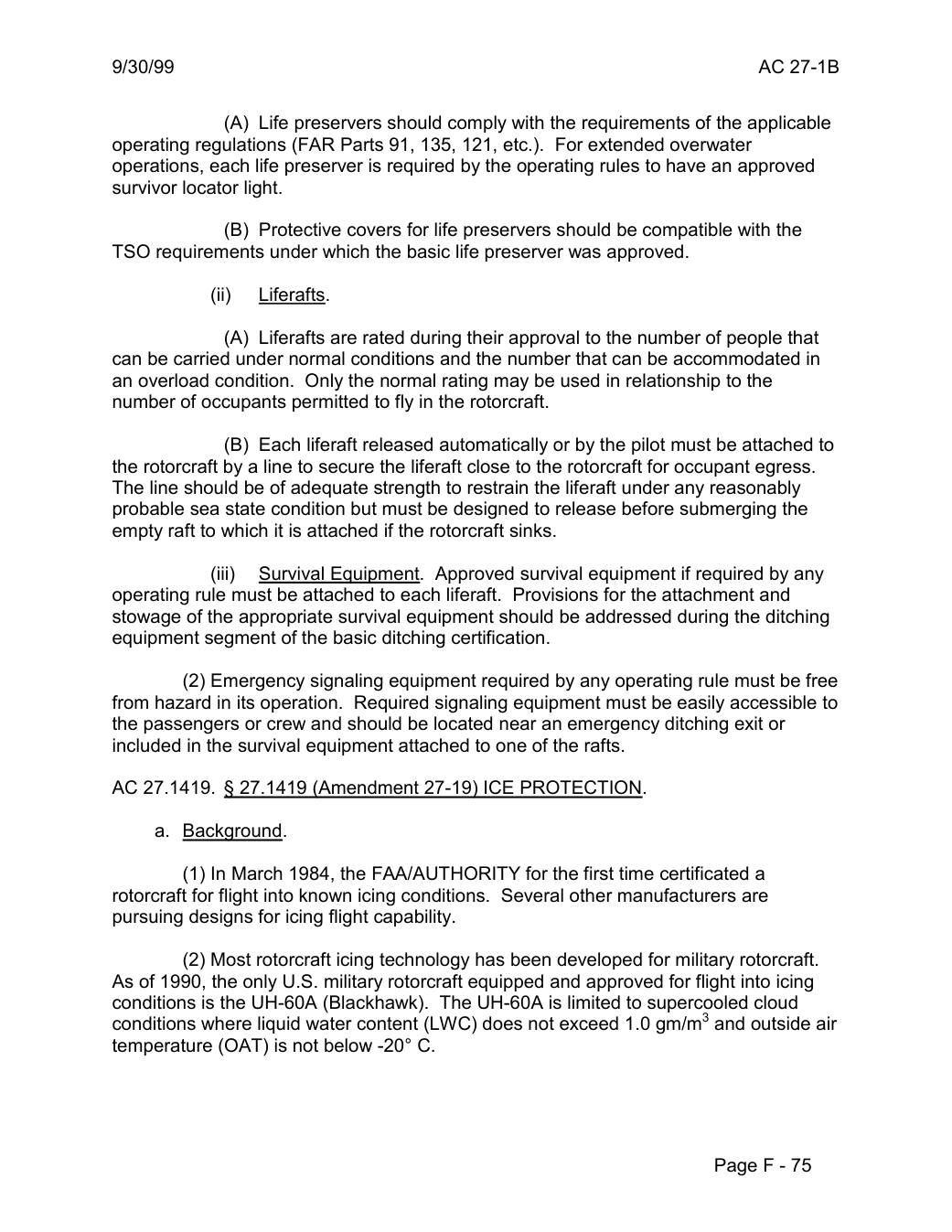
9/30/99                                             AC 27-1B

              (A) Life preservers should comply with the requirements of the applicable
operating regulations (FAR Parts 91, 135, 121, etc.). For extended overwater
operations, each life preserver is required by the operating rules to have an approved
survivor locator light.

              (B) Protective covers for life preservers should be compatible with the
TSO requirements under which the basic life preserver was approved.

                   (ii)    Liferafts.

              (A) Liferafts are rated during their approval to the number of people that
can be carried under normal conditions and the number that can be accommodated in
an overload condition. Only the normal rating may be used in relationship to the
number of occupants permitted to fly in the rotorcraft.

              (B) Each liferaft released automatically or by the pilot must be attached to
the rotorcraft by a line to secure the liferaft close to the rotorcraft for occupant egress.
The line should be of adequate strength to restrain the liferaft under any reasonably
probable sea state condition but must be designed to release before submerging the
empty raft to which it is attached if the rotorcraft sinks.

                    (iii)   Survival Equipment. Approved survival equipment if required by any
operating rule must be attached to each liferaft. Provisions for the attachment and
stowage of the appropriate survival equipment should be addressed during the ditching
equipment segment of the basic ditching certification.

         (2) Emergency signaling equipment required by any operating rule must be free
from hazard in its operation. Required signaling equipment must be easily accessible to
the passengers or crew and should be located near an emergency ditching exit or
included in the survival equipment attached to one of the rafts.

AC 27.1419. § 27.1419 (Amendment 27-19) ICE PROTECTION.

     a. Background.

         (1) In March 1984, the FAA/AUTHORITY for the first time certificated a
rotorcraft for flight into known icing conditions. Several other manufacturers are
pursuing designs for icing flight capability.

         (2) Most rotorcraft icing technology has been developed for military rotorcraft.
As of 1990, the only U.S. military rotorcraft equipped and approved for flight into icing
conditions is the UH-60A (Blackhawk). The UH-60A is limited to supercooled cloud
conditions where liquid water content (LWC) does not exceed 1.0 gm/m3 and outside air
temperature (OAT) is not below -20° C.


                                                       Page F - 75
Saved from the FAA on November 17, 2026. All original pages are retained. Engineering explanations are presented separately below.
Aerospace Consulting / Engineering perspective
Start with the certification basis and the function.
Identify the applicable amendment before selecting the safety guidance. Connect intended functions and operating conditions to failure conditions, architecture decisions, common-cause considerations, verification and limitations. For flight controls and IFR work, carry the relevant 27.672, 27.1329 and Appendix B assumptions into the system safety and compliance evidence.
1196 original pages. 0 pages have reviewed text reflows. Original-first pages retain the source layout, with extracted text available for finding words.
A focused review, an agreed assessment package or ongoing support alongside your team. We can agree the relevant inputs and scope in the initial conversation.
This opens your email application.
Start a conversation
Tell us about your programme, the system you are developing and the support you need.
We can agree a focused use-case review, a defined evidence package or ongoing programme support.
This opens your email application.
Specialist aerospace expertise
Aerospace Consulting is led by Hussein Khimji, an FAA Designated Engineering Representative in systems and equipment, with a focus on system safety, flight controls and avionics.
We work with aircraft developers and systems suppliers to connect technical decisions, safety assessments and certification evidence.
This is the proposed introduction. The full About page will add your approved biography and associate expertise.
Systems engineering & development assurance
Tell us about the aircraft or system, its intended function, stage of development and the support you need.