
Original FAA page, including its printed amendment and change markings. Extracted words support search; text reflow has not been reviewed.
AC 27-1B · F-69Open saved PDF here ↗
Extracted text for finding words
This extraction supports search. Read the original page for complete notation and layout.
9/30/99                                             AC 27-1B

that when a rotorcraft has landed on the water and is not in flight, it is considered a
vessel in accordance with the United States Coast Guard (USCG) navigation rules
(Inland Navigation Rules Act of 1980).  If water operations are contemplated, one
should acquire the USCG Navigation Rules, COMDTINST M16672.2A, which are for
sale from Superintendent of Documents, U.S. Government Printing
Office, Washington, D.C. 20402.

     b. Procedures. A white light should be installed in a position where it will show
the maximum unbroken light for a horizontal arc of 360° around the rotorcraft.  If
possible, this light should not be obscured by sectors of more than 6°. The light should
be installed to meet the malfunction requirements of § 27.1309(b). (Reference
paragraph AC 27.1309.) For the purpose of this light, the following definition found in
the Inland Navigation Rules, 33 CFR 84.13, Color specification of lights, and
33 CFR 84.15, Intensity of lights, applies:

         (1) The chromaticity of white lights shall conform to the following standards,
which lie within the boundaries of the area of the diagram specified for each color by the
International Commission on Illumination (CIE), in the “Colors of Light Signals,” which is
incorporated by reference.  It is Publication CIE No. 2.2 (TC-1.6), 1975, and is available
from the Illumination Engineering Society, 345 East 47th Street, New York, NY 10017.
It is also available for inspection at the Office of the Federal Register, Room 8401,
1100 L Street NW., Washington, D.C. 20408.

         (2) The boundaries of the area for white are given by indicating the corner
coordinates, which are as follows:

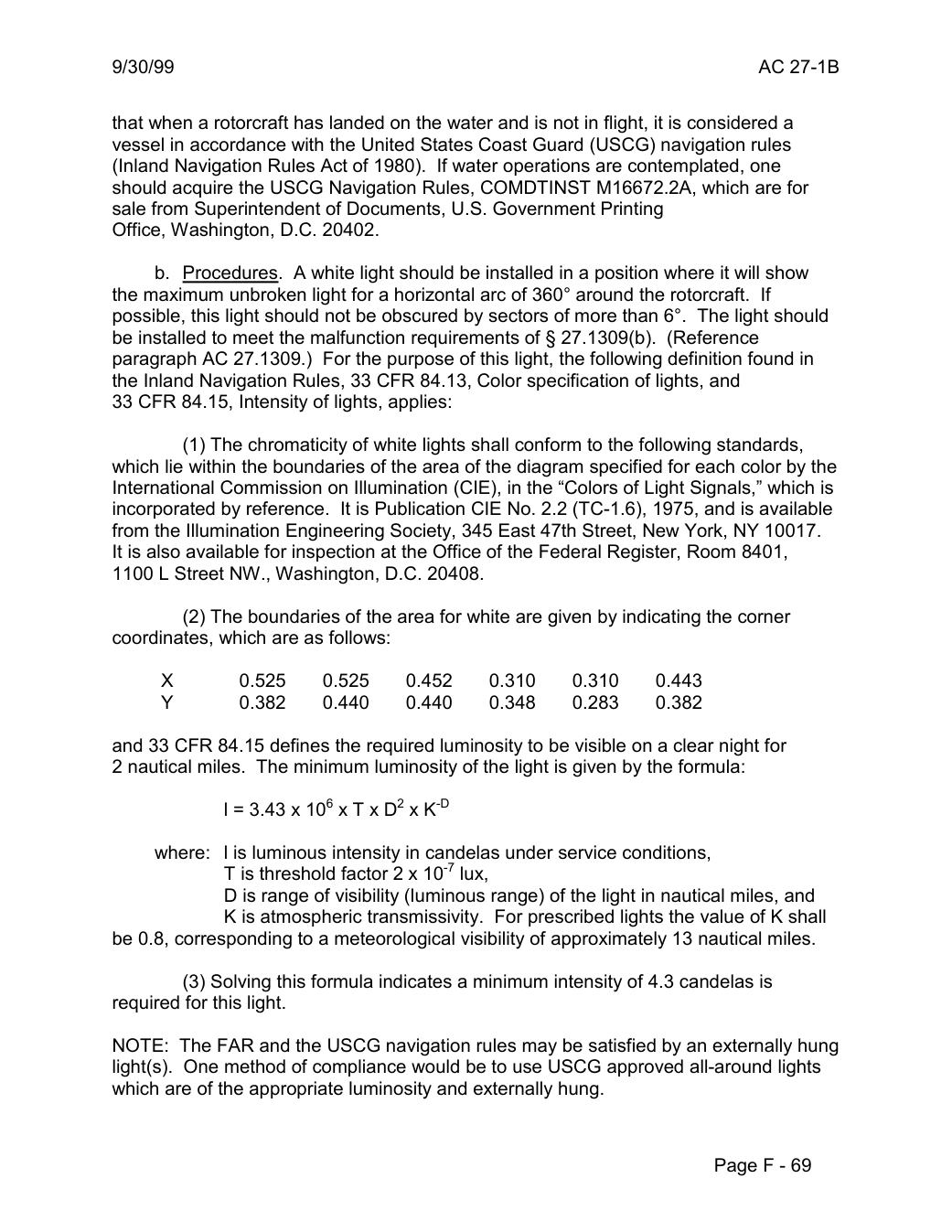
    X       0.525    0.525    0.452    0.310    0.310    0.443
    Y       0.382    0.440    0.440    0.348    0.283    0.382

and 33 CFR 84.15 defines the required luminosity to be visible on a clear night for
2 nautical miles. The minimum luminosity of the light is given by the formula:

                           l = 3.43 x 10⁶ x T x D2 x K-D

     where:   l is luminous intensity in candelas under service conditions,
          T is threshold factor 2 x 10⁻⁷ lux,
        D is range of visibility (luminous range) of the light in nautical miles, and
         K is atmospheric transmissivity. For prescribed lights the value of K shall
be 0.8, corresponding to a meteorological visibility of approximately 13 nautical miles.

         (3) Solving this formula indicates a minimum intensity of 4.3 candelas is
required for this light.

NOTE: The FAR and the USCG navigation rules may be satisfied by an externally hung
light(s). One method of compliance would be to use USCG approved all-around lights
which are of the appropriate luminosity and externally hung.


                                                       Page F - 69